South Manchuria Railway: The Economic Engine of Imperial Japan
The South Manchuria Railway, known in Japan as Mantetsu, was far more than a simple transportation provider. Operating as a massive National Policy Company, it functioned as the industrial and political backbone of the Empire of Japan's interests in northeastern China. From its inception in 1906 to its dissolution in 1945, Mantetsu shaped the economic, cultural, and political landscape of the region, earning it the nickname "Japan's East India Company in China."
Originally established to manage railway lines seized from Russia following the Russo-Japanese War, the company expanded into a sprawling conglomerate. It managed everything from coal mines and steel works to agricultural research and urban planning, creating a complex web of influence that stretched across Manchuria and into occupied Korea.
Key Facts
- Founded: 26 November 1906 by the Government of Japan.
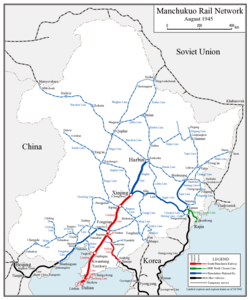
- Primary Function: Operation of railways in the Dalian–Fengtian–Changchun corridor.
- Economic Impact: Provided over a quarter of Japan's total tax revenue during the 1920s.
- Major Innovation: Operated the Asia Express, the fastest scheduled train in Asia during the 1930s.
- Dissolution: Defunct after the Soviet invasion of Manchuria in August 1945.
The Evolution of a Railway Giant
The roots of the network lie in the southern branch of the Russian-built Chinese Eastern Railway. Following Japan's victory in the Russo-Japanese War, the Treaty of Portsmouth facilitated the transfer of these lines to Japanese control. To manage this new territory, the South Manchuria Railway Company was formed with a capitalization of 200 million yen.
One of the company's first major technical undertakings was the standardization of the railway gauge—the distance between the inner sides of the two rails. After initial conversions to the Japanese 3 ft 6 in gauge, the company eventually transitioned to the standard gauge (4 ft 8½ in) to better integrate with other Chinese railway systems.

Expansion and Industrialization
Mantetsu's influence grew through aggressive vertical integration. The company did not just move goods; it produced them. By spinning off subsidiaries, Mantetsu controlled a vast array of industries, including:
- Showa Steel Works and Dalian Ceramics.
- Dalian Oil & Fat and South Manchuria Glass.
- Power generation, flour mills, and chemical plants.

This industrial might was fueled largely by the soybean trade. By 1927, Manchuria produced half of the world's soybean supply, with Mantetsu facilitating massive exports of soy oil and soy meal for fertilizer and animal feed. This extractive economy made the company one of the most profitable corporations in Japanese history, with annual returns ranging from 25 to 45 percent.

Urban Planning and the Asia Express
Beyond the tracks, Mantetsu acted as a colonial administrator. In the 1930s, after the establishment of the puppet state of Manchukuo, the company was entrusted with managing the Manchukuo National Railway. It applied advanced urban planning to cities like Xinjing (modern-day Changchun), implementing modern sewer systems, public parks, and sophisticated architecture.

In 1934, the company reached a pinnacle of technological prestige with the inauguration of the Asia Express. This high-speed service ran from Dalian to Xinjing, reaching top speeds of 134 km/h (83 mph), making it the premier rail experience in Asia at the time.

Luxury on the Rails
To cater to travelers and project an image of modernity, Mantetsu developed a unique food culture. Dining cars offered specialized cuisine, such as Yamato beef steak and Mongolian barbeque, often in collaboration with the Japan Tourist Bureau. This luxury service was designed to create a distinct, high-end atmosphere for passengers traversing the Manchurian plains.

The Decline and Legacy
The dominance of Mantetsu came to an abrupt end during World War II. Following the Soviet invasion of Manchuria in August 1945, the company's assets were looted, and its operations were disrupted. Under the orders of American occupation authorities in Japan, the company was formally dissolved.

The physical infrastructure, however, remained. The lines were eventually integrated into the China Railway system. Today, the historic routes are part of modern networks such as the Shenda Railway and the Jingha Railway, serving as the foundation for the contemporary transport links between Dalian, Shenyang, and Changchun.


Summary of Mantetsu Operations
| Category | Details |
|---|---|
| Headquarters | Dairen (later Xinjing) |
| Key Industry | Soybean export and heavy industry |
| Peak Technology | Asia Express (134 km/h) |
| Primary Gauge | Standard Gauge (1,435 mm) |
| Economic Role | Major contributor to Japanese tax revenue |
Frequently Asked Questions
What was the primary purpose of the South Manchuria Railway?
While its official function was operating railways in the Dalian–Fengtian–Changchun corridor, its broader purpose was to serve as a tool for Japanese economic and political expansion in Manchuria.
How did Mantetsu impact the soybean industry?
Mantetsu drove the massive expansion of soybean farming in Manchuria. By 1927, the region provided 50% of the world's soybean supply, largely through Mantetsu's export infrastructure.
What was the Asia Express?
The Asia Express was a state-of-the-art, high-speed train inaugurated in 1934 that ran between Dalian and Xinjing, representing the fastest scheduled rail service in Asia at the time.
Why was the company called "Japan's East India Company"?
This nickname reflected the company's vast reach beyond mere rail operations, as it controlled diverse industries including mining, manufacturing, and agricultural research, much like a colonial trading company.
What happened to the railway after 1945?
Following the Soviet invasion and Japan's defeat, the company was dissolved. Its lines were eventually taken over by the Soviet Union and later handed to the China Railway after the founding of the People's Republic of China.