South Korea Suicide Rates: Analyzing Demographic Trends and Socioeconomic Drivers
South Korea faces a significant public health challenge regarding suicide rates. In 2021, the nation recorded the second highest suicide rate globally and held the highest rate among all OECD (Organisation for Economic Co-operation and Development) countries. While the issue affects various demographics, the patterns of mortality shift significantly across different age groups and socioeconomic conditions.
![South Korea's suicide rate per 100,000 people compared to other countries, World Health Organization, 2016. According to researcher Peeter Värnik, a simple majority of total suicides occur in just six countries, South Korea is one of them.[1]](/images/1a/30/1a30a6194a46d4a398672c3a7b337eb4a5ef440b36725e716387ccef6690ff2d.png)
The complexity of this crisis is reflected in the data. While the elderly remain at the highest risk, there has been a concerning rise in deaths among teenagers since 2010. By 2025, suicide had become the leading cause of death for South Koreans in their 40s, even surpassing cancer. For those in their 20s, suicide accounted for more than half of all deaths in 2022, and it remains the primary cause of death for individuals aged between 10 and 39.
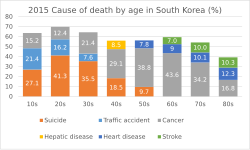
Key Facts
![The most recent available data on OECD countries' suicide rates per 100 000 persons (November 2, 2022). South Korea has the highest rate in the OECD.[2]](/images/59/cc/59ccdbb91f32bf36f9d4188ad4967aa30853a6050a7076acccada4f2da2a5b49.jpg)
- South Korea has the highest suicide rate among OECD nations.
- Suicide is the leading cause of death for South Koreans aged 10 to 39.
- Elderly poverty and ageism are major contributors to high suicide rates in seniors.
- In 2025, suicide surpassed cancer as the leading cause of death for people in their 40s.
- The Suicide Prevention Act of 2011 established a national network of mental health welfare centers.
Demographic and Regional Variations
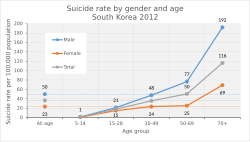
Suicide rates in South Korea are not uniform; they vary significantly by age, gender, and geography. For instance, the province of Gangwon reports a suicide rate 37.84% higher than the national average. Other regions with high rates include Chungnam and Jeonbuk.
Age and Gender Trends
The vulnerability of specific age groups is a critical concern. In the 2015–2019 period, the number of suicides or self-inflicted injuries rose from 4,947 to 9,828, with a high concentration of cases involving individuals aged 9 to 24. Data suggests that approximately 26.9 young South Koreans attempt suicide or suffer self-inflicted injuries every day.
Regional Hotspots
Geographic location plays a role in mortality statistics. For those over the age of 65, Ulsan, Gangwon, and Incheon show the highest rates. For the 40–59 age bracket, Daegu sees the highest frequency, while Gangwon, Jeonnam, and Chungnam lead for those aged 20 to 39.
Socioeconomic Drivers and the Elderly
A primary driver for suicide among senior citizens is relative poverty. Although poverty rates among the elderly have declined since 2011, South Korea still maintains the highest elderly poverty rate in the OECD. This economic strain is compounded by a weakening social safety net and a shift in cultural traditions; the historical expectation that children would care for their aging parents has largely faded in the 21st century.
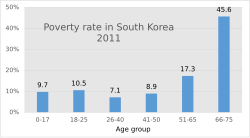
Furthermore, ageism—or age discrimination—is a significant factor. Approximately 85.7% of individuals in their 50s reported experiencing ageism, particularly during job applications. In rural areas, high rates of reported elderly discrimination contribute to increased suicide rates.
Methods and Notable Cases
Research indicates that the methods used for suicide have evolved. A study by Subin Park et al. noted that between 2000 and 2011, there was a notable increase in suicides by hanging, which was perceived by some as more accessible or painless.
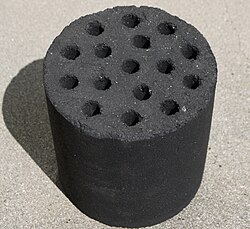
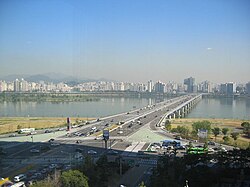
Specific locations have also become associated with these tragedies. The Mapo Bridge in Seoul is locally referred to as the "Suicide Bridge" or "The Bridge of Death" due to its frequent usage as a site for suicide attempts.
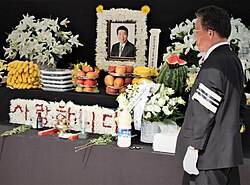
The impact of suicide is often felt deeply within the public consciousness through the loss of notable figures. High-profile cases include the death of President Roh Moo-hyun in 2009, actress Lee Eun-ju in 2005, and more recently, actor Lee Sun-kyun in 2023. The death of Goo Hara, a former member of the group KARA, in 2019 highlighted the devastating impact of online cyberbullying.



Summary of Suicide Statistics and Trends
| Category | Key Finding/Statistic |
|---|---|
| OECD Standing | Highest suicide rate among OECD countries |
| Primary Age Risk | Leading cause of death for ages 10–39 |
| 40s Demographic | Suicide surpassed cancer as the leading cause of death in 2025 |
| Elderly Risk Factor | Highest poverty rate among OECD elderly populations |
| Youth Trend | Deaths among teens have been rising since 2010 |
Frequently Asked Questions
What is the leading cause of death for young people in South Korea?
For individuals between the ages of 10 and 39, suicide is the leading cause of death.
How has the government responded to the suicide crisis?
In 2011, the South Korean government enacted the Suicide Prevention Act, which established a nationwide network of government-funded mental health welfare and prevention centers.
What role does poverty play in elderly suicide rates?
High rates of relative poverty and a poorly funded social safety net contribute to suicide among the elderly, often driven by a desire not to become a financial burden to their families.
Are there specific regions with higher suicide rates?
Yes, Gangwon has a suicide rate 37.84% higher than the national average. Other regions like Chungnam and Jeonbuk also show elevated rates.
What is the 109 Suicide Prevention Hotline?
The 109 hotline is a dedicated suicide prevention resource available in South Korea for those in need of assistance.