South Korea's Pension System and the Challenge of Elderly Poverty
South Korea faces a significant social challenge: a high rate of relative poverty among its elderly population. While the nation has seen rapid economic development, its social welfare infrastructure is relatively young compared to other democratic nations. Currently, approximately half of South Koreans aged 65 and over live in relative poverty—a figure nearly four times the OECD average of 13%.
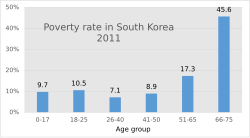
The poverty rate of elderly people in South Korea is the highest among the OECD countries.
This economic vulnerability is compounded by the fact that public social spending in South Korea is the lowest among OECD member countries as a percentage of GDP. As the nation transitions toward a "hyper-aged" society, the pressure on the pension system and social safety nets continues to grow.
Key Facts
- Nearly 50% of South Koreans aged 65+ live in relative poverty.
- South Korea's public social spending is half the OECD average.
- The National Pension Service (NPS) was established in 1988.
- The country is expected to reach "hyper-aged" status by 2025.
- The National Pension Scheme requires a minimum of 10 years of contributions to qualify for benefits.
The Structure of Income Support
To support citizens in their later years, South Korea utilizes a multi-layered approach to income. This system is often categorized into different "pillars" of support, ranging from government-mandated schemes to private savings.
| Pillar | Type of Support | Description |
|---|---|---|
| Pillar Zero | Social Welfare | Basic Livelihood Security Programme and Basic Old-Age Pension. |
| First Pillar | Public Pension | The National Pension Scheme (NPS). |
| Second Pillar | Company Pension | Corporate-based retirement savings. |
| Third Pillar | Private Pension | Individual retirement savings. |
Public Welfare and Social Safety Nets
Basic Livelihood Security Programme (BLSP)
The Basic Livelihood Security Programme is designed to assist citizens living in absolute poverty—a state where income falls below the minimum cost of living. Established in 1999, it provides cash payments alongside benefits for housing and education. However, strict eligibility criteria, including means testing of assets and the requirement to prove a lack of family support, mean it does not cover all elderly citizens in need.
Basic Old-Age Pension
The Basic Old-Age Pension serves as a supplementary measure for those in the bottom 70th percentile of income. In 2014, this program was extended to provide monthly allowances to approximately 4.9 million people. While it provides a vital cushion, in 2012, it covered only about 16% of the minimum cost of living for recipients.
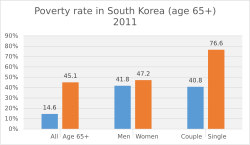
Poverty rate in South Korea (age 65+) in 2011
National Basic Livelihood Security (NBLS)
Implemented in 2000 following the 1997 Asian financial crisis, the NBLS provides guaranteed income to seniors who lack family support and fall below the national poverty line. Despite revisions to poverty guidelines, eligibility requirements have limited the number of seniors receiving these benefits to approximately 15%.
The National Pension Scheme (NPS)
The National Pension Scheme, introduced in 1988, is a mandatory, income-related public pension. It is administered by the National Pension Service (NPS) and features a strong redistributive element. To qualify for a standard pension, individuals must be at least 62 years old and have contributed for at least ten years.
The scheme is funded through contributions from both employees and employers. In workplace-based schemes, employees contribute 4.5% of their gross monthly earnings, while employers match this with an additional 4.5%. Those who are self-employed or not employed but aged 18–59 must cover the full 9% contribution themselves.
Challenges and Reforms
The NPS faces long-term sustainability challenges. As life expectancy increases and the fertility rate declines, the old-age dependency ratio is projected to rise significantly. Furthermore, because of the ten-year contribution requirement, many retirees are unable to draw benefits, contributing to the high poverty rates among the elderly.
Private and Corporate Pensions
To alleviate the burden on the state, South Korea has encouraged the growth of the "second pillar": corporate pensions. While enrollment has grown—reaching 5.4 million workers by 2016—the system still has room for expansion. As the government moves to lower the public pension replacement rate (the percentage of pre-retirement income replaced by the pension), strengthening corporate and private savings is becoming a central policy focus.
Demographic Shifts and Economic Trends
South Korea's demographic landscape is changing rapidly. The country reached "aging society" status in 2000, and experts predict it will become a "hyper-aged" society by 2025. This shift is driven by a declining birthrate and increased life expectancy.
Economic factors also play a role in these trends. A highly competitive labor market and high levels of education have contributed to delayed marriage and lower birthrates among the youth. For many young South Koreans, securing stable employment is seen as a necessary prerequisite for marriage and financial security.
Frequently Asked Questions
Why is elderly poverty so high in South Korea?
High elderly poverty is driven by a relatively recent pension system, strict eligibility requirements for welfare programs, and the fact that only about one-fifth of the elderly population currently receives a pension.
What is the difference between relative and absolute poverty?
Relative poverty refers to being significantly below the average income of the population (the OECD average), whereas absolute poverty occurs when an individual's income falls below the minimum cost required to meet basic living needs.
How much do employees contribute to the National Pension Scheme?
In a workplace-based scheme, employees contribute 4.5% of their gross monthly earnings, which is matched by a 4.5% contribution from their employer.
What is the "hyper-aged" status?
A hyper-aged status refers to a demographic stage where a very high proportion of the population is aged 65 or older, a milestone South Korea is expected to reach by 2025.
Can I receive a pension if I haven't worked for 20 years?
Yes. While 20 years of contributions are required for a full old-age pension, those who have made at least 10 years of contributions may be eligible for a "reduced old-age pension" upon reaching age 60.