South Korea Administrative Divisions: A Comprehensive Overview of Local Government
South Korea operates under a sophisticated, multi-tiered administrative system designed to manage its diverse landscape, from the dense urban corridors of Seoul to the tranquil rural villages. This structure, which follows a basic outline implemented during the reign of Gojong in 1895, organizes the nation into high-level provincial divisions and lower-level local autonomy units.
Understanding how South Korea is organized requires looking at both the high-level regional governments and the smaller municipal entities that serve local populations. This hierarchy ensures that both massive metropolitan areas and small rural townships receive appropriate governance.
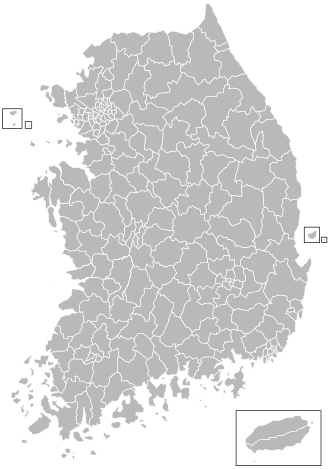
A map of all South Korean metropolitan cities' districts (gu), municipal cities (si), and counties (gun)
Key Facts

- South Korea consists of 16 first-tier administrative divisions.
- The top tier includes 5 metropolitan cities, 1 special city, 1 special metropolitan city, 1 special self-governing city, and 8 provinces.
- Seoul is the only Special City (teukbyeolsi) in the country.
- High-level governors are elected every four years.
- The system is divided into high-level local governments and low-level local autonomy units.
High-Level Local Government (Tier 1)

The first tier of administration, known as high-level local governments (gwangyeok jibang jachidanche), manages large regions. These divisions are led by governors or mayors who are elected every four years.
Types of Provincial-Level Divisions
The top tier is composed of several distinct categories:
- Provinces (do): The standard large-scale regional division.
- Special Self-Governing Provinces (teukbyeol-jachido): Provinces with increased autonomy, such as Gangwon State and Jeonbuk State.
- Metropolitan Cities (gwangyeoksi): Large urban centers that operate at a provincial level.
- Special City (teukbyeolsi): Specifically refers to Seoul.
- Special Metropolitan City (tonghap-teukbyeolsi): A unique high-level division, such as the Jeonnam-Gwangju Special Metropolitan City.
- Special Self-Governing City (teukbyeol-jachisi): A high-level city with autonomous status, such as Sejong.

ภาพประกอบจากบทความต้นฉบับ
Municipal and Submunicipal Divisions (Tiers 2-5)

Below the provincial level, the country is subdivided into various entities that manage specific urban and rural needs. These are categorized by their level of autonomy and population density.
Tier 2: Low-Level Local Autonomy
These units are the primary building blocks of local governance:
- City (si): A division of a province. If a city's population exceeds 500,000, it is considered a specific city and may establish non-autonomous districts. If it exceeds 1,000,000, it may be promoted to a metropolitan city.
- County (gun): A more rural division with a population typically under 150,000. Counties are subdivided into towns and townships.
- District (gu): Found within large cities (over 500,000 people), these autonomous districts handle many functions similar to a city government.

ภาพประกอบจากบทความต้นฉบับ
Tier 3 and 4: Towns, Townships, and Neighborhoods
As we move into smaller administrative units, the focus shifts to local community management:
- Town (eup): A division of a county or smaller city, requiring a minimum population of 20,000.
- Township (myeon): A rural division within a county or smaller city, requiring a minimum population of 6,000.
- Neighborhood (dong): The primary division of districts and cities. There are legal dongs (beopjeongdong) and administrative dongs (haengjeongdong), the latter of which have their own offices and staff.

ภาพประกอบจากบทความต้นฉบับ
Tier 5: The Smallest Units
The most granular levels of division include Urban Villages (tong) and Rural Villages (ri). The ri is the smallest level of rural government containing a significant number of people, while hamlets (ban) represent the most localized level.
Summary of Administrative Hierarchy

| Level | Group Name | Key Examples |
|---|---|---|
| 1 | High-level Local Government | Provinces, Metropolitan Cities, Special City |
| 2 | Low-level Local Autonomy | Cities (si), Counties (gun), Autonomous Districts (gu) |
| 3 | Administrative/Non-autonomous | Administrative Cities, Non-autonomous Districts |
| 4 | Submunicipal | Towns (eup), Townships (myeon), Neighborhoods (dong) |
| 5 | Village Level | Urban Villages (tong), Rural Villages (ri), Hamlets (ban) |

ภาพประกอบจากบทความต้นฉบับ
Frequently Asked Questions


What is the difference between a 'si' and a 'gun'?
A si (city) is an urban division of a province, whereas a gun (county) is a more rural division. A county typically has a population of less than 150,000 and is less densely populated than a city or district.
How does a county become a city?
Once a town (eup) within a county attains a population of 50,000, the county can be promoted to a city (si).
What are administrative dongs?
Administrative dongs are subdivisions of a legal dong. They are used to manage populations more effectively, with each administrative dong having its own dedicated office and staff.
How often are provincial governors elected?
The governors of provincial-level divisions in South Korea are elected every four years.
What makes a city a 'specific city'?
A city with a population exceeding 500,000, such as Suwon or Cheongju, is classified as a specific city and has the authority to set non-autonomous districts (gu).

ภาพประกอบจากบทความต้นฉบับ