Society of Antiquaries Publications: A History of Archaeological Documentation
For centuries, the Society of Antiquaries has served as a cornerstone for the preservation of history, utilizing a diverse array of publications to document ancient buildings, sites, and artefacts. From massive copperplate engravings to modern digital journals, the society's publishing history reflects the evolution of archaeological study in Britain and beyond.
Vetusta Monumenta: The Art of the Folio
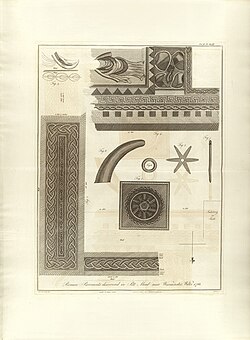
Launched in 1718, Vetusta Monumenta was a series of illustrated papers focusing primarily on the ancient sites and artefacts of Britain. Published in a large folio format, these works were renowned for their high-quality engravings and detailed reproductions. The series was produced on an irregular basis, continuing until 1906.
To achieve this level of detail, the society employed skilled engravers from its inception, including George Vertue and James Basire. These artists created copperplates that produced large, visually appealing prints designed to meet the public's growing interest in archaeology. These illustrations were often quasi-scientific, featuring multiple viewpoints of specific architectural details.
![Vertue, 'The Gate at Whitehall' (Holbein Gate) in Vetusta Monumenta Vol.1, 1747 (1826)[19]](/images/6a/f0/6af06632d723969c5690e06895960f462b0d2738d1442e29982e47a19f2c8a8b.jpg)
Under the leadership of Richard Gough (director from 1771 to 1791), the society sought to improve its research output, driven by the visible decay of Gothic architecture. This led to the commissioning of water-colour reproductions by Edward Edwards and Samuel Hieronymus Grimm in 1771.
Some of these works required a scale larger than standard paper sizes. Consequently, the manufacturer James Whatman created a specialized sheet measuring 31 in × 53 in (790 mm × 1,350 mm), a format known as Antiquarian. One notable example was a reproduction of a 16th-century oil painting of the Field of the Cloth of Gold, which featured a plate measuring 4 ft 1 in by 2 ft 3 in and took two years to engrave. While the standard print run was 400 copies, only three of the seven plates from this series survive today.
Archaeologia and the Transition to Digital
In 1770, the society launched its first formal journal, Archaeologia (full title: Archaeologia; or, Miscellaneous Tracts relating to Antiquity). Published in a quarto format, it primarily featured papers delivered at society meetings, including many previously unpublished works from earlier decades.
Archaeologia maintained a relatively regular publication schedule until after the Second World War, after which it became irregular. By the late 20th century, output slowed significantly, with only two volumes published in the 1980s and two in the 1990s. The society's 2007 tercentennial collection of essays was designated as volume 111, marking the final print volume.
In January 2023, Archaeologia was relaunched as an occasional digital journal. This new iteration provides an open-access platform for research papers that exceed the 10,000-word limit of the Antiquaries Journal.
Proceedings and the Antiquaries Journal
To facilitate more frequent updates, the society introduced the Proceedings of the Society of Antiquaries of London in 1843. This second periodical used a smaller, initially unillustrated format. The first series ran from 1844 to 1859 (four volumes), followed by a second series that produced 32 volumes through 1920.
In 1921, the Proceedings were replaced by the Antiquaries Journal. This annual publication remains active today, reaching its 101st volume in 2021.
Modern Communications: Salon
Adapting to the digital age, the society launched Salon (Society of Antiquaries Online Newsletter) at the end of 2001. This fortnightly online newsletter serves as a contemporary communication tool for the society's members and the wider public.
Key Facts
- Vetusta Monumenta (1718–1906) specialized in large-scale folio engravings of British antiquities.
- The Antiquarian paper format (31 in × 53 in) was custom-made by James Whatman for oversized historical reproductions.
- Archaeologia began in 1770 and transitioned to a digital, open-access format in 2023.
- The Antiquaries Journal has been the society's primary annual publication since 1921.
- Salon is the society's official fortnightly digital newsletter, established in 2001.
| Publication | Start Date | Format | Primary Purpose |
|---|---|---|---|
| Vetusta Monumenta | 1718 | Folio / Antiquarian | Illustrated papers on ancient buildings and artefacts |
| Archaeologia | 1770 | Quarto / Digital | Miscellaneous tracts and long-form research |
| Proceedings | 1843 | Small format | Frequent reports of society proceedings |
| Antiquaries Journal | 1921 | Annual Journal | Ongoing scholarly archaeological research |
| Salon | 2001 | Online Newsletter | Fortnightly society updates |
Frequently Asked Questions
What is the "Antiquarian" format?
The Antiquarian format refers to a specific oversized sheet of paper measuring 31 in × 53 in (790 mm × 1,350 mm), created by manufacturer James Whatman to accommodate large-scale historical reproductions.
How has Archaeologia changed over time?
Originally a quarto print journal started in 1770, Archaeologia became irregular after WWII and ceased print publication after volume 111 in 2007. It was relaunched in 2023 as a digital, open-access journal for papers longer than 10,000 words.
Who were the primary engravers for Vetusta Monumenta?
The society employed several engravers to produce copperplates for the folio editions, most notably George Vertue and James Basire.
What is the difference between the Proceedings and the Antiquaries Journal?
The Proceedings (1843–1920) was a smaller, more frequent periodical used to publish society proceedings. It was superseded in 1921 by the Antiquaries Journal, which continues as an annual publication.
What is Salon?
Salon is the Society of Antiquaries Online Newsletter, a fortnightly digital publication established at the end of 2001.