Skeleton Racing: The High-Speed Thrill of Winter Sliding
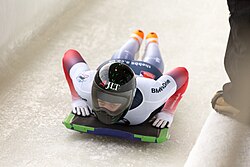
Skeleton is a high-intensity winter sport and time trial where a single athlete slides head-first down a frozen track on a small sled. Known for its breathtaking speeds and physical demands, elite racers can reach velocities exceeding 130 km/h (81 mph) and experience accelerations of up to 5 g.
From its humble beginnings in the Swiss Alps to its status as a permanent fixture in the Winter Olympic Games, skeleton combines precision, bravery, and engineering. Whether it is the historic Cresta Run or modern artificially refrigerated tracks, the sport continues to expand its global reach.
Key Facts
- Governing Body: International Bobsleigh and Skeleton Federation (IBSF).
- Olympic Status: Permanent since 2002; previously appeared in 1928 and 1948.
- Top Speed: Over 130 km/h (81 mph).
- Position: Athletes race in a head-first, prone position.
- Origin: Developed in late 19th-century Switzerland.
The History and Evolution of Skeleton
The roots of skeleton date back to 1882, when English soldiers built a toboggan track between Davos and Klosters in Switzerland. Unlike the simpler tracks found in North America, the Swiss tracks introduced curves and bends that added a new layer of challenge. The name "skeleton" is believed to either describe the bare-bones appearance of the early sleds or be a derivation of the Norwegian word for toboggan, kjelke.
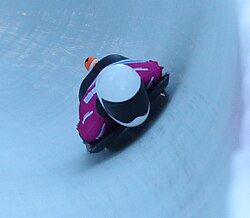
In 1884, Major William Bulpett and hotelier Caspar Badrutt established the Cresta Run in St. Moritz. This three-quarter-mile track, featuring ten turns still in use today, became the epicenter of the sport. It was on this track that the traditional head-first position was introduced by a Mr. Cornish during the 1887 Grand National competition.
International Expansion
While initially centered in Switzerland, the sport spread to Austria in 1905, leading to the first Austrian championships in 1906. The equipment also evolved; in 1892, L. P. Child introduced the "America" sled, a metal design that replaced heavier wooden models and revolutionized the sport's speed and agility.
The Federation Internationale de Bobsleigh et de Tobogganing (FIBT)—renamed the International Bobsleigh & Skeleton Federation (IBSF) in 2015—was founded in 1923 to govern the sport. Today, the IBSF supports "emerging nations," helping athletes from countries without their own tracks, such as Brazil, Iraq, and South Africa, enter international competition.
Competitive Structure and Circuits
The IBSF manages a tiered system of international competitions to rank athletes globally.
The World Cup
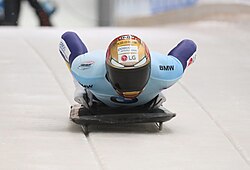
The World Cup is the pinnacle of skeleton racing. It features the strictest quotas, requiring teams to have athletes ranked in the top 70 for men or top 55 for women. To ensure safety, athletes must have completed five races on at least two different tracks over the previous two seasons. The season's top-ranked man and woman are awarded the prestigious Crystal Globe trophy.
Continental and Junior Cups
- Continental Cups: The entry-level international tier where athletes earn ranking points to move up the ladder.
- Intercontinental Cup: Previously an intermediate tier, this was discontinued after the 2022–23 season to bolster World Cup participation.
- Junior World Championships: An annual event for athletes under 23 years of age.
The Olympic Winter Games
Skeleton's Olympic journey has been intermittent. After appearing in 1928 and 1948 in St. Moritz, it was absent for 54 years until its permanent return at the 2002 Salt Lake City Games, which also saw the introduction of women's events.
Qualification for the Olympics is based on IBSF rankings. To ensure global representation, the IBSF uses a "cleaning" process (Rule 4.1) that removes lower-ranking athletes from countries that have already filled their quotas, allowing representatives from underrepresented continents to qualify.
Technical Specifications: Sleds and Gear
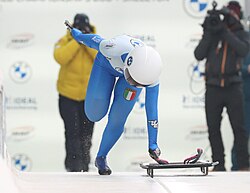
Modern skeleton sleds are highly regulated to ensure fair competition and safety. Frames must be constructed of steel and are prohibited from having steering or braking mechanisms. The base plate may be made of plastic, and handles are provided to help the athlete maintain their grip during the run.
| Category | Max Combined Weight (Athlete + Sled) | Max Sled Weight |
|---|---|---|
| Men | 115 kg (253.5 lb) | 43 kg (94.8 lb) |
| Women | 102 kg (224.9 lb) | 38 kg (83.8 lb) |
Essential Equipment
- Helmet: An alpine racing helmet with a chin guard or a skeleton-specific model.
- Speedsuit: A skin-tight suit made of uncoated textile.
- Footwear: Spiked shoes, similar to track and field spikes, for the explosive start.
- Protection: Goggles or face shields, and optional elbow and shoulder pads.
Frequently Asked Questions
What is the difference between skeleton and luge?
The primary difference is the position of the athlete: skeleton racers slide head-first and prone (face down), while luge athletes slide feet-first and supine (face up).
How do athletes steer a skeleton sled?
Since sleds have no steering mechanisms, athletes steer using subtle shifts in body weight, shoulder movements, and pressure from their knees.
Who governs the sport of skeleton?
The sport is governed by the International Bobsleigh & Skeleton Federation (IBSF), headquartered in Lausanne, Switzerland.
What is the "Crystal Globe"?
The Crystal Globe is the trophy awarded to the highest-ranking man and woman at the end of the IBSF World Cup season.
Can anyone compete in skeleton?
While professional racing requires strict IBSF qualification and experience on certified tracks, the sport is often promoted as a gateway for young athletes to eventually transition into bobsleigh.