Skiing: From Ancient Transport to Global Sport
Skiing is the practice of using skis to glide across snow, serving as a method of basic transport, a popular recreational activity, and a highly competitive winter sport. Today, the sport is governed globally by the International Ski and Snowboard Federation (FIS) and features prominently in the Winter Olympic Games as recognized by the International Olympic Committee (IOC).
Key Facts
- Origins: While modern skiing evolved in Scandinavia, ancient paintings suggest it may have been practiced over 10,000 years ago in the Altai Mountains.
- Etymology: The word "ski" derives from the Old Norse "skíð," meaning a split piece of wood or firewood.
- Primary Categories: The sport is broadly divided into Alpine (downhill) and Nordic (cross-country/jumping) styles.
- Binding Difference: The fundamental difference between Alpine and Nordic skiing is the binding—Alpine bindings fix the heel, while Nordic bindings leave the heel free.
- Governing Body: The FIS sanctions the majority of professional competitive skiing disciplines.
The Evolution of Skiing
Skiing has a history spanning nearly five millennia. While its Scandinavian roots are well-documented, scholars continue to debate evidence of skiing in the Altai Mountains from ten centuries before the common era. Early practitioners in northern Finland and Sweden used asymmetrical skis until the late 19th century: a long, straight ski for gliding and a shorter one for kicking. To manage friction, the long ski was treated with animal fat, a precursor to modern ski waxing.
Initially, skiers used a single long pole or spear; the first record of two poles dates back to 1741. By 1747, European military forces began equipping troops with skis, a practice that continues in specialized ski warfare units into the 21st century.
Until the mid-19th century, skiing was primarily a tool for transport. However, the development of ski lifts in the late 19th and early 20th centuries transformed it into a sport. This technological shift led to the divergence of Alpine and Nordic skiing around the 1920s, as skiers no longer needed to climb back up the mountain manually.
Major Skiing Disciplines
Alpine Skiing
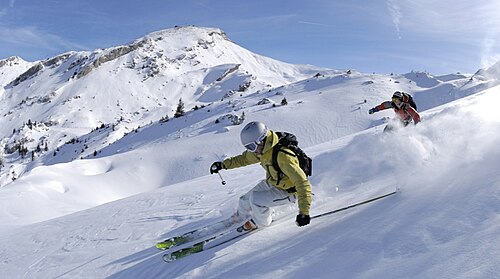
Commonly known as downhill skiing, this discipline typically occurs on a piste (a groomed ski trail) at a resort. It utilizes fixed-heel bindings that secure the boot at both the toe and heel. While most skiers use chairlifts to reach the summit, backcountry enthusiasts may use helicopters, snowcats, or snowmobiles. Specialized Alpine Touring setups allow for versatility, using switchable bindings and climbing skins (textured strips attached to the ski base) to provide traction for uphill travel.
Nordic Skiing
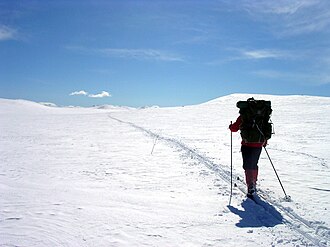
Nordic disciplines, including cross-country skiing and ski jumping, use bindings that attach only at the toe, leaving the heel free to lift. Cross-country skiing takes place on groomed trails or in the backcountry, while ski jumping is performed on dedicated jumps.
Telemark Skiing
Named after the Telemark region of Norway, this is a specific turning technique and FIS-sanctioned discipline. It combines elements of both styles, using Nordic-style free-heel bindings but employing skis that are often as wide as those used in Alpine skiing.
Competitive Skiing and Sanctioned Events
The FIS oversees a wide array of competitions, many of which are featured in the Winter Olympics and World Cups.
| Discipline | Key Events/Formats | Notable Characteristics |
|---|---|---|
| Cross-Country | Classic, Free-style, Biathlon | Groomed courses; Biathlon adds rifle shooting. |
| Alpine | Downhill, Slalom, Super-G, Giant Slalom | High-speed descent; includes head-to-head dual slalom. |
| Ski Jumping | World Cup, Ski Flying | Focus on distance and style from a jump. |
| Freestyle | Moguls, Aerials, Half-pipe, Slopestyle | Acrobatic maneuvers and technical tricks. |
| Nordic Combined | Combined Event | A hybrid of ski jumping and cross-country. |
| Speed Skiing | World Cup | Pure velocity; records exceed 89 mph. |
| Grass Skiing | World Cup | Practiced on grass as a training or standalone sport. |
Equipment and Technique
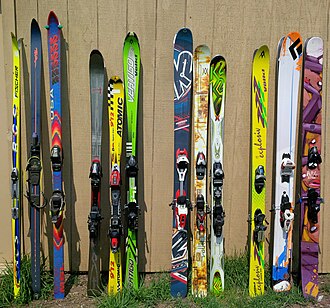
Modern skiing relies on a suite of specialized gear, including skis, boots, bindings, poles, helmets, goggles, and protective suits. Ski geometry has evolved significantly; for example, twin-tip skis allow athletes to move both forward and backward, while parabolic designs (such as the Elan SCX) have enabled the modern carve turn.
Beyond traditional snow, skiing is now practiced on synthetic "dry" slopes, sand, and indoors via simulators. Roller skiing and grass skiing provide year-round alternatives for athletes.
Frequently Asked Questions
What is the main difference between Alpine and Nordic skiing?
The primary difference is the binding system. Alpine skiing uses fixed-heel bindings for stability during downhill descents, whereas Nordic skiing uses bindings that attach only at the toe, allowing the heel to lift for easier forward movement.
What are climbing skins used for?
Climbing skins are textured strips temporarily attached to the bottom of skis. They provide the necessary traction to glide uphill without sliding backward, allowing skiers to access backcountry areas without lifts.
What is a "piste" in alpine skiing?
A piste is a groomed ski trail or run at a ski resort, specifically prepared for skiers to ensure a consistent and safer surface.
How did skiing start as a military tool?
By 1747, continental European armies began equipping troops with skis for mobility in winter terrain. This evolved into specialized ski warfare training and military races, particularly in Norway during the 18th century.
What is the "carve turn" in modern skiing?
The carve turn is a modern technique made possible by parabolic ski designs, which allow the skier to slice through the snow along the edge of the ski rather than skidding.