Skanska: A Global Leader in Construction and Sustainable Development
Founded in 1887, Skanska has evolved from a Swedish enterprise into one of the world's most prominent construction groups. As a publicly traded Aktiebolag (a Swedish joint-stock company) listed on the Nasdaq Stockholm, Skanska operates at the intersection of infrastructure, commercial property, and residential development. With a legacy spanning over 130 years, the company has shaped some of the most iconic skylines in Europe and North America.
Key Facts
- Founded: 1887 in Stockholm, Sweden.
- Global Reach: Major operations in the Nordic region, Europe, and North America.
- Financials (2025): Revenue of SEK 176.7 billion and net income of SEK 5.8 billion.
- Workforce: 25,860 employees as of 2025.
- Sustainability: First in the industry to implement ISO 14000 standards globally.
- Leadership: Led by President and CEO Anders Danielsson and Chairman Hans Biörck.
Corporate Evolution and Market Presence
Originally known as Skånska Cementgjuteriet, the company began its international expansion in the mid-1950s, venturing into Asia, Africa, and South America. A pivotal move occurred in 1971 when the company entered the United States market, where it has since become one of the largest players in the sector. In 1984, the group officially adopted the name "Skanska," which had already gained widespread international recognition.
Today, Skanska focuses its strategic efforts on three primary regions: the Nordic countries (Sweden, Norway, Finland, and Denmark), the rest of Europe (including the UK, Poland, and the Czech Republic), and North America. While it previously operated in Latin America, those operations have been phased out.
| Region | Number of Employees | Revenue (SEK) |
|---|---|---|
| Nordic Countries | 17,000 | 64.0 billion |
| Rest of Europe | 17,000 | 35.0 billion |
| North America | 10,000 | 49.9 billion |
Operational Specializations
Skanska organizes its business into four distinct streams to manage its diverse portfolio of projects:
- Construction: The largest revenue driver, focusing on large-scale builds.
- Residential Development: Creating housing solutions.
- Commercial Property Development: Developing offices and business hubs.
- Infrastructure Development: Building essential public works like bridges and tunnels.
Skanska USA
The North American division has grown through strategic acquisitions of specialized firms. Notable legacy companies integrated into Skanska USA include Slattery Contracting Company (Heavy Civil), Beers Construction (Building Construction), and Underpinning & Foundation (Ground Improvement). These acquisitions have allowed Skanska to dominate various niches from steel erection to complex foundation work across the Northeast, Southeast, and Western regions.
Commitment to Environmental Sustainability
Skanska has positioned itself as a pioneer in "green building." The company was ranked as the No. 1 Green Builder in the U.S. in 2007 and the greenest company in the UK in 2011. Their environmental strategy is guided by the "five zeros" vision: zero loss-making projects, zero work site accidents, zero environmental incidents, zero ethical breaches, and zero defects.
To standardize these goals, Skanska became the first construction company to implement ISO 14000 (international standards for environmental management) globally, with all business units certified under ISO 14001 since 2000.
Major Global Projects
European Landmarks
In Europe, Skanska's portfolio includes critical infrastructure and healthcare facilities. Key achievements include the Øresund Bridge connecting Sweden and Denmark, and several major London projects such as the Heron Tower and the Royal London Hospital.
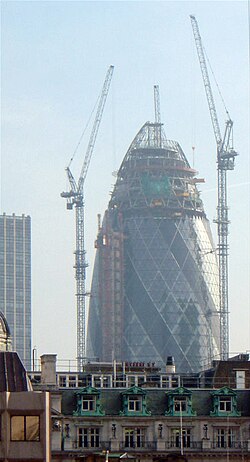
One of their most visually striking contributions to the London skyline is 30 St Mary Axe, completed in 2004.
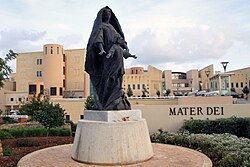
Other notable European projects include the Mater Dei Hospital in Malta and the redevelopment of St Bartholomew's Hospital.
North American Achievements
In the United States, Skanska has handled massive urban infrastructure and sports venues. They completed the MetLife Stadium in 2010 and the Moynihan Train Hall in 2020. In New York City, the company played a vital role in the restoration of the World Trade Center site, including the construction of the World Trade Center Transportation Hub and its iconic "Oculus" entrance.
Challenges and Controversies
Despite its success, Skanska has faced significant challenges. In Malta, the Mater Dei Hospital project was marred by the use of lower-quality cement, which limited the building's ability to add further floors. In Sweden, the Hallandsås Tunnel project faced a severe environmental crisis in 1997 due to the use of Rhoca-Gil, a toxic sealing compound containing acrylamide, which led to livestock deaths and criminal charges.
The company has also dealt with labor disputes in the UK regarding an illegal construction industry blacklist and a 2020 incident in Florida where unsecured barges damaged the Pensacola Bay Bridge during Hurricane Sally.
Frequently Asked Questions
What are Skanska's primary business areas?
Skanska operates in four main streams: construction, residential development, commercial property development, and infrastructure development.
Where is Skanska headquartered?
The company is headquartered in Stockholm, Sweden.
What is the "five zeros" vision?
It is Skanska's official vision to achieve zero loss-making projects, zero work site accidents, zero environmental incidents, zero ethical breaches, and zero defects.
Which major New York City projects has Skanska completed?
Key projects include the World Trade Center Transportation Hub (the Oculus), the Second Avenue Subway tunneling, and the Moynihan Train Hall.
How does Skanska approach environmental standards?
Skanska was the first in its industry to implement ISO 14000 standards globally, ensuring all business units are ISO 14001 certified since 2000.