Sittellas: The Unique Bark-Foraging Birds of Australasia
The sittellas are a specialized family of small passerine (perching) birds found exclusively in Australasia. While they bear a striking resemblance to the nuthatches of the Northern Hemisphere, these birds are distinct evolutionary lineages. Known for their agility on tree trunks and their complex social structures, sittellas play a vital role in the woodland ecosystems they inhabit.
Key Facts
- Family: Neosittidae, containing a single genus, Daphoenositta.
- Species: Three living species: the Varied, Black, and Papuan sittellas.
- Range: Restricted to Australia and New Guinea.
- Diet: Primarily insects and arthropods gleaned from tree bark.
- Social Behavior: Highly social birds that often live in cooperative clans.
- Unique Trait: Some populations have been reported to use tools to extract prey.
Evolution and Taxonomy
For decades, the evolutionary history of sittellas was a subject of debate due to their morphological similarity to nuthatches. Both groups share similar climbing techniques and body shapes. However, critical differences exist: nuthatches nest in tree cavities, whereas sittellas build open-cup nests on branches. Additionally, sittella leg muscles more closely resemble those of honeyeaters.
After being tentatively placed in various groups—including the Old World babblers and treecreepers—DNA-DNA hybridization studies by Sibley and Ahlquist eventually clarified their position. They are now placed in the superfamily Corvoidea. A 2019 molecular genetic study further refined this, identifying the family Neosittidae as a sister group to the Mohouidae family (which includes whiteheads and yellowheads).
The family consists of the genus Daphoenositta. While previously split into two genera, they were merged based on taxonomic priority. The fossil record includes Daphoenositta trevorworthyi from the middle Miocene, discovered in Queensland's Riversleigh World Heritage Area, marking the oldest known record of the family.
Species and Distribution
There are three recognized species of sittellas, each with distinct geographic ranges and physical characteristics.
| Common Name | Scientific Name | Distribution |
|---|---|---|
| Black Sittella | Daphoenositta miranda | New Guinea |
| Varied Sittella | Daphoenositta chrysoptera | Australia |
| Papuan Sittella | Daphoenositta papuensis | New Guinea |
The Varied Sittella
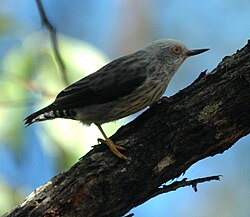
The Varied Sittella is the most common species. Although it exhibits significant plumage variation across Australia—once leading researchers to believe there were five separate species—it is now classified as a single species with five subspecies due to extensive hybridization zones.
Physical Characteristics
Sittellas are small birds, typically measuring between 10 and 14 cm in length and weighing between 8 and 20 g. They possess long, broad wings with fingered tips, though their flight is generally weak, which may explain why they have not colonized islands like Tasmania.
Their most distinctive feature is the bill: the Black Sittella has a dagger-shaped bill, while the Varied Sittella's bill is slightly upturned. This specialized tool allows them to extricate insects from bark. Their plumage varies by species and sex, exhibiting sexual dimorphism (distinct differences between males and females). For example, the Black Sittella is mostly black with a red face, while the Varied and Papuan species feature more complex patterns of grey, white, and black.
Habitat and Social Behavior
Sittellas are sedentary, social birds. In Australia, they occupy most woodland and forest types except dense rainforests; conversely, in New Guinea, they are found primarily in rainforests, avoiding lowland forests.
They are rarely found alone, typically living in groups of five or more. In New South Wales, Varied Sittellas form clans of eight to twelve individuals that defend mutual territories. These groups exhibit high levels of social bonding, including mutual preening and communal roosting. To avoid predators, birds arrive at their roosting sites—usually high, inclined dead branches—at 30 to 60-second intervals. Within the roost, males typically occupy the edges of the group, while juveniles are sheltered in the center.
Diet and Foraging Techniques
The diet of the sittella consists mainly of insects and arthropods. In some studies, adult beetles (such as weevils and ladybirds) made up roughly 36% of the diet, while other studies found beetle larvae to comprise up to 87%. They also consume spiders, true bugs, moth larvae, and occasionally wasps or bees.
Sittellas forage primarily in the canopy, hopping along horizontal branches or moving up and down tree trunks. They use their feet to hold prey while eating—similar to parrots—and use their feet to pry back strips of bark. Remarkably, there have been isolated reports of tool use, where sticks were used to extract beetle larvae from cavities.
Breeding and Nesting
The Varied Sittella is a cooperative breeder. This means that multiple individuals within a clan help raise the young. Some groups even employ a plural breeding system where more than one pair nests within the same group, and in rare cases, two females may share a single nest.
Nests are typically constructed in the prong of two branches, often in stringybark trees (specifically Eucalyptus macrorhycha). The nest is a deep cup made of materials that camouflage it against the tree bark. Construction takes about a week, with the group sharing the workload. A clutch of 2–3 eggs is incubated for 19–20 days. After hatching, the young are fed in the nest for about 20 days and receive extended parental care for 60 to 80 days after fledging.
Frequently Asked Questions
Are sittellas related to nuthatches?
While they look and behave similarly, they are not closely related. Nuthatches are found in the Northern Hemisphere, while sittellas are native to Australasia. They differ significantly in their nesting habits and leg anatomy.
What do sittellas eat?
Their diet consists primarily of insects and arthropods, with a strong preference for beetles, beetle larvae, and spiders, which they glean from the bark of trees.
How do sittellas build their nests?
Sittellas build open-cup nests in the fork of branches, usually high in the tree. They use bark from the tree to decorate and camouflage the nest, making it blend in with the surroundings.
Do sittellas use tools?
Yes, there have been isolated reports of some sittella populations using sticks to pry boring beetle larvae out of tree cavities, a behavior similar to that of the woodpecker finch.
What is cooperative breeding in sittellas?
Cooperative breeding is a social system where members of a family group, other than the biological parents, help to protect and feed the chicks, increasing the likelihood of the brood's survival.