Sir Michael Rimington: The Distinguished Cavalry Leader of Two World Wars
Lieutenant-General Sir Michael Frederic Rimington (1858–1928) was a prominent British Army officer whose career spanned nearly four decades of military service. Known to his peers and subordinates as "Mike," Rimington established himself as a master of cavalry operations, leading forces through the rugged terrains of South Africa and the grueling battlefields of the Western Front during the First World War.
From his early days with the 6th (Inniskilling) Dragoons to his high-ranking commands in India and France, Rimington was regarded as a soldier who "meant business." His legacy is defined by his ability to lead independent raids and his commitment to the evolution of cavalry tactics in an era of transitioning warfare.
Key Facts
- Full Name: Sir Michael Frederic Rimington, KCB, CVO.
- Highest Rank: Lieutenant-General.
- Notable Commands: Rimington's Guides, 1st Indian Cavalry Division, and the Indian Cavalry Corps.
- Major Conflicts: Second Boer War and First World War.
- Key Contribution: Expert in irregular mounted scouting and cavalry leadership.
- Literary Works: Author of Hints on Stable Management and Our Cavalry.
Early Life and Military Foundations
Born on May 23, 1858, in Penrith, Cumberland, Rimington was educated at Highgate School in London before attending Keble College, Oxford. Upon graduating in 1881, he entered the British Army as a lieutenant with the 6th (Inniskilling) Dragoons.
His early active service took place in South Africa, where he participated in the 1884 Warren Expedition to recapture the United States of Stellaland. By 1888, he was serving as the regimental adjutant during the campaign against Dinizulu. During this period, he also began his family, marrying Agnes Cunningham in 1887. Their son, Reginald, would later follow in his father's footsteps, serving in the 6th Dragoons and the Royal Tank Regiment before being killed in North Africa in 1941.
Returning to the United Kingdom in 1890, Rimington focused on regimental duties and staff positions. His expertise in equine care led him to publish Hints on Stable Management around 1897, the same year he was promoted to major.
The Second Boer War and "Rimington's Tigers"
In July 1899, Rimington returned to South Africa on special service. With the outbreak of the Second Boer War in October, he was tasked with raising a force of irregular mounted scouts. This unit, known as Rimington's Guides, earned the nickname "Rimington's Tigers" due to the wildcat fur bands they wore on their hats.
Rimington led the Guides through several pivotal engagements, including the battles of Belmont, Enslin, Modder River, and Magersfontein. Under the leadership of Sir John French, he commanded the unit at Paardeberg and Poplar Grove during the march to Pretoria, and later at Diamond Hill in June 1900. As the conflict shifted toward guerrilla warfare, the Guides remained heavily engaged until Rimington left the unit in January 1901, at which point it was reorganized as Damant's Horse.
Rimington then returned to lead the 6th Dragoons as a lieutenant-colonel. His exceptional leadership earned him five mentions in despatches and the Queen's and King's South Africa Medals, the latter featuring ten clasps—the highest number typically awarded. Lord Kitchener praised him as a leader "particularly well qualified for the conduct of special and independent raids."
Command in India and the First World War
Following the Boer War, Rimington's career ascended rapidly. He commanded the 3rd Cavalry Brigade at The Curragh and later the Secunderabad Cavalry Brigade in India. By 1911, he had become the Inspector-General of cavalry units in India, a role that allowed him to refine his theories on the modern role of the horse in war, which he detailed in his 1912 book, Our Cavalry.
When the First World War erupted in 1914, Rimington accompanied the Indian Expeditionary Force to France. He initially commanded the 1st Indian Cavalry Division and was subsequently promoted to lead the Indian Cavalry Corps on the Western Front.
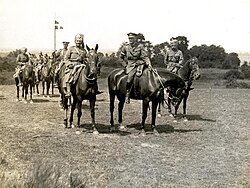
After the Indian Cavalry Corps was disbanded, Rimington returned to the United Kingdom to manage a reserve centre from 1916 to 1918. He officially retired from the army in 1919, having been knighted and awarded the French Legion of Honour for his wartime service.
Summary of Service and Honors
| Category | Details |
|---|---|
| Service Years | 1881–1919 |
| Primary Regiment | 6th (Inniskilling) Dragoons |
| Key Commands | Rimington's Guides, 1st Indian Cavalry Division, Indian Cavalry Corps |
| Major Awards | KCB, CVO, Legion of Honour, Queen's & King's South Africa Medals |
| Education | Highgate School, Keble College, Oxford |
Frequently Asked Questions
What were "Rimington's Tigers"?
Rimington's Tigers was the nickname for Rimington's Guides, a force of irregular mounted scouts raised by Sir Michael Rimington during the Second Boer War. They were so named because of the wildcat fur bands they wore on their hats.
What books did Sir Michael Rimington write?
He authored two military-focused books: Hints on Stable Management, which focused on equine care, and Our Cavalry (1912), which summarized the contemporary role of cavalry for junior officers.
What was Rimington's role in the First World War?
He commanded the 1st Indian Cavalry Division and later the Indian Cavalry Corps on the Western Front in France before returning to the UK to lead a reserve centre.
How did his son, Reginald, follow in his footsteps?
Reginald Rimington also joined the 6th Dragoons and later the Royal Tank Regiment. He rose to command the 3rd Armoured Brigade during World War II but was killed in North Africa in April 1941.
What were his most significant military honors?
He was appointed a Knight Commander of the Order of the Bath (KCB) and a Commander of the Royal Victorian Order (CVO), and he received the French Legion of Honour.