Sir Ernest Swinton and the Genesis of the Tank
Major-General Sir Ernest Swinton was a visionary British Army officer whose contributions fundamentally altered the landscape of modern warfare. While he served with distinction across multiple conflicts, he is most remembered for his pivotal role in the development and adoption of the tank during the First World War. Beyond his military engineering, Swinton was a prolific author and war correspondent, blending tactical brilliance with a literary sensibility.
Key Facts
- Role: Major-General in the Royal Engineers.
- Key Contribution: Initiated the use of the word "tank" as a code-name for armoured vehicles.
- Tactical Legacy: Wrote The Defence of Duffer's Drift, a classic used by British, Canadian, and US militaries.
- Technical Influence: Advocated for the use of tracked vehicles to overcome trench warfare.
- Academic Career: Served as the Chichele Professor of Military History at Oxford University.
Early Life and Military Foundations
Born in Bangalore, India, on October 21, 1868, Ernest Swinton was the son of a judge in the Madras Civil Service. After returning to England in 1874, he received an extensive education across several institutions, including Rugby School and the Royal Military Academy, Woolwich. He began his professional military journey on February 17, 1888, when he was commissioned as a second lieutenant in the Corps of Royal Engineers.
Swinton's early career took him back to India and later to South Africa, where he served as a captain during the Second Boer War (1899–1902). Although his primary duties involved railway construction, he developed a deep fascination with fortifications and the lethality of the newly introduced machine-gun. This period of observation led him to write The Defence of Duffer's Drift, a seminal work on small unit tactics that remains a training staple for officers and non-commissioned officers (NCOs) today.
The First World War and the Birth of the Tank
At the outbreak of the First World War in 1914, Lord Kitchener appointed Swinton as the official British war correspondent on the Western Front. While his reports were subject to strict censorship, his position allowed him to witness the devastating stalemate of trench warfare firsthand.
The spark for the tank came from a combination of technical intelligence and a sudden epiphany. In July 1914, a friend and mining engineer, Hugh F. Marriott, wrote to Swinton describing the Holt Caterpillar Tractor, an American-made tracked vehicle. While Swinton initially viewed it as a transport tool, the reality of the Western Front changed his perspective. On October 1, 1914, while driving from St. Omer to Calais, Swinton realized that a bullet-proof, tracked vehicle could be the key to destroying enemy machine-gun nests and breaking the deadlock of the trenches.
By November 1914, Swinton proposed the construction of such a vehicle to Sir Maurice Hankey. His efforts culminated in July 1915 when he joined the War Office and collaborated with the Landship Committee—a body then controlled by the Admiralty. Swinton was instrumental in bridging the gap between the Navy and the Army, persuading the Prime Minister to hold an inter-departmental conference in August 1915 to establish the army's specific performance requirements for these new machines.
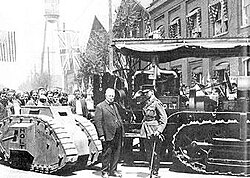
By 1916, promoted to lieutenant colonel, Swinton took charge of training the first tank units and authored the first tactical instructions for armoured warfare. While the Royal Commission later credited Sir William Tritton and Major Walter Gordon Wilson as the primary inventors, Swinton's strategic vision and advocacy were essential to the tank's deployment. By 1918, the War Office had acquired 2,100 Holt tractors to support the effort.
Post-War Career and Academic Legacy
Swinton retired as a major general in 1919, but his influence extended far beyond the battlefield. He transitioned into civil aviation at the Air Ministry and later served as a director for the automotive company Citroën starting in 1922. His intellectual contributions continued at the University of Oxford, where he was a fellow of All Souls College and the Chichele Professor of Military History from 1925 to 1939.
He also remained connected to the military as the Colonel Commandant of the Royal Tank Corps from 1934 to 1938. In his later years, he edited Twenty Years After: the Battlefields of 1914–18: then and Now, a comprehensive visual record of the war's impact on the French landscape.
| Category | Details |
|---|---|
| Military Rank | Major-General (Royal Engineers) |
| Key Conflicts | Second Boer War, First World War |
| Major Innovation | Advocacy and tactical development of the tank |
| Notable Publication | The Defence of Duffer's Drift |
| Academic Post | Chichele Professor of Military History, Oxford |
| Major Awards | KBE, CB, DSO, Legion of Honour |
Frequently Asked Questions
Did Sir Ernest Swinton invent the tank?
While the Royal Commission on Awards to Inventors credited Sir William Tritton and Major Walter Gordon Wilson as the inventors, Swinton is credited with the conceptual spark and the strategic push to develop a bullet-proof, tracked vehicle to overcome trench warfare.
How did the word "tank" originate?
Sir Ernest Swinton, along with Lieutenant-Colonel Walter Dally Jones, is credited with initiating the use of the word "tank" as a code-name to keep the development of the armoured vehicles secret from enemy intelligence.
What is the significance of "The Defence of Duffer's Drift"?
It is a military classic on minor tactics. Written after the Boer War, it has been used for decades by the British, Canadian, and US militaries to train officers and NCOs in small unit tactics.
What was the role of the Holt Caterpillar Tractor?
The Holt tractor provided the technical basis for the tank's movement. Its "chain track" system allowed heavy vehicles to traverse soft or broken ground, a capability Swinton recognized as essential for crossing trenches.
What did Swinton do after his military retirement?
After retiring in 1919, he worked for the Air Ministry, served as a director for Citroën, and became a distinguished professor of military history at Oxford University.