Shrikes: The Fascinating Butcherbirds of the Avian World
In the world of birds, few creatures possess a reputation as striking—and macabre—as the shrike. Known colloquially as "butcherbirds," these medium-sized passerines (perching birds) combine the songbird's form with the predatory instincts of a hawk. From their piercing calls to their unique method of storing food, shrikes are a marvel of evolutionary adaptation.
The name "shrike" originates from the Old English word scrīc, a nod to their shrill, shriek-like vocalizations. However, it is their behavior that truly sets them apart, specifically their habit of impaling prey on thorns and spikes to create a biological larder.
Key Facts
- Family: Laniidae, consisting of 34 species across two primary genera.
- Diet: Carnivorous, feeding on insects and small vertebrates.
- Defining Habit: Impaling prey on thorns or barbed wire for storage and courtship.
- Distribution: Primarily Eurasian and African, with two species in North America.
- Physical Traits: Hooked beaks similar to birds of prey and typically grey, brown, or black-and-white plumage.
Taxonomy and Classification
The family Laniidae was first introduced as a subfamily in 1815 by Constantine Samuel Rafinesque, while the type genus, Lanius, was established by Carl Linnaeus in 1758. Currently, the family is divided into two genera: Lanius and Eurocephalus.
Recent scientific advancements have challenged this classification. A 2023 molecular phylogenetic study revealed that the white-crowned shrikes (genus Eurocephalus) are more closely related to crows in the family Corvidae than to other shrikes. Consequently, researchers have proposed moving Eurocephalus into its own distinct family, Eurocephalidae.
Distribution and Habitat
Shrikes are found across a wide geographic range, though they are entirely absent from South America and Australia. While most species reside in Eurasia and Africa, the loggerhead and northern shrikes breed in North America. Some species, like the great grey shrike, span the Northern Hemisphere, whereas others, such as the São Tomé fiscal, are endemic to a single island.
These birds typically prefer open landscapes, such as savannahs and steppes, though a small number of species are specialized forest dwellers. Many shrike species are migratory, breeding in northern latitudes during the summer and moving to warmer climates for the winter.
Physical Characteristics
Most shrikes measure between 16 and 25 cm in length, though the genus Corvinella can reach up to 50 cm due to exceptionally long tail feathers. Their most distinctive feature is the hooked beak, an evolutionary tool designed for a carnivorous diet.
| Feature | Typical Description |
|---|---|
| Plumage | Grey, brown, or black-and-white |
| Beak Shape | Hooked (raptor-like) |
| Average Size | 16–25 cm (up to 50 cm in Corvinella) |
| Primary Habitat | Open steppe and savannah |
| Dietary Class | Carnivore |
Predatory Behavior and the "Larder"
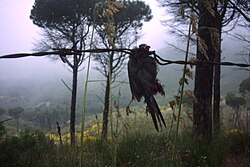
The most famous behavior of the shrike is the impaling of insects and small vertebrates on thorns, branches, or man-made objects like barbed-wire fences. This serves several critical purposes:
- Food Storage: It creates a cache, allowing the bird to return to uneaten portions later.
- Courtship: Males use these larders to display their fitness and the quality of their territory to prospective mates.
- Toxin Degradation: When eating the toxic lubber grasshopper (Romalea microptera), shrikes wait 1–2 days for the toxins to degrade before consumption.
- Dismemberment: Females use impaling primarily to help tear apart their prey.
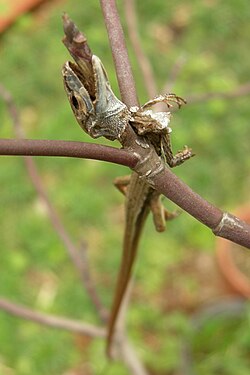
Hunting techniques vary by species. For example, the loggerhead shrike kills vertebrates by grabbing or piercing the neck with its beak and shaking the prey violently. Additionally, shrikes are known to use vocal mimicry, imitating the calls of other birds to lure them into striking distance.
Social Structure and Breeding
Shrikes are highly territorial birds. They utilize exposed perches to scan for prey and signal their presence to rivals. While generally monogamous, some species exhibit polygyny. Interestingly, cooperative breeding—where offspring help parents raise the next brood—has been observed in the Eurocephalus and Corvinella genera, as well as one Lanius species.
During courtship, males perform a ritualized dance that mimics the skewering of prey and offer food to the female. Their nests are simple, cup-shaped structures made of twigs and grasses, typically tucked into bushes or low tree branches.
Frequently Asked Questions
Why are shrikes called butcherbirds?
They earned this name because of their habit of impaling prey on thorns, spines, or barbed wire, resembling a butcher's hook.
Do all shrikes impale their food?
While it is a hallmark of the family, the behavior is most prominent in males for courtship and storage. Females primarily use impaling to assist in dismembering prey.
Where can shrikes be found?
They are widely distributed across Eurasia and Africa, with two species breeding in North America. They are not found in South America or Australia.
How do shrikes hunt their prey?
Shrikes use a combination of high perches for spotting prey, vocal mimicry to lure other birds, and powerful hooked beaks to kill their targets.
Are shrikes related to crows?
While most shrikes are in the family Laniidae, a 2023 study suggests that the white-crowned shrikes (genus Eurocephalus) are more closely related to the Corvidae (crow) family.