Ship Stability: The Role of Metacentre and Righting Arms
Maintaining stability is the most critical aspect of naval architecture. Whether it is a massive cargo ship or a racing yacht, a vessel's ability to return to an upright position after being tilted by wind or waves depends on the complex interplay between gravity and buoyancy. This stability is governed by three primary points: the centre of gravity, the centre of buoyancy, and the metacentre.
The Fundamental Centres of Stability
To understand how a ship stays afloat and upright, we must first define the key reference points used to calculate its balance:
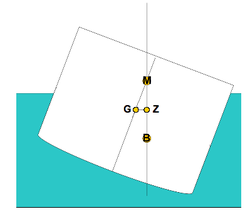
- Centre of Gravity (G or CG): The point where the total weight of the ship and its cargo is concentrated. This point generally remains fixed relative to the ship unless cargo is moved.
- Centre of Buoyancy (B): The geometric centre of the volume of water displaced by the hull. Unlike the centre of gravity, the centre of buoyancy shifts as the ship heels (rolls sideways) because the shape of the submerged volume changes.
- Metacentre (M): The point where a vertical line passing through the heeled centre of buoyancy intersects the vertical line passing through the original, upright centre of buoyancy.
When a ship is in equilibrium and upright, the centre of buoyancy is vertically aligned with the centre of gravity. As the ship rolls, the shift in the centre of buoyancy creates a force that can either right the vessel or cause it to capsize.
The Metacentre and Metacentric Height (GM)
The metacentric height (GM) is the distance between the centre of gravity (G) and the metacentre (M). This value serves as a primary indicator of a vessel's initial stability for small angles of heel (typically 0 to 15 degrees).
Calculating the Metacentre
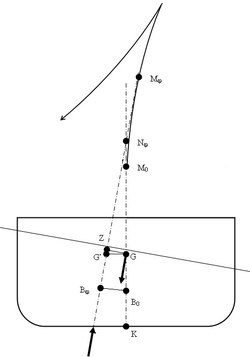
The distance from the keel (K) to the metacentre (KM) is calculated by adding the height of the centre of buoyancy (KB) to the distance between the buoyancy centre and the metacentre (BM):
KM = KB + BM
The BM value is determined by the ratio of the second moment of area (I)—which describes how the waterline width resists overturning—to the volume of displacement (V):
BM = I / V
Stability and Roll Frequency
The GM acts similarly to a spring constant in a mechanical system. A larger GM creates a "stiffer" boat that returns to upright quickly, resulting in a short roll period and high accelerations at the deck level. Conversely, a smaller GM results in a "tender" boat with a slower, more comfortable roll, though it carries a higher risk of overturning.
Sailing yachts, particularly racing models, are designed to be stiff to resist the heeling force of the wind. Their comfort is maintained not by a low GM, but by the aerodynamic damping of the sails and the moment of inertia provided by a tall mast.
The Righting Arm and Righting Moment
As a vessel heels beyond 15 degrees, the metacentre can no longer be considered a fixed point. Stability is then measured by the righting arm (GZ), which is the horizontal distance between the vertical lines of gravity and buoyancy.
The righting moment (RM) is the actual torque that pushes the ship back to upright, calculated as:
RM = GZ · Δ (where Δ is the vessel displacement).
Critical Stability Thresholds
Naval architects monitor several critical angles to ensure safety:
- Maximum Righting Moment: The peak torque the vessel can generate before capsizing.
- Point of Deck Immersion: The angle at which the main deck first touches the water.
- Downflooding Angle: The angle at which water can enter the interior of the vessel.
- Point of Vanishing Stability: The angle of unstable equilibrium. If the ship heels beyond this point, the righting moment becomes negative, and the vessel will capsize.
For monohulled sailing vessels, it is ideal to maintain a positive righting arm up to 120° of heel, though many are stable only up to 90°.
Key Facts
- GM (Metacentric Height) determines the initial stability and rolling frequency of a ship.
- Wide, shallow hulls generally have higher transverse metacentres than narrow, deep hulls.
- GZ (Righting Arm) is the primary measure of stability for large angles of heel.
- Potential energy is stored during a roll by raising the centre of mass or lowering the centre of buoyancy.
- Vanishing stability occurs when the righting moment becomes negative, leading to capsizing.
| Reference Point | Symbol | Definition | Impact on Stability |
|---|---|---|---|
| Centre of Gravity | G / CG | Point of total ship weight | Lowering G increases stability (GM). |
| Centre of Buoyancy | B | Centre of displaced water volume | Shifts laterally as the ship heels. |
| Metacentre | M | Intersection of buoyancy lines | Position relative to G determines stability. |
| Righting Arm | GZ | Horizontal distance between G and B | Determines the righting moment at large angles. |
Frequently Asked Questions
What happens if the centre of gravity is above the metacentre?
If the centre of gravity (G) is above the metacentre (M), the metacentric height (GM) becomes negative. In this state, the vessel is unstable and will not right itself, likely leading to a capsize.
How does hull shape affect the metacentre?
The metacentre is determined by the ratio of the boat's inertia resistance (waterline width) to its volume. Wide and shallow hulls typically have high transverse metacentres, making them very stable but prone to quick, sharp rolls.
What is the difference between a "stiff" and a "tender" boat?
A "stiff" boat has a large GM, meaning it resists heeling strongly and snaps back to upright quickly. A "tender" boat has a small GM, resulting in a slower, more gradual roll that is often more comfortable for passengers but less resistant to overturning.
What is the point of vanishing stability?
The point of vanishing stability is the critical angle of heel where the righting arm (GZ) becomes zero. Beyond this angle, the vessel can no longer right itself, and any further tilt will cause it to roll over completely.
Why are sailing yachts designed differently than motor vessels?
Sailing yachts must withstand significant heeling forces from the wind. They are designed with a much larger righting moment at extreme angles to prevent capsizing, often requiring positive stability up to 90° or even 120° of heel.