Shinty: The Ancient and Dynamic Sport of Scotland
Shinty is a high-energy, full-contact team sport deeply rooted in the cultural fabric of Scotland. With pre-medieval origins, it is a game of skill, strength, and endurance, characterized by the use of a curved stick to propel a small ball into a goal. While it remains a cornerstone of Highland tradition, the sport has evolved from localized glen-to-glen variations into a codified national game governed by the Camanachd Association.
Historically, the game was known by various names depending on the region. In the Scottish Lowlands, it was referred to as hailes, cammock, or knotty, while in Gaelic, it is known as camanachd or iomain. The term "shinty" itself may have emerged around 1700, possibly derived from the cries of players ("shin ye") or the Gaelic word sìnteag.
Key Facts
- Governing Body: Camanachd Association.
- Player Base: 3,449 registered players across 48 clubs.
- Team Size: 12 players per side for men; 10 for women.
- Primary Equipment: A caman (stick) and a hard leather-covered ball.
- Core Objective: To hit the ball into the opponent's goal, known as a "hail".
- Season: Played during the summer (March to October).
The Mechanics of the Game
The Playing Area
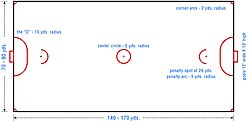
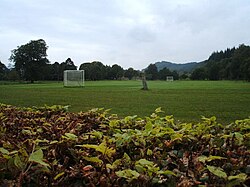
A shinty pitch is a rectangular grass or artificial turf field measuring between 140 and 170 yards in length and 70 to 80 yards in width. Each end features a goal (hail) that is 12 feet wide and 10 feet high. The field includes specific markings, such as a 10-yard area around the goals, penalty and center spots with 5-yard radius arcs, and 2-yard radius corner arcs.
Equipment: The Caman and the Ball
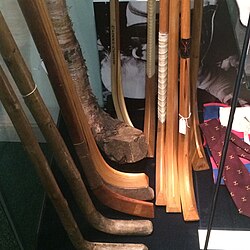
The caman is the specialized stick used to strike the ball. Approximately 3.5 feet long, it is traditionally crafted from ash or hickory and features two slanted faces and a wedge-shaped head. Unlike the Irish hurling stick, the caman has no blade. Its design is derived from the Gaelic word cam, meaning bent or crooked.
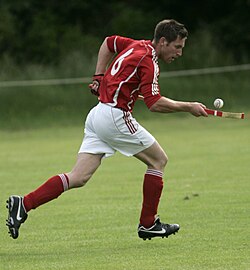
The ball is a hard, solid sphere with a cork core covered in stitched leather, similar in appearance to a baseball. It typically has a circumference of 7.5 to 8 inches and weighs between 2.5 and 3 ounces. While usually white, some clubs, such as Kyles Athletic, traditionally use black balls.
Rules and Gameplay
Matches consist of two 45-minute halves. Except for the goalkeeper, players are prohibited from using their hands to play the ball. While the sport originally lacked substitutes, they were introduced in the 1960s; since 2011, senior-level play has allowed for rolling substitutions.
Organization and Competition
League Structure and Dominance
Shinty is organized into various cup and league competitions. The Premier Division is a national competition, while lower leagues are divided geographically. Historically, the sport has seen periods of extreme dominance. Kingussie Camanachd is noted in the Guinness Book of Records as one of the most successful sporting teams ever, having won 20 consecutive league championships in the early 1990s. This streak was eventually broken by Newtonmore in 2006, though Kingussie and Newtonmore continue to be major forces in the 2020s.
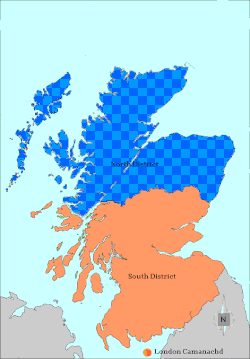
Major Cups
Cup competitions are often held in higher regard than league play. The Camanachd Cup is the premier national trophy. Other significant competitions include the Macaulay Cup, which maintains a North/South final format, and regional trophies like the MacTavish Cup (North) and the Glasgow Celtic Society Cup (South).
International Reach and Relations
Due to its shared ancestry with Irish hurling, Scotland and Ireland compete in an annual international series using "composite rules." Beyond Scotland, the sport has a presence in England—with clubs in London, Cornwall, and Northallerton—and is seeing a revival among the Scottish diaspora in North America, particularly in California and Oregon.
Shinty Summary Table
| Feature | Specification |
|---|---|
| Pitch Dimensions | 140-170 yards (L) x 70-80 yards (W) |
| Goal Size | 12 ft wide x 10 ft high |
| Caman Material | Traditionally Ash or Hickory |
| Ball Weight | 2.5 to 3 ounces |
| Match Duration | Two 45-minute halves |
| Governing Body | Camanachd Association |
Frequently Asked Questions
What is the difference between shinty and hurling?
While both share ancient roots, they differ in equipment and rules. The shinty caman has no blade, unlike the Irish camán, and the games are played under different codified rules, though they meet annually in international matches using a compromise set of rules.
When is the shinty season played?
Following a vote in 2005, shinty moved to a summer season, which typically runs from March to October.
Who is the most successful team in shinty history?
Kingussie Camanachd is widely regarded as the most successful, having achieved a record-breaking run of 20 consecutive league championships.
Can women play shinty?
Yes, shinty is a mixed-sex sport. Women's teams typically consist of 10 players per side, compared to 12 for men's teams.
Where is shinty played outside of Scotland?
Shinty is played in England (including London and Cornwall) and has been revived in the United States, with clubs in Oregon and California playing at Highland games.