Sequence Homology: Distinguishing Orthologs, Paralogs, and Xenologs in Evolutionary Biology
In the study of life's history, sequence homology serves as a fundamental concept. It refers to the biological relationship between DNA, RNA, or protein sequences that is defined by shared ancestry. By analyzing these sequences, scientists can trace how genetic information has changed, diverged, or been transferred across the evolutionary timeline.
Homology is typically inferred through sequence similarity. When two sequences show significant similarity in their nucleotide or amino acid patterns, it provides strong evidence that they descended from a common ancestral sequence. To identify these relationships, researchers use sequence alignments, which map out specific regions to determine which parts of a sequence are truly homologous.
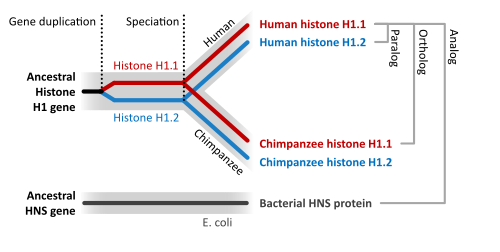
Key Facts
- Homology is defined by shared evolutionary ancestry.
- Orthologs arise from speciation events.
- Paralogs result from gene duplication events within a genome.
- Xenologs are produced through horizontal (lateral) gene transfer.
- Analogs perform similar functions but lack a common evolutionary origin.
The Three Pillars of Genetic Homology
To understand how genes evolve, we must distinguish between the different ways shared ancestry manifests. These mechanisms determine whether genes are considered orthologs, paralogs, or xenologs.
Orthology: Divergence via Speciation
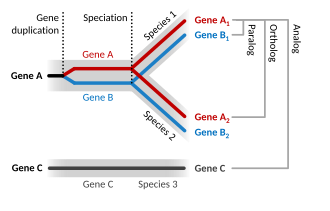
Orthologs are genes in different species that evolved from a single ancestral gene through a speciation event. Because the history of the gene mirrors the history of the species, orthologs often retain similar biological functions across different organisms.
Paralogy: Divergence via Duplication
Paralogs occur when a gene undergoes a duplication event within a single genome. This creates two or more copies of the gene that exist "in parallel." Over time, these copies may evolve new functions or specialize in different roles. A classic example is found in the human AMPK protein, where the catalytic domain has two paralogous versions: α1 (encoded by PRKAA1) and α2 (encoded by PRKAA2).
In vertebrates, paralogy is often seen in organized sets, such as the Hox genes. These genes are organized into clusters on different chromosomes; for example, the human HoxA cluster is located on chromosome 7. In mice, the HoxA cluster may contain 11 paralogous genes, though some may be missing due to evolutionary changes.
![Vertebrate Hox genes are organized in sets of paralogs. Each Hox cluster (HoxA, HoxB, etc.) is on a different chromosome. For instance, the human HoxA cluster is on chromosome 7. The mouse HoxA cluster shown here has 11 paralogous genes (2 are missing).[41]](/images/87/00/870087eec9dba85d78c653b0856940b97f2bb5f63f55b5ba1d0c3a5d2c75e7d0.png)
Xenology: Horizontal Gene Transfer
Xenologs represent a unique evolutionary path where genetic material is transferred between different species through horizontal (or lateral) gene transfer, rather than through vertical inheritance from parent to offspring.
Comparing Homology and Analogy
It is vital to distinguish between homology and analogy. While homologous sequences share a common ancestor, analogous structures or genes perform similar functions but have entirely separate evolutionary origins. For instance, a histone-like protein in E. coli may serve a similar purpose to human histones, but because they do not share a direct ancestral lineage, they are analogs rather than homologs.
![A sequence alignment of mammalian histone proteins. Sequences are the middle 120-180 amino acid residues of the proteins. Residues that are conserved across all sequences are highlighted in grey. The key below denotes conserved sequence (*), conservative mutations (:), semi-conservative mutations (.), and non-conservative mutations ( ).[2]](/images/05/5b/055b391bc23b3d414625eec56418db19dc752a8627bcf5e8333318be8bcd1077.png)
Tools for Orthology Inference
Modern bioinformatics relies on various databases and computational tools to identify orthologous relationships and map evolutionary histories. These tools range from specialized databases to automated inference pipelines.
| Resource Name | Primary Focus / Description |
|---|---|
| eggNOG | Evolutionary genealogy of genes and non-supervised orthologous groups. |
| OMA | Orthologous MAtrix for retrieving relationships across all domains of life. |
| OrthoFinder | Phylogenetic orthology inference for comparative genomics. |
| TreeFam | Database for predicting orthology at scalable resolution via tree analysis. |
| OrthoMaM | Database of orthologous genomic markers specifically for placental mammals. |
| GreenPhylDB | Comparative genomics database focused on plants. |
| InParanoid | Focuses on pairwise ortholog relationships in eukaryotes. |
Frequently Asked Questions
What is the main difference between an ortholog and a paralog?
The difference lies in the evolutionary event: orthologs are created when a gene diverges due to a speciation event (splitting between species), whereas paralogs are created when a gene is duplicated within a single genome.
How do scientists identify homologous sequences?
Scientists primarily use sequence alignment to compare the nucleotide or amino acid sequences of DNA, RNA, or proteins. Significant similarity in these alignments suggests a shared evolutionary history.
What are "ohnologs"?
Ohnologs are a specific type of paralog that originates from whole-genome duplication events, particularly those occurring in early vertebrate evolution.
Can two genes have the same function but not be homologous?
Yes. These are known as analogs. They perform similar biological roles but evolved independently from different ancestral origins.
What is xenology?
Xenology refers to homology resulting from horizontal gene transfer, where genetic material moves between organisms through means other than traditional reproduction and inheritance.