Semperoper: The Architectural and Musical Legacy of Dresden's Opera House
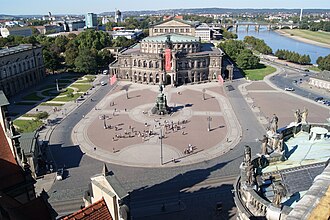
Located on the Theaterplatz near the banks of the Elbe River in the historic heart of Dresden, Germany, the Semperoper stands as one of the world's most prestigious venues for performing arts. It serves as the home of the Sächsische Staatsoper Dresden (Saxon State Opera), the Staatskapelle Dresden (Saxon State Orchestra), and the Semperoper Ballett. Renowned for its stunning architecture and a storied history of world premieres, the opera house is a symbol of Dresden's cultural resilience.
Key Facts
- Architect: Designed by Gottfried Semper.
- Capacity: 1,300 seats.
- Location: Theaterplatz, Dresden, Germany.
- Major Premieres: Works by Richard Wagner and Richard Strauss.
- Reconstructions: Rebuilt in 1878 and 1985.
A History of Destruction and Rebirth
The story of the Semperoper is one of repeated loss and meticulous restoration. The original building opened on April 13, 1841, with a performance by Carl Maria von Weber. The architecture was a subject of debate, blending early Renaissance and Baroque elements with Corinthian pillars typical of the Greek classical revival. This blend of styles is known as eclecticism, a common practice of the era.
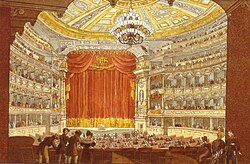
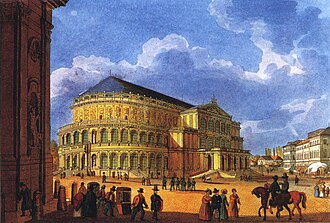
In 1869, a devastating fire destroyed the first building. Despite being in exile due to his involvement in the May 1849 uprising in Dresden, Gottfried Semper was requested to design the reconstruction. His son, Manfred Semper, executed the plans, and the second opera house opened in 1878 in the Neo-Renaissance style. During the interim construction period, performances were hosted at the Gewerbehaussaal starting in 1870.
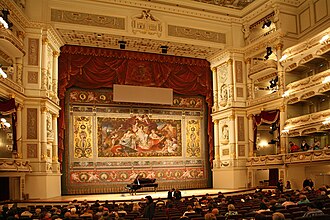
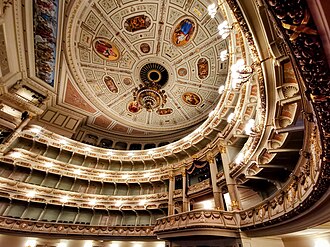
The building became a prime example of Baroque Revival architecture. The exterior features a Panther quadriga with a statue of Dionysos atop the portal, while monuments to literary giants such as William Shakespeare, Johann Wolfgang von Goethe, Friedrich Schiller, Sophocles, Molière, and Euripides adorn the facade. The interior was crafted by leading architects of the time, including Johannes Schilling, with artistic contributions from Ernst Rietschel and Ernst Julius Hähnel.
Tragedy struck again in 1945 during the final months of World War II. The bombing of Dresden and the subsequent firestorm left only the exterior shell standing.
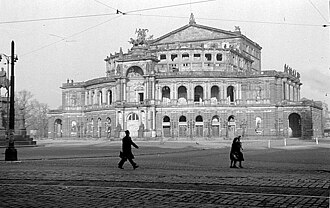
Exactly forty years later, on February 13, 1985, the reconstruction was completed. The building was restored to its pre-war appearance but integrated modern stage machinery and a new rear service building. It reopened with Carl Maria von Weber's Der Freischütz, the same opera performed just before the 1945 destruction. More recently, the building recovered from heavy water damage caused by the Elbe floods of 2002, reopening in December of that year with international support.
Musical Significance and Premieres
The Semperoper is legendary for its association with some of the greatest composers in history. It was a pivotal site for Richard Wagner, who premiered Rienzi (1842), The Flying Dutchman (1843), and Tannhäuser (1845) here. Later, the house became a center for Richard Strauss, hosting the premieres of Salome (1905), Elektra (1909), Der Rosenkavalier (1911), and many others.
Summary of Key Opera Premieres
| Year | Composer | Work |
|---|---|---|
| 1842 | Richard Wagner | Rienzi |
| 1843 | Richard Wagner | The Flying Dutchman |
| 1905 | Richard Strauss | Salome |
| 1911 | Richard Strauss | Der Rosenkavalier |
| 1985 | Siegfried Matthus | Die Weise von Liebe und Tod des Cornets Christoph Rilke |
Administration and Operations
The musical direction of the house is shared between the opera and the orchestra. While the Sächsische Staatskapelle Dresden provides the music for most operas, the Generalmusikdirektor (GMD) of the Semperoper is typically different from the conductor of the Staatskapelle during concert performances. Notable figures who held both roles include Karl Böhm, Hans Vonk, and Fabio Luisi.
Management of the company is led by the Intendant (General Manager). Peter Theiler served as Intendant starting in the 2018–2019 season, with his tenure concluding in the 2023–2024 season. Nora Schmid was appointed as the incoming Intendantin effective for the 2024–2025 season, becoming only the second woman to hold the position after Ulrike Hessler.
Frequently Asked Questions
Who was the architect of the Semperoper?
The opera house was designed by Gottfried Semper. He designed the original 1841 building and provided the plans for the 1878 reconstruction, which was executed by his son, Manfred Semper.
What architectural styles are present in the building?
The original building was eclectic, featuring early Renaissance, Baroque, and Greek classical revival elements. The second building (1878) was built in the Neo-Renaissance style and is considered a prime example of Baroque Revival architecture.
Which famous composers premiered works at the Semperoper?
The venue is most famous for premieres by Richard Wagner (such as Tannhäuser) and Richard Strauss (such as Salome and Elektra).
How many times has the Semperoper been rebuilt?
The building has been reconstructed twice: first in 1878 following a fire in 1869, and again in 1985 following its destruction during the bombing of Dresden in 1945.
Who is the current or incoming Intendant?
Nora Schmid was appointed as the Intendantin effective with the 2024–2025 season, succeeding Peter Theiler.