Semiaquilegia: The Rare Half-Columbines of East Asia
Native to the diverse landscapes of eastern Asia, Semiaquilegia is a genus of perennial herbaceous plants belonging to the buttercup family, Ranunculaceae. First proposed by the botanist Tomitaro Makino in 1902, these plants are often recognized for their striking resemblance to the more common columbines (Aquilegia). In fact, the name Semiaquilegia literally translates to "half-columbines," reflecting their close relationship and shared characteristics with that genus.
Key Facts
- Family: Ranunculaceae (Subfamily Thalictroideae).
- Origin: Native to East Asia, including China, Japan, and Korea.
- Defining Feature: Lacks the long nectar spurs typical of true columbines.
- Root System: Possesses tuberous roots.
- Species Count: Generally considered monotypic (one species), though some authorities recognize up to four.
Botanical Description
Semiaquilegia plants are characterized by their perennial nature and tuberous roots. Their foliage is arranged in two ways: basal (emerging from the base of the stem) and cauline (attached to the aerial stem). During early summer, small leaves typically develop along the flower stem.
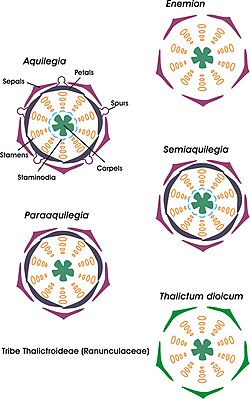
The flowers are actinomorphic, meaning they possess radial symmetry. Each flower consists of five petaloid sepals and five petals, with the petals arranged in a basally gibbous (swollen at the base) fashion. They typically feature 8 to 14 stamens with yellow anthers. A distinguishing trait of the genus is that the inner stamens can resemble flattened staminodes (sterile stamens).
While they look similar to Aquilegia, Semiaquilegia flowers either completely lack nectar spurs or possess extremely short ones. The fruit consists of three to five diverging follicles containing brown to black-brown seeds that are heavily wrinkled.
Taxonomy and Classification
The classification of Semiaquilegia has been a subject of botanical debate since its inception. Tomitaro Makino established the genus in 1902, distinguishing it from Aquilegia based on the absence of nectar spurs, a lower stamen count (fewer than 15), and the presence of staminode-like inner stamens.
In 1920, botanists James Ramsay Drummond and John Hutchinson attempted to expand the genus to include species previously identified as Isopyrum. However, this expansion was later viewed as problematic. By 2003, most of these additions were removed, and many authorities returned to viewing Semiaquilegia adoxoides as the sole valid species in the genus.
Accepted Species
While many botanists recognize only the type species, the Royal Botanic Gardens, Kew's Plants of the World Online accepts four distinct species:
- Semiaquilegia adoxoides (DC.) Makino [1902]
- Semiaquilegia danxiashanensis L.Wu, J.J.Zhou, Qiang Zhang & W.S.Deng [2019]
- Semiaquilegia guangxiensis Yan Liu & Y.S.Huang [2017]
- Semiaquilegia quelpaertensis D.C.Son & K.H.Lee [2017]
Distribution and Cultivation
Semiaquilegia is native to East Asia. When defined as a single-species genus (S. adoxoides), its natural range spans China, Japan, and Korea.
For those interested in gardening, the Alpine Garden Society notes that these plants are well-suited for pot cultivation within alpine houses. They require well-drained soil and can be relatively short-lived. Propagation is most successful when seeds are sown fresh in the spring, though careful division of the plants is also a viable method.
| Feature | Description |
|---|---|
| Root Type | Tuberous |
| Flower Symmetry | Actinomorphic (Radial) |
| Stamen Count | 8 to 14 |
| Key Distinction | No or very short nectar spurs |
| Native Range | East Asia (China, Japan, Korea) |
Frequently Asked Questions
How does Semiaquilegia differ from Aquilegia?
The primary difference is the nectar spur; Semiaquilegia either lacks these spurs entirely or has extremely short ones, whereas Aquilegia is known for its prominent spurs. Semiaquilegia also generally has fewer than 15 stamens.
Where is Semiaquilegia naturally found?
It is native to East Asia, specifically across the regions of China, Japan, and Korea.
How many species of Semiaquilegia exist?
Most authorities recognize only one species, Semiaquilegia adoxoides, though the Royal Botanic Gardens, Kew accepts four species.
What are the best conditions for growing Semiaquilegia?
They thrive in well-drained soil and are ideal for cultivation in pots within alpine houses.
How can Semiaquilegia be propagated?
Propagation can be achieved by sowing fresh seeds in the spring or through the careful division of existing plants.