Aquilegia oxysepala: The Sharp-Sepaled Columbine of East Asia
Aquilegia oxysepala is a striking perennial flowering plant belonging to the genus Aquilegia (commonly known as columbines) within the buttercup family, Ranunculaceae. Native to the temperate regions of East Asia, this species is celebrated for its unique floral architecture and its long history of traditional use in East Asian medicine.
From the rugged landscapes of southeastern Siberia to the islands of Japan, this herbaceous plant thrives in diverse environments, bringing vibrant purple and yellow hues to the forest edges and grassy slopes during the spring.
Key Facts
- Native Range: East Asia, extending from southeastern Siberia to Japan.
- Bloom Period: May, lasting approximately three weeks.
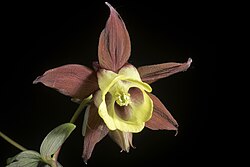
- Distinctive Features: Purple sepals with acute tips and pale yellow to yellowish-white petals.
- Habitat: Forest edges and grassy slopes at elevations from 400 m to 2,700 m.
- Traditional Use: Used in China for thousands of years to treat women's health issues.
Botanical Description and Morphology
Aquilegia oxysepala is characterized by its complex flower structure, which is typical of the columbine genus. Each flower generally consists of five sepals and five petals. A defining feature of these petals is the blade—the broad portion that protrudes forward—and the nectar spur, an elongated structure extending backward that holds the flower's nectar.
Floral Details
The sepals of A. oxysepala are purple and ovate-lanceolate in shape, ending in an acute (sharp) tip. These sepals typically measure between 20 mm and 30 mm in length. The petal blades are pale yellow to yellowish-white, measuring 10 mm to 13 mm, while the purple nectar spurs are strongly hooked and reach approximately 20 mm in length.
Comparison and Seeds
While it closely resembles Aquilegia vulgaris, A. oxysepala can be distinguished by its specific purple and yellow coloration and the acute tips of its sepals and staminodes. The plant produces small, shiny black seeds approximately 2 mm long.
Taxonomy and Distribution
The species was first formally described in 1856 by German-Russian botanists Ernst Rudolf von Trautvetter and Carl Anton von Meyer. The binomial name is derived from Greek, where oxysepala translates to "acute sepals" or "sharp sepals." The type locality for the species is Udskoi in eastern Siberia.
In the wild, A. oxysepala prefers temperate biomes. It is commonly found at elevations ranging from 400 m (1,300 ft) to 2,700 m (8,900 ft) above sea level. While many Aquilegia species are interfertile (capable of hybridizing), research indicates that A. oxysepala and its relative A. viridiflora do not hybridize with North American columbine species.
Chemical Properties and Medicinal Uses
For millennia, A. oxysepala has been utilized in China as a medicine and dietary supplement, specifically to treat conditions such as intermenstrual bleeding and irregular menstruation in women. It is also noted for possessing antibacterial qualities.
Modern scientific analysis has focused on the plant's polyphenols, primarily flavonoids, found in its hydroethanolic extract. These compounds act as antioxidants. Research shows the extract is effective at scavenging hydroxyl radicals, superoxide anions, and DPPH, though it is poor at scavenging hydrogen peroxide. Notably, the common supplement ascorbic acid (Vitamin C) demonstrates superior scavenging effects compared to the A. oxysepala extract.
Cultivation and Identification
By 1946, botanist Philip A. Munz noted that A. oxysepala was widely available in cultivation. However, he highlighted a common issue with mislabeling in gardens, where specimens were sometimes confused with other species, or Aquilegia buergeriana was incorrectly labeled as A. oxysepala var. yabeana.
| Feature | Description |
|---|---|
| Flower Colors | Purple sepals, pale yellow/white petals |
| Bloom Time | May (3-week duration) |
| Sepal Length | 20 mm to 30 mm |
| Nectar Spurs | Purple, strongly hooked, ~20 mm |
| Elevation Range | 400 m to 2,700 m |
| Primary Compounds | Polyphenols (Flavonoids) |
Frequently Asked Questions
What does the name Aquilegia oxysepala mean?
The specific epithet oxysepala is derived from Greek and translates to "acute sepals" or "sharp sepals," referring to the pointed tips of the flower's sepals.
Where is this plant naturally found?
It is native to East Asia, with a distribution range that extends from southeastern Siberia to Japan, typically inhabiting forest edges and grassy slopes.
What are the medicinal uses of Aquilegia oxysepala?
In traditional Chinese medicine, it has been used for thousands of years to treat women's health issues, including irregular menstruation and intermenstrual bleeding.
How does it differ from Aquilegia vulgaris?
It is primarily distinguished from A. vulgaris by its specific purple and yellow coloration and the acute terminuses of its sepals and staminodes.
Does it have antioxidant properties?
Yes, its hydroethanolic extract contains flavonoids that scavenge superoxide anion, hydroxyl radicals, and DPPH, although it is less effective than ascorbic acid.