Second Sino-Japanese War
The Second Sino-Japanese War, known in China as the War of Resistance against Japanese Aggression, was a massive conflict that spanned from July 7, 1937, to September 2, 1945. While often viewed as a theater of World War II, the conflict began years earlier as part of Japan's imperial expansion into East Asia. It was a war of staggering scale, involving millions of soldiers and resulting in tens of millions of casualties, fundamentally altering the political landscape of Asia.
Key Facts
- Duration: July 7, 1937 – September 2, 1945 (over 8 years).
- Primary Belligerents: The Republic of China (Kuomintang and Chinese Communist Party) and its allies against the Empire of Japan and its puppet states.
- Total Deaths: Estimated between 14 million and 22 million people.
- Outcome: Chinese victory and the surrender of Japan.
- Key Locations: Mainland China, Burma, Korea, Indochina, and Taiwan.
The Road to War: Japanese Expansion
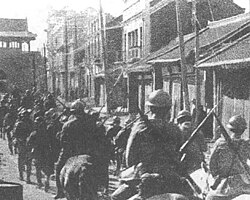
The full-scale invasion of 1937 was the culmination of years of Japanese encroachment. The tension escalated significantly on September 18, 1931, with the Mukden Incident, which led to the Japanese occupation of Manchuria. Throughout the early 1930s, Japan continued to push its borders, establishing puppet regimes and engaging in sporadic clashes with Chinese forces.
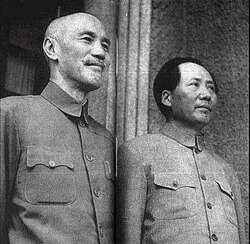
During this period, China was internally fractured by the Warlord Era and a burgeoning civil war between the Kuomintang (KMT), led by Chiang Kai-shek, and the Chinese Communist Party (CCP), led by Mao Zedong. However, the threat of Japanese imperialism eventually forced these rivals into a fragile "United Front" to defend their homeland.
Course of the Conflict
1937: The Outbreak of Full-Scale War
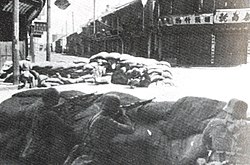
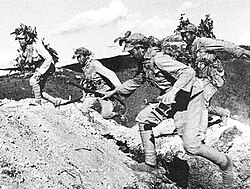
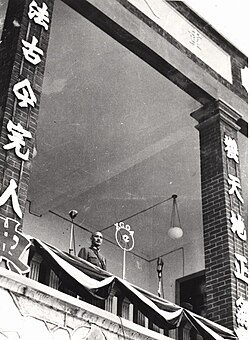
The catalyst for total war was the Marco Polo Bridge Incident on July 7, 1937. This clash sparked the Beiping–Tianjin campaign and led Chiang Kai-shek to formally announce a policy of national resistance.
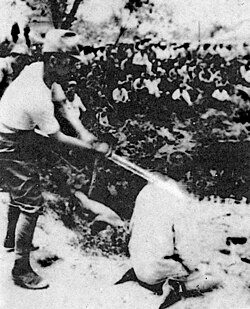
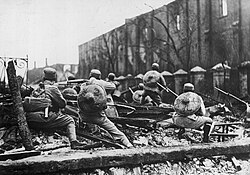
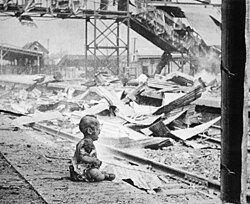
The war quickly intensified with the Battle of Shanghai, where Chinese troops fought desperately to hold defensive positions against Japanese landing forces. Despite fierce resistance, the city fell, leading to the subsequent capture of the capital, Nanjing. The fall of Nanjing was marked by the Nanjing Massacre, a period of mass killing and atrocities committed by the Imperial Japanese Army.
1938–1941: Strategic Retreat and Stalemate
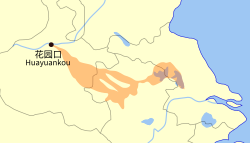
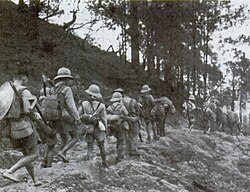
By 1938, Chinese forces began a strategic retreat to the interior to avoid total collapse. Major engagements occurred at Xuzhou and Wuhan. In a desperate attempt to slow the Japanese advance, Chinese forces triggered the Yellow River flood, a tactical decision that caused immense civilian suffering but hindered the enemy's progress.
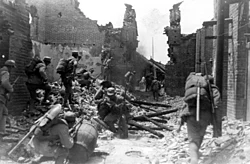
The war then entered a period of stalemate. Japan occupied the coastal cities and major rail lines, while the Chinese government relocated its capital to Chongqing. Japan attempted to break this deadlock through the "Three Alls Policy" (kill all, burn all, loot all) and relentless aerial bombardments of civilian centers.
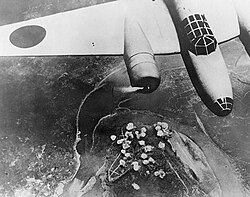
![Casualties of a mass panic during a June 1941 Japanese bombing of Chongqing. More than 5,000 civilians died during the first two days of air raids in 1939.[206]](/images/c6/ba/c6ba9904b51e1403b59ceeca063119cb7e2b67876dc455103ac7f76f0eefb36e.jpg)
1942–1945: Allied Entry and Conclusion
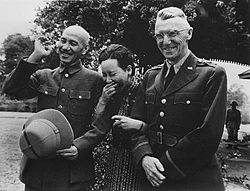
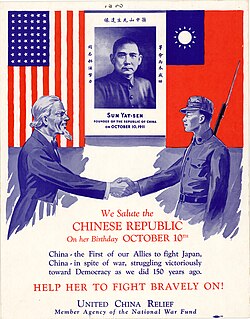
The entry of the United States and Great Britain into the war following the attack on Pearl Harbor transformed the conflict into the China Burma India (CBI) theater. The Allies provided critical foreign aid, and the American Volunteer Group (the "Flying Tigers") assisted in the air war.
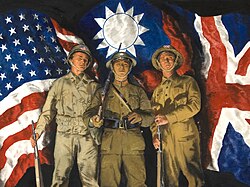
Despite a final major Japanese offensive known as Operation Ichi-Go in 1944, the tide had turned. The combination of Allied strategic bombing of Japan and the collapse of Japanese forces across the Pacific led to the final surrender on September 2, 1945.
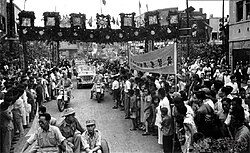
Military Tactics and Human Cost
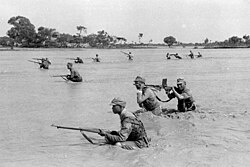
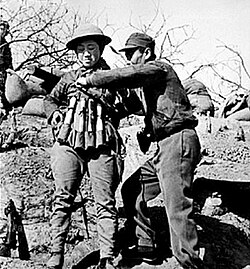
The war was characterized by extreme brutality. The Imperial Japanese Army utilized chemical and biological warfare, while Chinese forces employed guerrilla tactics and, in some instances, suicide attacks using explosive vests to destroy tanks.
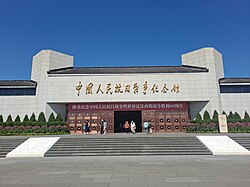
The human cost was catastrophic. Millions of Chinese soldiers and civilians perished, and Japanese forces suffered significant losses due to combat and disease. The scale of the tragedy is still commemorated today at sites like the Museum of the War of Chinese People's Resistance Against Japanese Aggression.
| Group | Estimated Strength (Peak) | Estimated Casualties/Deaths |
|---|---|---|
| Nationalists (KMT) | 5.7 Million (1945) | ~3.2 Million (Official Data) |
| Communists (CCP) | 1.2 Million (1945) | 446,736 – 584,267 |
| Empire of Japan | ~1.1 Million (Excl. Manchuria/Burma) | 2.4 – 3.0 Million (Total) |
| Civilians | N/A | 12 Million+ Deaths |
Frequently Asked Questions
What was the Marco Polo Bridge Incident?
The Marco Polo Bridge Incident was a clash between Japanese and Chinese troops on July 7, 1937, near Beijing. It served as the immediate trigger for the full-scale Second Sino-Japanese War.
Who were the primary leaders of the Chinese resistance?
The resistance was led by Generalissimo Chiang Kai-shek of the Kuomintang (KMT) and Mao Zedong of the Chinese Communist Party (CCP), who formed a United Front to fight the Japanese invasion.
What was the "Three Alls Policy"?
The "Three Alls Policy" was a scorched-earth strategy employed by the Imperial Japanese Army, summarized as "kill all, burn all, loot all," designed to destroy the support base of Chinese resistance.
How did the United States assist China during the war?
The United States provided military aid, financial support, and personnel, most notably through the American Volunteer Group (Flying Tigers) and the China Burma India theater operations.
What happened after the Japanese surrender in 1945?
Following the surrender, the fragile alliance between the KMT and CCP collapsed, leading to the resumption of the Chinese Civil War for control of the country.