Second Scholasticism and the School of Salamanca
Second Scholasticism, often referred to as Modern Scholasticism, was a powerful intellectual revival of the scholastic system of philosophy and theology during the 16th and 17th centuries. While it drew its roots from medieval Scholasticism, this second wave surpassed its predecessor in analytical complexity, scope, and the sheer volume of its literary and editorial production.
At the heart of this movement was the School of Salamanca, the primary theological, philosophical, and juridical center of Spain during the Modern era. By revisiting the works of Thomas Aquinas and the ancient classics—most notably Aristotle—scholars at Salamanca sought to prove that reason and Christian faith were entirely compatible. They did not operate in a vacuum; they engaged with the humanism of the Renaissance to address the pressing challenges of their time, such as the Protestant Reformation and the ethics of colonization.
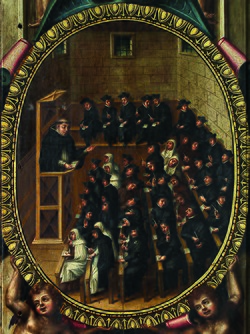
Key Facts
- Core Objective: To harmonize reason with faith using the framework of High Scholasticism (Thomism).
- Primary Hub: The University of Salamanca in Spain.
- Intellectual Impact: Laid the groundwork for modern international law and influenced early modern physics and mathematics.
- Key Figures: Included prominent Dominicans like Francisco de Vitoria and Jesuits like Francisco Suárez and Luis de Molina.
- Scope: Extended beyond theology into economics, jurisprudence, and metaphysics.
The Pioneers of the School of Salamanca
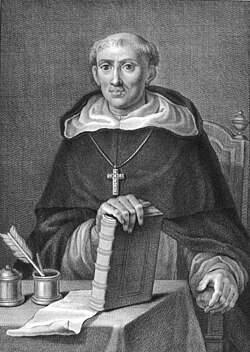
The movement was driven by a diverse group of thinkers, primarily from the Dominican and Franciscan orders. Francisco de Vitoria (c.1492–1546) stands as one of the most influential early exponents, helping to shift the focus of theological study toward the Summa theologiae of Thomas Aquinas.
Domingo de Soto and the Law of Nations
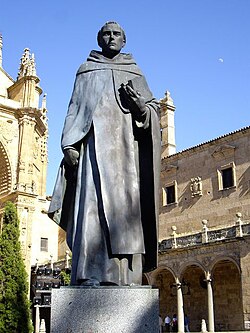
Domingo de Soto, a professor at Salamanca and confessor to Emperor Charles V, made significant contributions to legal theory. In his work De iustitia et de iure, he argued that reason (rationis ordinatio) should be the mechanism for evaluating laws. He viewed jus gentium (international law) as a part of positive law—the law of specific communities—rather than purely natural or moral law.
Beyond law, Soto's commentaries on Aristotle included a theory on the trajectory of missiles, which anticipated the laws of falling bodies later popularized by Galileo.
The Jesuit Contribution and Theological Disputes
The Society of Jesus (Jesuits) brought a new level of systematic rigor to Second Scholasticism, though their interpretations often clashed with the Dominicans.
Luis de Molina and the Question of Free Will
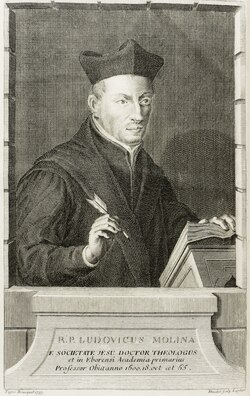
Luis de Molina is best known for his work on divine foreknowledge and human freedom. He proposed the concept of scientia media (middle knowledge), suggesting that God knows the outcome of human choices in any given hypothetical reality. This implied that human free choice is a precondition for divine predestination.
This view sparked a fierce debate with the Thomists of Salamanca, led by Domingo Báñez, who argued that predestination precedes human action. The dispute was so intense it required a papal tribunal from 1597 to 1607, which eventually permitted both theories.
Francisco Suárez: The Systematic Giant
Francisco Suárez is regarded as the culmination of the scholastic revival in Spain. His Disputationes metaphysicae became a standard text across Europe, influencing both Catholic and Protestant thinkers. Suárez is particularly noted for rejecting the Thomistic real distinction between essence and existence.
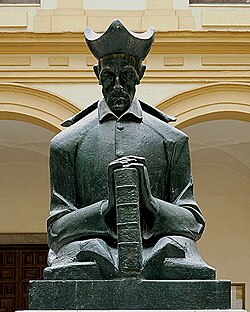
His work De Legibus, alongside the writings of Vitoria and Hugo Grotius, provided the intellectual foundations for modern international law. Suárez's ability to synthesize vast amounts of philosophical data made him the most systematic theologian among the early Jesuits.
Gabriel Vázquez and Later Influence
Gabriel Vázquez was a scholar of immense patristic learning whose massive commentary on the Summa Theologica influenced subsequent philosophy. Some historians suggest Vázquez may have been a source for Descartes's mind-body dualism and Immanuel Kant's arguments regarding morality.
Evolution and Diversification in the 17th Century
As the movement progressed, it branched into more specialized and sometimes controversial directions.
Antonio Pérez and the Return to Augustine
Antonio Pérez (1599–?) sought to blend the insights of St. Augustine with the sophisticated language of Aristotelian scholasticism. Known as the theologus mirabilis (extraordinary theologian), Pérez pushed Jesuit moral philosophy toward rigorism—a stricter approach to moral requirements—and a form of fideism that emphasized the authority of faith over rationalist conceptions.
Sebastián Izquierdo and Combinatorics
The reach of Second Scholasticism extended into mathematics through Sebastián Izquierdo. In his work Pharus scientiarum, Izquierdo discussed the number of k-combinations from a set of n elements, making him a pioneer in combinatorics. His work was later cited by Gottfried Wilhelm Leibniz.
Juan Caramuel y Lobkowitz
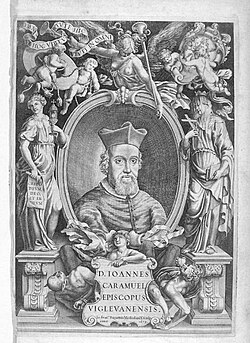
Juan Caramuel y Lobkowitz represented the cosmopolitan nature of the era. Educated in Spain and active in Louvain, Germany, and Prague, he engaged in high-level Catholic-Protestant controversies and served as a bishop in Italy, embodying the intellectual mobility of the 17th-century scholastic world.
Summary of Key Figures
| Scholar | Affiliation | Primary Contribution |
|---|---|---|
| Francisco de Vitoria | Dominican | Early foundations of international law and Thomism. |
| Domingo de Soto | Dominican | Legal reason and early physics (missile trajectories). |
| Luis de Molina | Jesuit | Concept of scientia media and human free will. |
| Francisco Suárez | Jesuit | Systematic metaphysics and international law. |
| Sebastián Izquierdo | Jesuit | Early developments in combinatorics. |
Frequently Asked Questions
What is the difference between Scholasticism and Second Scholasticism?
While medieval Scholasticism laid the groundwork, Second Scholasticism (16th-17th centuries) was a revival that was broader in scope, more analytically complex, and more engaged with historical criticism and contemporary issues like colonization.
What was the School of Salamanca?
The School of Salamanca was the primary center of theological, philosophical, and juridical thought in Spain during the Modern era, serving as the main engine for the dissemination of Second Scholasticism.
How did Second Scholasticism influence international law?
Through the works of Francisco de Vitoria, Domingo de Soto, and Francisco Suárez, the movement developed ethical and juridical frameworks for the law of nations (jus gentium), which helped form the basis of modern international law.
What was the 'De Auxiliis' controversy involving Luis de Molina?
It was a theological dispute between Jesuits (led by Molina) and Dominicans (led by Domingo Báñez) regarding the relationship between divine grace, predestination, and human free will.
Did Second Scholasticism contribute to science?
Yes. For example, Domingo de Soto's work on missile trajectories anticipated Galileo's laws of motion, and Sebastián Izquierdo made early contributions to the mathematical field of combinatorics.