Seagrass Ecosystems: The Evolutionary Journey and Biological Complexity of Marine Angiosperms
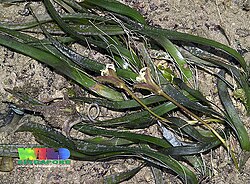
Seagrasses represent a remarkable biological phenomenon: flowering plants that have successfully returned to the sea. While most land plants evolved to thrive in terrestrial environments, these specialized marine angiosperms (flowering plants) have adapted to life beneath the waves, forming vast underwater meadows that serve as critical pillars for ocean health.
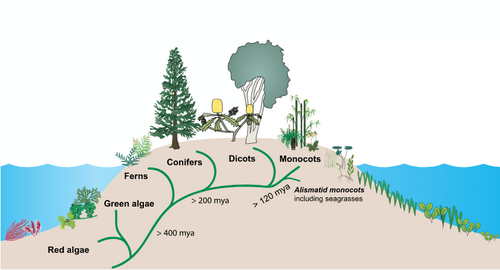
Spanning a temporal range from approximately 70 to 0 million years ago, the evolutionary history of seagrasses is a story of remarkable adaptation. They belong to the clade Embryophytes and the order Alismatales, having transitioned from marine origins to land and subsequently re-colonizing the ocean.
Key Facts
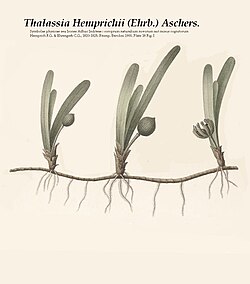
- Evolutionary History: Seagrasses are angiosperms that returned to the sea from land-based ancestors.
- Diversity: There are approximately 61 known species distributed across several families.
- Dominant Species: Zostera marina is the most abundant seagrass species in the Northern Hemisphere.
- Ecological Role: They are vital components of the "blue carbon" cycle and provide nursery habitats for marine life.
- Biological Complexity: Seagrasses function as a holobiont, a complex entity comprising the plant and its associated microbiome.
Taxonomy and Diversity
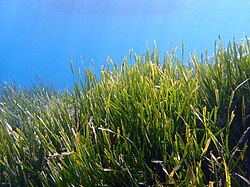
The classification of seagrasses reveals a diverse group of plants organized into several distinct families. Understanding this taxonomy is essential for studying the specific ecological niches they occupy.
| Family | Genera Included | Approximate Species Count |
|---|---|---|
| Zosteraceae | Phyllospadix, Zostera | 22 |
| Hydrocharitaceae | Enhalus, Halophila, Thalassia | 22 |
| Posidoniaceae | Posidonia | 2 to 9 |
| Cymodoceaceae | Amphibolis, Cymodocea, Halodule, Syringodium, Thalassodendron | 17 |
Major Genera
Within these families, certain genera play prominent roles. For instance, Halophila contains 19 species, while Zostera includes 16. The genus Posidonia is particularly noted for its significant presence in Mediterranean ecosystems.
Biological Processes and Life Cycles
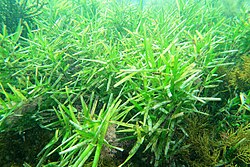
The survival of seagrass meadows depends on complex reproductive and physiological processes. Sexual recruitment—the process by which new individuals are added to a population through seeds—is a critical phase for species like Posidonia oceanica.
![Seeds from Posidonia oceanica.[41] (A) Newly released seeds inside a fruit, (B) one-week-old seeds. FP: fruit pericarp, NRS: newly released seeds, WS: 1-week-old seeds, H: adhesive hairs, S: seed, R1: primary root, Rh: rhizome, L: leaves.](/images/9f/74/9f74f470425b703d1368a744c42fe4d1e1ae10ba52644602517b636012c91cd1.png)
![The sexual recruitment stages of Posidonia oceanica:[41] dispersion, adhesion and settlement](/images/73/f7/73f7d852f1d6ea9d5a4cb0c2a807ea5a5fa9162c45240ea92b001cebdf014663.png)
The recruitment process involves several stages, including dispersion, adhesion to substrates, and eventual settlement. For Posidonia oceanica, this involves the release of seeds from a fruit, which may utilize adhesive hairs to secure themselves to the seabed.
![Structures of sulfated galactans from marine organisms.[12] Sulfated polysaccharide structures from left to right: red algae: Botryocladia occidentalis, seagrass: Ruppia maritima, sea urchin: Echinometra lucunter, tunicate: Styela plicata.](/images/4c/0d/4c0df3a0f257ad05b4a575bfbcce4316fa04e76709c27e6d0f411803df0319cb.jpg)
Environmental Adaptations
Seagrasses exhibit significant morphological and photoacclimatory responses to their environment. This means they can change their physical structure or how they use light to survive in different conditions, such as moving between intertidal (areas exposed at low tide) and subtidal (permanently submerged) zones.
![Morphological and photoacclimatory responses of intertidal and subtidal Zostera marina eelgrass[68]](/images/af/f2/aff27c614efe31b2bae31b6f469346719312d06409395e0f093cd1771ccd5cd9.png)
![Zostera marina seedling[81]](/images/6e/94/6e942d78c6136843bb34b4513a20649c901039eb7e69003837fa9e20488babf0.jpg)
The Seagrass Holobiont and Microbiome
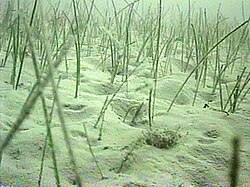
A seagrass plant does not exist in isolation. It functions as a holobiont, an integrated system consisting of the host plant and a vast community of microorganisms known as the microbiome. This includes bacteria living on the leaves (epibiotic) and within the tissues (endophytic), as well as those in the surrounding sediment.
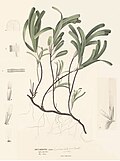
The interaction between the plant and its microbiome is deeply linked to nutrient cycling. The rhizosphere—the area of soil or sediment immediately surrounding the plant roots—is a site of intense biological activity. Through photosynthesis, seagrasses transport oxygen into the rhizosphere, which alters the chemical (redox) conditions of the sediment, differentiating it from the typically anoxic (oxygen-depleted) surrounding environment.
![The most important interconnected processes within the seagrass holobiont are related to processes in the carbon, nitrogen and sulfur cycles. Photosynthetically active radiation (PAR) determines the photosynthetic activity of the seagrass plant that determines how much carbon dioxide is fixed, how much dissolved organic carbon (DOC) is exuded from the leaves and root system, and how much oxygen is transported into the rhizosphere. Oxygen transportation into the rhizosphere alters the redox conditions in the rhizosphere, differentiating it from the surrounding sediments that are usually anoxic and sulfidic.[109][110]](/images/85/1c/851c52bc102f46430e35159556f79960ef396fb8301db1a2667fe858a3306d01.png)
Nutrient and Carbon Cycling
The interconnected processes within the holobiont involve the carbon, nitrogen, and sulfur cycles. Photosynthetically active radiation (PAR) drives the plant's ability to fix carbon dioxide, which in turn influences how much dissolved organic carbon (DOC) is released into the environment.
Ecological Importance and Habitat
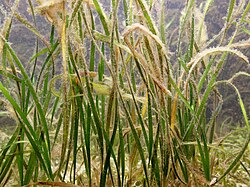
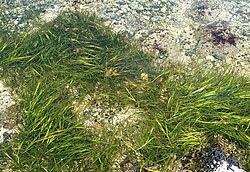
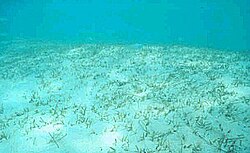
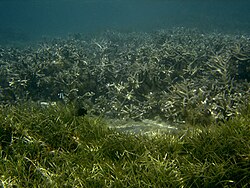
Seagrass meadows act as vital nursery habitats for a wide array of marine species. They provide shelter and food for everything from small invertebrates to large marine animals like turtles and various fish species.
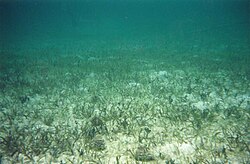
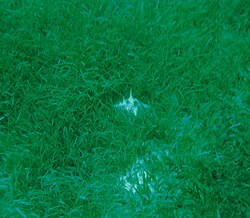
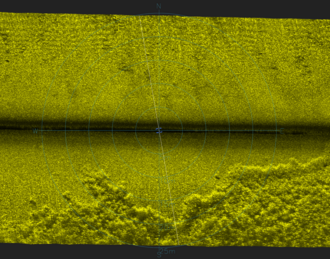
Beyond providing habitat, seagrasses are essential for blue carbon sequestration, meaning they capture and store atmospheric carbon in the ocean floor, helping to mitigate climate change. However, these ecosystems face significant threats and require active conservation efforts to ensure their survival.
Frequently Asked Questions
What is the difference between intertidal and subtidal seagrasses?
Intertidal seagrasses live in areas that are periodically exposed to the air during low tide, requiring adaptations to handle desiccation (drying out). Subtidal seagrasses remain permanently submerged under water.
Why are seagrasses called "blue carbon" contributors?
Seagrasses are highly efficient at capturing carbon dioxide through photosynthesis and storing it in their biomass and the surrounding sediments, making them a key component of the ocean's carbon sequestration process.
What is the seagrass holobiont?
The holobiont refers to the seagrass plant plus all the microscopic organisms (the microbiome) that live on, in, or around it, working together as a single functional unit.
How do seagrasses affect the sediment around them?
By transporting oxygen from their leaves down to their roots, seagrasses oxygenate the rhizosphere. This changes the chemical environment of the sediment, making it different from the surrounding oxygen-poor, sulfidic seabed.
What are the main threats to seagrass meadows?
While specific threats vary, seagrass ecosystems are generally vulnerable to environmental changes, including temperature extremes, turbidity (cloudiness of the water), and human-induced impacts like eutrophication.