Sea Urchins: Biology, Ecology, and Global Significance
Sea urchins are fascinating marine invertebrates belonging to the class Echinoidea. Known for their spiny exteriors and unique radial symmetry, these creatures have existed since the Ordovician period, adapting to nearly every corner of the ocean floor. From shallow intertidal zones to the deepest trenches on Earth, sea urchins play a pivotal role in maintaining the health of marine ecosystems.
These animals are part of the phylum Echinodermata, a group characterized by a water vascular system and a pentameral (five-part) body plan. While they may appear simple, their complex anatomy and ecological impact make them a subject of intense scientific study.
Key Facts
- Temporal Range: Present from the Ordovician period to the present day.
- Habitat: Found in most benthic (bottom-dwelling) habitats, including the hadal zone at depths of 6,850 meters.
- Dietary Role: Primary grazers that can significantly alter kelp forest ecosystems.
- Culinary Value: Their gonads, known as uni in Japan, are a high-value global delicacy.
- Longevity: Some species, such as the red sea urchin, can live for over 100 years.
Anatomy and Biological Systems
Musculoskeletal Structure
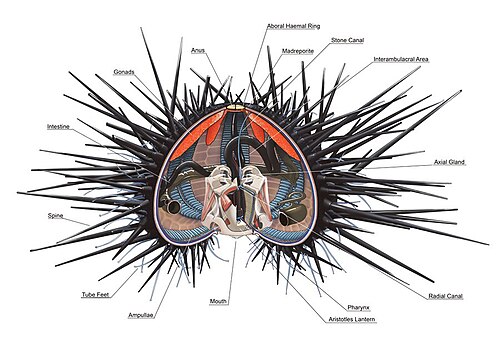
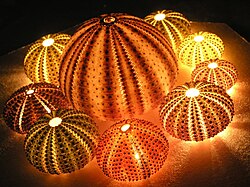
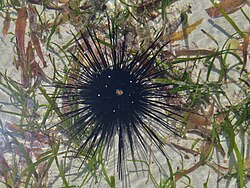
The primary body of a sea urchin is called the test, a hard shell composed of fused calcite plates. This structure provides protection while supporting the animal's spines and tube feet. The spines are used for protection and movement, with some families, like Cidaridae, possessing thick spines specifically for navigating soft seabeds.
Feeding and the "Aristotle's Lantern"
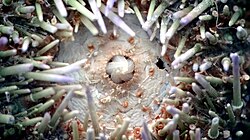
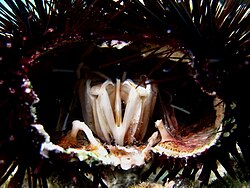
One of the most remarkable features of the sea urchin is its complex chewing apparatus, known as Aristotle's lantern. This system consists of five calcium carbonate teeth that are self-sharpening, allowing the urchin to scrape algae from rocks or chew through hard substrates.
Circulation, Respiration, and Senses
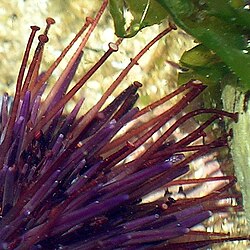
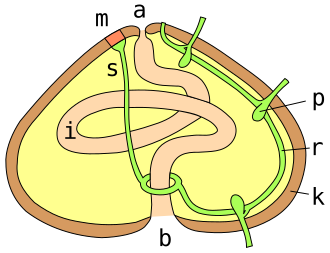
Sea urchins utilize a water vascular system to operate their tube feet, which are used for locomotion and attachment. Their internal systems include a radial canal and a madreporite (a perforated plate that allows water to enter the system). Interestingly, research suggests that sea urchins may use their entire body as a sensory organ to detect light and environmental changes.
Life Cycle and Development
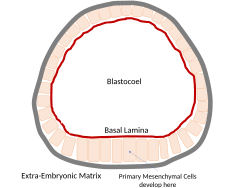
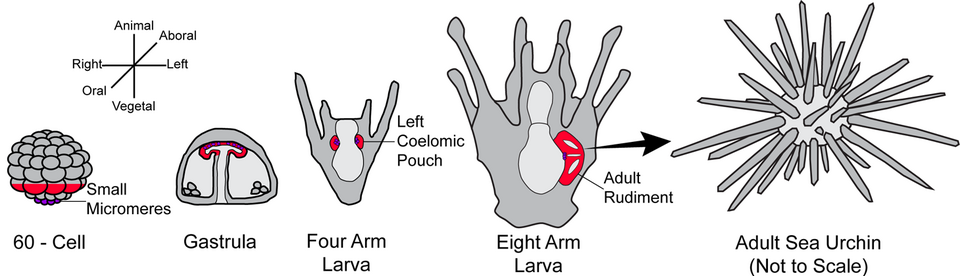
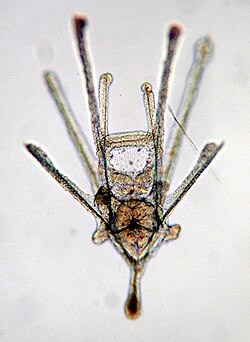
The development of a sea urchin is a complex process that begins with a blastula and progresses through a larval stage known as the pluteus. Unlike the adult's radial symmetry, the pluteus larva exhibits bilateral symmetry before metamorphosing into the adult form.
Ecology and Environmental Impact
Habitat Distribution
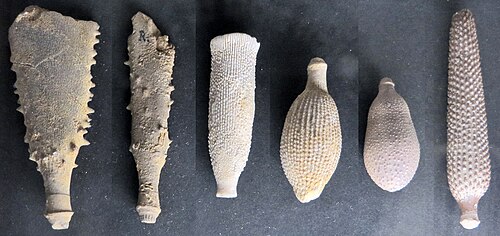
Sea urchins are found across a vast range of depths. While many inhabit shallow waters, others are specialized for the abyssal zone. The family Pourtalesiidae, for instance, consists of bottle-shaped irregular urchins found in the hadal zone, with records as deep as 6,850 meters in the Sunda Trench.
Urchin Barrens
In certain conditions, sea urchin populations can explode, leading to the creation of urchin barrens. This occurs when urchins overgraze kelp forests, stripping the seabed of vegetation and collapsing the local ecosystem. This phenomenon has been well-documented in Californian kelp forests involving the purple sea urchin (Strongylocentrotus purpuratus).
![A dense "formation" of purple sea urchins (Strongylocentrotus purpuratus); Ventura, California. The impact of this species of sea urchin on Californian kelp forests are well publicized.[49][50][51]](/images/85/7e/857e19e14d38af8319658012a3421d6ac48f2608444aa3d1cf5803c78da6693f.jpg)
Defenses and Predation
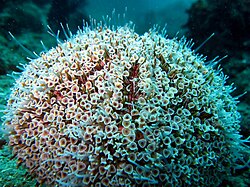
To protect themselves, sea urchins employ various strategies. Most rely on their spines, but some species, such as the flower urchin, are lethally venomous. Predators include wolf eels and saddle wrasses, which have evolved to bypass these defenses.
Human Interaction and Economic Value
Culinary Use
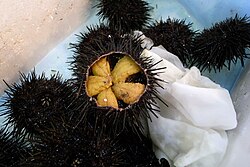
The gonads of sea urchins, often referred to as roe or corals, are highly prized delicacies. In Japan, this is known as uni and is served in sushi, sashimi, or as uni-don. Japan is the largest consumer, importing vast quantities from the United States and South Korea, which has led to concerns regarding overfishing.
Medical and Cultural Significance
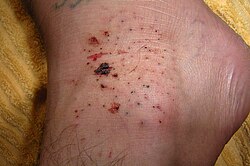
Beyond food, sea urchins have appeared in human history as amulets, with fossils found at Middle Saxon sites. In modern times, they are used in genomic research to study immune systems and tissue regeneration. However, contact with live urchins can cause injuries, often leaving purple-black skin stains from the animal's natural dyes.
![A fossil sea urchin found on a Middle Saxon site in Lincolnshire, thought to have been used as an amulet[99]](/images/be/c3/bec3756feddc7f5277b519c64868bd538b3a280ff5a9dc2061768f133d01df21.jpg)
Summary of Sea Urchin Characteristics
| Feature | Details |
|---|---|
| Classification | Class Echinoidea, Phylum Echinodermata |
| Key Anatomy | Calcite test, Aristotle's lantern, tube feet |
| Depth Range | Intertidal to 6,850 meters (Hadal zone) |
| Primary Diet | Algae and kelp (grazers) |
| Economic Part | Gonads (Uni) |
Frequently Asked Questions
What is Aristotle's lantern?
Aristotle's lantern is the complex dental apparatus of the sea urchin, consisting of five self-sharpening teeth used for scraping algae and boring into rock.
Are all sea urchins edible?
While many species are eaten, particularly for their gonads (uni), not all are safe. Some species, like the flower urchin, are lethally venomous and should be avoided.
What are urchin barrens?
Urchin barrens are areas of the ocean floor where sea urchin populations have become so dense that they overgraze the kelp forests, leaving the seabed nearly devoid of vegetation.
How deep can sea urchins live?
Sea urchins inhabit a wide range of depths, with some irregular species in the family Pourtalesiidae found as deep as 6,850 meters in the Sunda Trench.
How long do sea urchins live?
Longevity varies by species, but some, such as the red sea urchin (Strongylocentrotus franciscanus), have been confirmed to live for over 100 years.