Sceptres: The Global History of Sovereign Authority
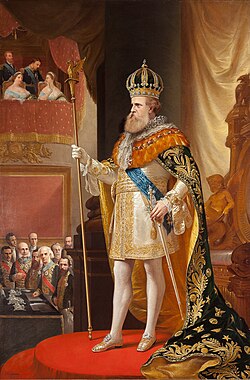
A sceptre (spelled scepter in American English) is a ceremonial staff or wand held by a ruling monarch. More than a mere accessory, it serves as a critical piece of royal or imperial insignia, acting as a physical manifestation of sovereign authority and the right to rule.
Key Facts
- Definition: A staff or wand signifying the sovereign authority of a monarch.
- Ancient Origins: Used in Egypt (e.g., the heqa-sceptre) and Mesopotamia (known as ĝidru or ḫaṭṭum).
- Greco-Roman Use: Evolved from a general symbol of authority for elders and judges to the sceptrum Augusti of Roman emperors.
- Indian Tradition: The Sengol represents a just rule and was installed in the new Indian Parliament in 2023.
- Christian Influence: Medieval European sceptres often replaced animal motifs with crosses or religious symbols.
Antiquity: Egypt and Mesopotamia
In Ancient Egypt, staves were primary signs of authority. While many were full-length staffs, they are categorized as sceptres due to their symbolic function. One of the earliest examples was found in the 2nd Dynasty tomb of Khasekhemwy in Abydos. Pharaoh Anedjib is also depicted with a mks-staff, though the heqa-sceptre, or "shepherd's crook," remains the most enduring symbol of Egyptian kingship.
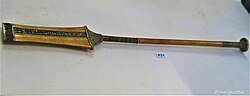
Similarly, in Mesopotamia, the sceptre was central to the insignia of both gods and sovereigns. Known as ĝidru in Sumerian and ḫaṭṭum in Akkadian, these objects appear consistently across literary texts and iconography throughout the region's history.
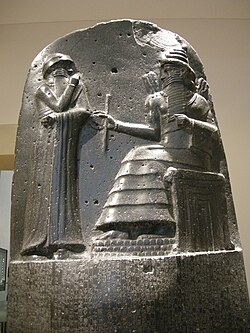
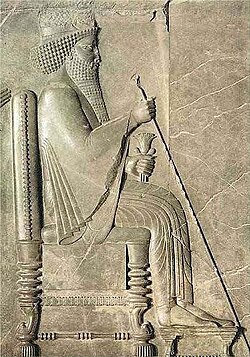
The significance of the sceptre also extends to early religious texts. The Biblical Book of Genesis mentions the sceptre of Judah, and the Book of Esther describes the golden sceptre of the King of Persia, which the queen had to touch to obtain favor.
The Greco-Roman World
Among the early Greeks, the skeptron (staff or baton) was used by respected elders, military leaders, priests, and judges. In mythology, the sceptres of Zeus and Hades were topped with birds. This association with Zeus granted kerykes (heralds) a status of inviolability, a precursor to modern diplomatic immunity.
The Etruscans further refined the sceptre, creating magnificent gold versions with intricate ornamentation. These influenced the Romans, who used an ivory sceptrum eburneum to denote consular rank or the status of an imperator (victorious general). During the Roman Empire, the sceptrum Augusti—often ivory tipped with a golden eagle—became the definitive symbol of the emperor.
The Sceptre in Indian Tradition
In India, the concept of the sceptre is tied to ethics and justice. The ancient Tamil work Tirukkural (dated before the 5th century CE) distinguishes between the Sengol (the just sceptre) and the Kondungol (the cruel sceptre). According to this treatise, it is the just sceptre, not the spear, that binds a king to his people.

This tradition continued with dynasties like the Chola kings. In 1947, a Sengol was presented to Jawaharlal Nehru to symbolize the transfer of power. While previously displayed in the Allahabad Museum as a "Golden walking Stick," the gold-plated sceptre was installed in the new Indian Parliament in 2023, though some historians debate the official nature of the 1947 transfer event.
Christendom and European Monarchy
With the rise of Christianity, the eagle finials of the Roman era were often replaced by crosses. In England, two sceptres have been used since the time of Richard I: one tipped with a cross and another with a dove. France utilized a sceptre tipped with a fleur de lys alongside the main de justice, which featured an open hand of benediction.
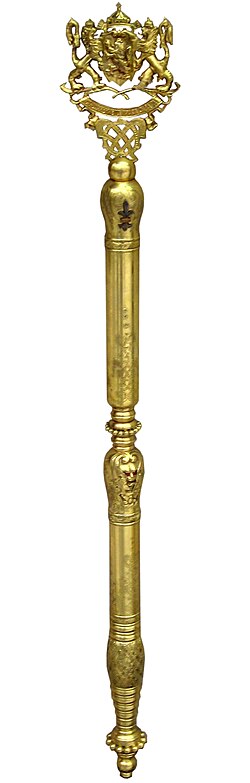
Some European sceptres featured unique religious shrines. A Scottish sceptre made in France around 1536 for James V contains images of the Virgin Mary, Saint Andrew, and Saint James the Great. In the English tradition, the original regalia of Saint Edward the Confessor were destroyed during the Commonwealth in 1649; the current sceptres were created for the coronation of Charles II.
Summary of Sceptre Traditions
| Culture/Region | Key Term/Type | Primary Symbolism/Feature |
|---|---|---|
| Ancient Egypt | Heqa-sceptre | Shepherd's crook; royal authority |
| Mesopotamia | Ĝidru / Ḫaṭṭum | Insignia of gods and sovereigns |
| Roman Empire | Sceptrum Augusti | Ivory with golden eagle; imperial power |
| India (Tamil) | Sengol | Just rule and ethical governance |
| England | Cross and Dove | Dual symbols of religious and royal authority |
| France | Fleur de lys / Main de justice | Dynastic purity and judicial benediction |
Frequently Asked Questions
What is the difference between a sceptre and a mace?
While both are ceremonial staffs, a sceptre is specifically a symbol of the sovereign's personal authority as a monarch, whereas a mace is often used as a symbol of delegated authority or as a guard's weapon turned ceremonial object.
What does the Sengol represent in Indian culture?
The Sengol represents the "just sceptre." According to the Tirukkural, it symbolizes the ethical behavior of a ruler and the bond of justice between the king and the people.
Why did Roman sceptres feature eagles?
The eagle was a symbol of Zeus (and later Jupiter), the king of the gods. By topping the sceptrum Augusti with an eagle, Roman emperors aligned their earthly power with divine authority.
Which English sceptres are currently in use?
The current English coronation sceptres, including those for the queen consort, were created for the coronation of Charles II after the original regalia were destroyed in 1649.
How did the sceptre evolve in Christian Europe?
The sceptre evolved by incorporating Christian iconography, most notably replacing pagan animal symbols with the cross, and in some cases, adding shrines or figures of saints.