Sawflies: The Diverse and Ancient Suborder Symphyta
Sawflies are a fascinating group of wasp-like insects belonging to the suborder Symphyta within the order Hymenoptera. While they may resemble wasps at a glance, they possess distinct biological characteristics that set them apart from the more familiar Apocrita (the group containing true wasps, bees, and ants). Having existed since the Triassic period, sawflies represent an ancient lineage of insects with a vast evolutionary history.
The common name "sawfly" is derived from the female's ovipositor—the organ used to lay eggs. In this suborder, the ovipositor has a serrated, saw-like appearance, which the female uses to cut into plant tissue to deposit her eggs. This specialized tool is a defining feature of the group, particularly within the massive Tenthredinoidea superfamily.
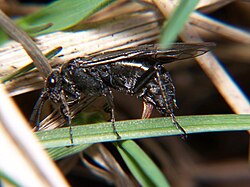
Key Facts
- Taxonomy: Suborder Symphyta, Order Hymenoptera.
- Diversity: Approximately 8,000 described species across more than 800 genera.
- Defining Feature: Lack of a narrow "wasp waist," possessing an unmodified abdomen instead.
- Diet: Most species are herbivorous, though some (Orussoidea) are parasitoids.
- Size Range: Typically 2.5 to 20 mm, though fossil records show much larger prehistoric species.
- Economic Impact: Certain species are significant pests in forestry and agriculture.
Physical Characteristics and Appearance
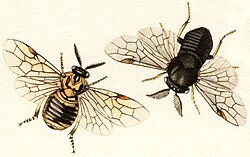
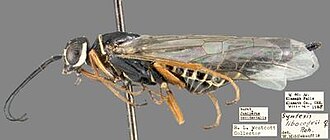
Unlike the highly specialized wasps we see in gardens, most sawflies are relatively stubby and soft-bodied, often flying with less agility. One of the most significant anatomical differences is the absence of the narrow waist found in other Hymenoptera; in sawflies, the first two segments of the abdomen appear continuous with the rest of the body.
Size varies significantly across the suborder. While many species are quite small, others can reach up to 20 mm. Interestingly, the fossil record reveals that sawflies were once much larger; the Mesozoic species Hoplitolyda duolunica reached a body length of 55 mm with a massive wingspan of 92 mm.
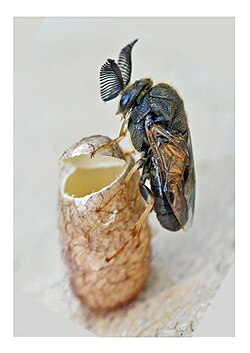
Some species have evolved Batesian mimicry, a survival strategy where a harmless insect evolves to look like a dangerous one. Certain sawflies mimic the coloration of wasps or bees to deter predators, leading many to mistake their saw-like ovipositor for a stinging organ.
Taxonomy and Classification
The classification of Symphyta has evolved significantly over time. Early studies relied on morphology and behavior, but modern molecular methods have refined our understanding. As of 2013, the suborder is treated as containing nine superfamilies and 25 families.
The Tenthredinoidea superfamily is by far the most dominant, containing roughly 7,000 of the known species. Within this group, the family Tenthredinidae is the largest, boasting approximately 5,500 species. Other notable superfamilies include Xyeloidea, Siricoidea, and the parasitoid Orussoidea.
| Superfamily | Notable Families | Key Characteristics |
|---|---|---|
| Tenthredinoidea | Tenthredinidae, Argidae, Cimbicidae | Largest group; mostly herbivorous. |
| Siricoidea | Siricidae | Includes wood-boring species. |
| Orussoidea | Orussidae | Primarily parasitoids. |
| Xyeloidea | Xyelidae | One of the most ancient lineages. |
| Pamphilioidea | Pamphiliidae | Includes various leaf-feeding species. |
Ecology and Behavior
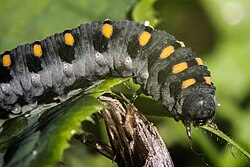
The majority of sawflies are herbivorous, playing a significant role in their ecosystems as consumers of plant matter. Their larvae are often the most visible stage, frequently appearing as caterpillar-like organisms that feed on leaves or stems.
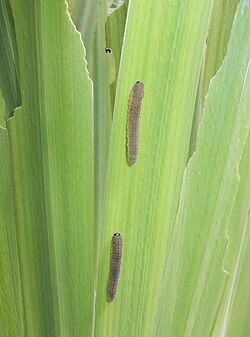
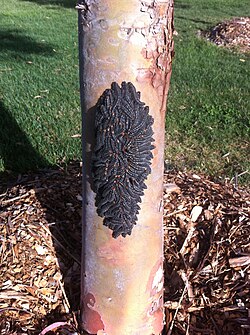
To survive predation from birds, small mammals like shrews, and other insects, sawfly larvae have developed several anti-predator adaptations. Some species can regurgitate an irritating liquid to repel attackers, while others utilize "safety in numbers" by clustering together in large groups.
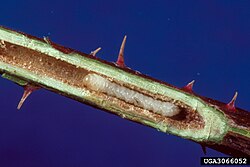
Larval forms vary widely. Some are highly visible, while others may live protected within plant tissues. For example, the rose stem sawfly larva lives within the stems of its host plant.
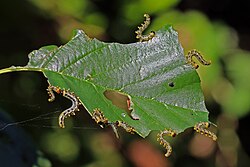
The life cycle of a sawfly typically involves several stages, including egg, larva, pupa, and adult. The diversity of these stages is reflected in the wide variety of larval appearances across different genera.
Economic Impact and Forestry
While many sawflies are harmless to humans, certain species are major economic pests, particularly in the forestry sector. Species within the Diprionidae family, such as the pine sawfly (Diprion pini), can cause devastating outbreaks.
In large-scale outbreaks, such as those seen in Finland between 1998 and 2001, larvae can defoliate hundreds of thousands of hectares. When trees are stripped of their leaves late in the growing season, they may lack the strength to survive the winter, leading to mortality rates as high as 75%. Similarly, outbreaks in Eucalyptus trees can cause stunting, dieback, or death in young plants.
To manage these pests, scientists often turn to biological control. This involves using the natural enemies of the sawflies—such as specific species of Hymenoptera or Diptera parasites—to regulate their populations. This method has been successfully used to control various sawfly species throughout the 20th century.
Frequently Asked Questions
How can I tell a sawfly apart from a wasp?
The most reliable way to distinguish them is by looking at the waist. Wasps (Apocrita) have a very narrow, constricted waist, whereas sawflies (Symphyta) have a broad, continuous abdomen without that constriction.
Are sawflies dangerous to humans?
Most sawflies are not dangerous to humans. While females have a saw-like ovipositor for laying eggs, they do not possess a stinger for defense or attacking humans.
Do all sawflies eat plants?
The vast majority are herbivorous, but there are exceptions. Members of the superfamily Orussoidea are parasitoids, meaning they live on or in other insects.
Why are sawflies considered pests?
Certain species can undergo massive population outbreaks that lead to the complete defoliation of trees, particularly in pine and eucalyptus forests, which can kill the trees or severely stunt their growth.
What are the natural enemies of sawflies?
Sawflies are preyed upon by birds, small mammals like shrews, and various other insects, including certain species of flies and wasps that act as parasitoids.