Sanjak of Alexandretta: The Transition from Syrian Mandate to Hatay Province
The Sanjak of Alexandretta (known in Turkish as İskenderun Sancağı) was a strategic administrative district within the French Mandate of Syria. Comprising the districts of Alexandretta (İskenderun) and Antioch (Antakya), this region became a focal point of geopolitical tension between France, Turkey, and the emerging Syrian state during the interwar period.
The region's unique status began with the 1921 Treaty of Ankara, which established a special administrative regime. This treaty ensured that Turkish inhabitants could develop their culture and that the Turkish language received official recognition, marking the start of a complex political journey toward autonomy and eventual annexation.
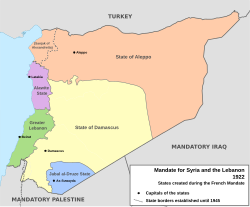
Administrative Evolution and Autonomy
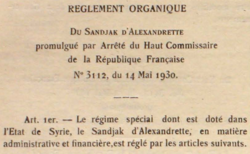
Throughout the 1920s, the sanjak's administrative ties shifted. In 1923, it was attached to the State of Aleppo, and by 1925, it became part of the combined State of Syria. However, it maintained a federal administrative status known as the régime spécial.
Political instability peaked following the 1936 elections. When two members of parliament were elected on a platform favoring Syrian independence from France, the result sparked communal riots and intense media debates in both Turkey and Syria. To resolve the crisis, the League of Nations brokered an arrangement in November 1937. Under this new statute, the sanjak was defined as "distinct but not separated" from the French Mandate of Syria diplomatically, while its defense was linked to both France and Turkey.
Demographics and Political Representation
The province was characterized by an ethnic plurality, consisting of Turks, Arabs, and several minority groups. While the population was diverse, political power was not evenly distributed; Turks were overrepresented in the provincial assembly, holding more than half of the seats. Furthermore, minority deputies were required to take their oaths of office in Turkish.
| Ethnic Group | Inhabitants | Percentage |
|---|---|---|
| Turks | 85,800 | 39% |
| Alawites | 61,600 | 28% |
| Armenians | 24,200 | 11% |
| Sunni Arabs | 22,000 | 10% |
| Melkites, Greeks, and other Christians | 17,600 | 8% |
| Circassians, Jews, Kurds | 8,800 | 4% |
| Total | 220,000 | 100% |
The Path to Annexation (1938–1939)
In 1938, a French-led census under international supervision determined the allocation of 40 seats in the sanjak assembly. The distribution favored the Turkish population with 22 seats, followed by Alawites (9), Armenians (5), Sunni Arabs (2), and Greek Orthodox (2).
Military tensions escalated in July 1938. Following agreements between France and Turkey to co-defend the region with 2,500 troops each, Turkish intervention forces entered İskenderun on July 5.
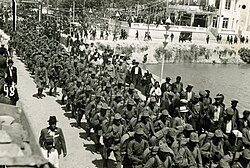
Despite the registration of 57,008 voters by July 22, 1938, no formal elections were held. Instead, a transition was managed by Turkish and French authorities. Tayfur Sökmen, appointed by Mustafa Kemal Atatürk, arrived in Antakya on August 25, 1938, to lead the transition.
The Hatay State
On September 2, 1938, the assembly proclaimed the creation of the Hatay State. This entity existed for one year under joint military supervision. The government was under Turkish control, led by President Tayfur Sökmen and Prime Minister Dr. Abdurrahman Melek, both of whom were members of the Turkish parliament.
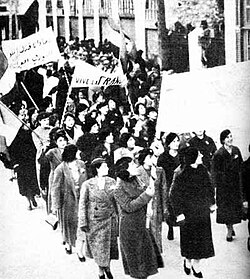
The transition concluded on June 29, 1939, when the Hatay legislature voted to disestablish the state and join Turkey following a referendum. This move sparked significant protests in Damascus, where demonstrators expressed their opposition to the loss of the territory.
Key Facts
- Original Status: A sanjak of the French Mandate of Syria consisting of Alexandretta and Antioch.
- Legal Basis: The 1921 Treaty of Ankara granted the region a special administrative regime.
- Demographics: The 1936 census recorded a population of 220,000, with Turks as the largest group (39%).
- Hatay State: A short-lived independent state (1938–1939) that served as a transition to Turkish rule.
- Final Outcome: The region became the Hatay Province of Turkey in 1939.
Frequently Asked Questions
What was the Sanjak of Alexandretta?
It was an administrative district in the French Mandate of Syria, comprising the areas of İskenderun and Antakya, which held a special autonomous status due to its diverse ethnic composition.
Why was the region given a "special administrative regime"?
Under the 1921 Treaty of Ankara, this regime was established to protect the cultural development of the Turkish inhabitants and ensure the official recognition of the Turkish language.
Who led the transition to the Hatay State?
The transition was led by Tayfur Sökmen, who was appointed by Atatürk to serve as the president of the newly proclaimed Hatay State.
How did the Sanjak of Alexandretta become part of Turkey?
After a year of existence as the autonomous Hatay State under joint French-Turkish supervision, the legislature voted to join Turkey in June 1939 following a referendum.
What was the ethnic makeup of the region in 1936?
The population was a plurality of Turks (39%), Alawites (28%), Armenians (11%), Sunni Arabs (10%), and other Christian and minority groups (12%).