Sandgrouse: Masters of Arid Landscapes
Sandgrouse are a specialized family of sixteen bird species, known scientifically as Pteroclidae, belonging to the order Pterocliformes. These ground-dwelling birds are perfectly adapted for life in treeless, open environments, including vast plains, savannahs, and semi-deserts. Their distribution spans across northern, southern, and eastern Africa, Madagascar, the Middle East, and India, extending through central Asia.
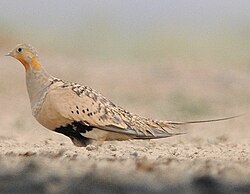
While most species remain within these arid zones, some exhibit remarkable range extensions. The black-bellied and pin-tailed sandgrouse can be found in France and the Iberian Peninsula, and Pallas's sandgrouse is known for occasional large-scale irruptions—sudden movements of a population into areas outside their normal range—which have historically brought them as far as the United Kingdom and Ireland.
Key Facts
- Habitat: Restricted to open, treeless country such as semi-deserts and savannahs.
- Water Transport: Specialized belly feathers allow males to carry 15 to 20 milliliters of water to their chicks.
- Diet: Primarily seed-eaters, though they may consume green shoots, berries, and insects.
- Social Structure: Highly gregarious, often feeding and drinking in flocks of up to 100 birds.
- Classification: Divided into two genera: Syrrhaptes (Central Asian species) and Pterocles (African and Asian species).
Physical Characteristics and Adaptations
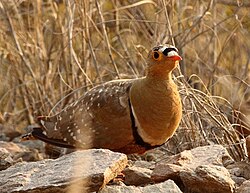
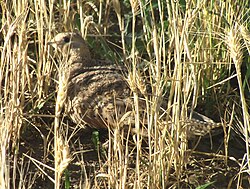
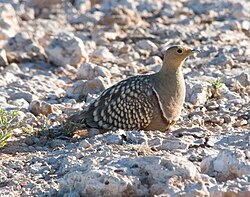
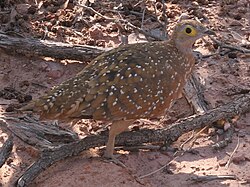
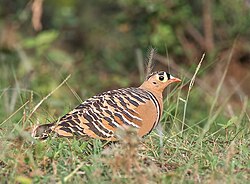
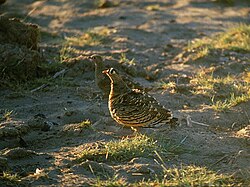
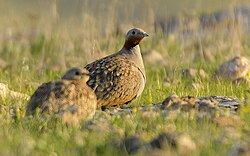
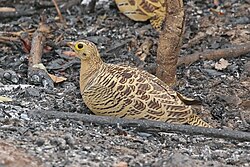
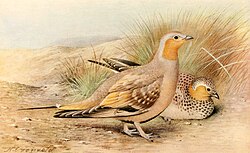
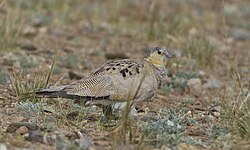
Sandgrouse possess sturdy, compact bodies and small heads reminiscent of pigeons. They typically range from 24 to 40 centimeters in length and weigh between 150 and 500 grams. To survive in harsh environments, they have evolved cryptic plumage—shades of sandy brown, grey, and buff that allow them to blend seamlessly into the dusty landscape.
Their physiology is built for efficiency and survival. Powerful wing muscles and long, pointed wings enable rapid take-offs and sustained, fast flight. A dense layer of under down provides critical insulation against extreme temperature fluctuations. One of their most extraordinary adaptations is found in the belly feathers, which can absorb and retain water, enabling adults to transport moisture to chicks located miles away from the nearest water source.
Genus Differences
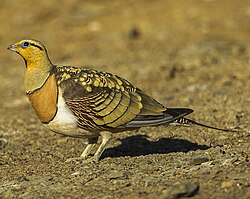
There are distinct physical differences between the two genera. Members of Syrrhaptes have feathers on both their legs and toes and lack hind toes. In contrast, members of Pterocles have feathers only on the front of their legs, no feathers on their toes, and rudimentary hind toes that remain raised off the ground.
Distribution and Habitat
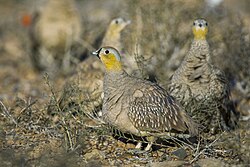
The Syrrhaptes genus is found in the steppes of central Asia, ranging from the Caspian Sea through Mongolia, Tibet, and southern Siberia to northern and central China. The Pterocles genus is more widespread, primarily inhabiting the drier regions of Africa, the Middle East, and western Asia, with the Madagascan sandgrouse being endemic to Madagascar.
Behavior and Ecology
Diet and Foraging
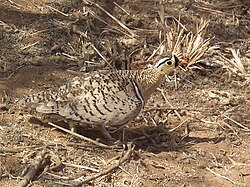
Sandgrouse are primarily granivores, focusing on seeds, particularly those from leguminous plants. They also eat bulbs, berries, and occasionally insects like termites and ants during the breeding season. To aid digestion, they swallow grit to help the gizzard grind up tough seeds.
To minimize competition, different species may employ different foraging techniques. For example, in Namibia, the double-banded sandgrouse feeds methodically, while the Namaqua sandgrouse feeds rapidly, flicking soil aside with its beak.
Watering Rituals
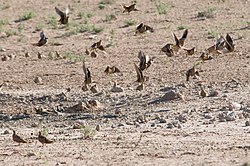
Because of their dry diet, regular access to water is vital. Sandgrouse are highly synchronized; thousands of birds may converge on a single watering hole from across hundreds of square miles. They drink by sucking water into the beak and letting it flow into the crop, a process that allows them to store enough water for 24 hours in just a few seconds.
To avoid predators, they prefer watering sites with open topography that lacks cover for mammals. Some species exhibit extreme endurance; the Burchell's sandgrouse in the Kalahari Desert may travel over 100 miles (160 km) daily to reach water.
Breeding and Life Cycle
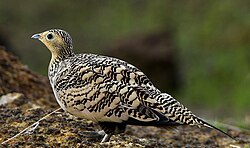
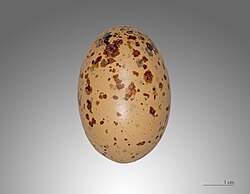
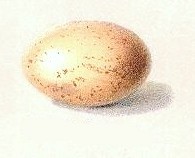
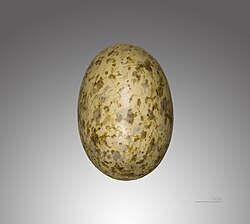
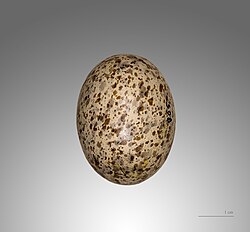
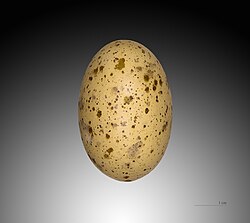
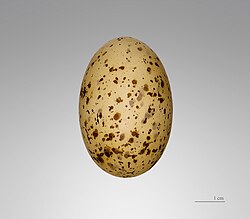
Sandgrouse are monogamous, and their breeding season typically follows the rainy season when seed crops are abundant. They nest in simple depressions in the ground, occasionally lined with dry foliage. A typical clutch consists of three cryptic eggs, which are incubated sharedly: males usually take the night shift, while females incubate during the day.
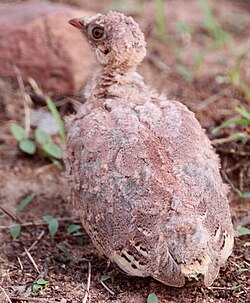
The eggs hatch after 20 to 25 days, producing precocial young—chicks that are relatively mature and mobile from the moment of hatching.
Taxonomy and Classification
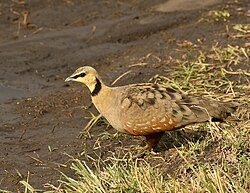
The taxonomic history of the sandgrouse is complex. They were once grouped with Galliformes (true grouse) due to superficial similarities, a result of convergent evolution (where unrelated species evolve similar traits). They were later linked to Columbiformes (pigeons) due to their drinking methods. Modern DNA studies, including work by Fain and Houde (2004) and Hackett et al. (2008), place them in the clade Columbimorphae, suggesting a closer relationship to pigeons and mesites.
Species Summary
The following table provides an overview of selected sandgrouse species and their distributions.
| Common Name | Scientific Name | Primary Range | Conservation Status |
|---|---|---|---|
| Pin-tailed Sandgrouse | Pterocles alchata | North West Africa, Middle East, Kazakhstan | Least Concern |
| Namaqua Sandgrouse | Pterocles namaqua | Southern Africa (Angola to South Africa) | Least Concern |
| Black-bellied Sandgrouse | Pterocles orientalis | NW Africa, Iberian Peninsula, Central Asia | Least Concern |
| Pallas's Sandgrouse | Syrrhaptes paradoxus | Central Asian steppes and mountains | Least Concern |
| Tibetan Sandgrouse | Syrrhaptes tibetanus | Tibet, Central China, Central Asia | Least Concern |
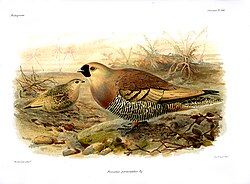
| Madagascar Sandgrouse | Pterocles personatus | Madagascar | Least Concern |
Frequently Asked Questions
How do sandgrouse transport water to their young?
Adult sandgrouse, particularly males, have specialized belly feathers that can absorb and retain between 15 and 20 milliliters of water. They soak these feathers at a watering hole and then fly back to their chicks to provide them with moisture.
Why are sandgrouse not commonly hunted as game birds?
Sandgrouse are generally not sought after as game because they are not considered particularly palatable, although they are sometimes taken in large numbers at watering sites.
What is the difference between the two sandgrouse genera?
The genus Syrrhaptes consists of Central Asian species with feathers on their toes and no hind toes. The genus Pterocles includes African and Asian species with feathers only on the front of the legs and rudimentary hind toes.
Are any sandgrouse species endangered?
Most species are listed as Least Concern. However, there have been localized range contractions in Europe, and a subspecies of the chestnut-bellied sandgrouse (P. e. floweri) is thought to be extinct after last being seen in 1979.
How do sandgrouse protect themselves from predators while drinking?
They use safety in numbers; by drinking in massive, synchronized flocks, it becomes difficult for predators to target a single bird. They also carefully choose watering sites with open topography to avoid mammalian predators hiding in cover.