San José: The Vibrant Heart of Costa Rica
Nestled in the mid-west of the Central Valley, San José serves as the capital and largest city of Costa Rica. More than just a political seat, it is the nation's primary economic engine, a major transportation hub, and the focal point of the country's cultural identity. Named in honor of Joseph of Nazareth, the city is a bustling metropolis that balances urban development with the natural beauty of its surrounding highlands.
The city functions as both the capital of the nation and the capital of the San José Province. While the municipal land area covers 44.62 square kilometers, it is the core of the Greater Metropolitan Area, which includes neighboring cities like Alajuela, Heredia, and Cartago, housing a combined population of over 2 million people.
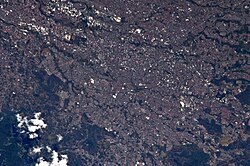
Key Facts

- Nickname: Chepe ("Joe")
- Motto: Ad Meliora ("Towards better things")
- Elevation: 1,030 meters (3,380 feet)
- Population: 352,381 (City estimate, 2022)
- HDI: 0.828 (Very High)
- Climate: Tropical wet and dry (Aw)
History and Governance
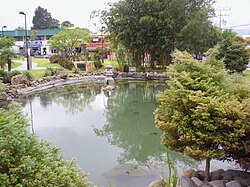
San José has a unique origin compared to other regional capitals. Unlike Cartago, it was not founded by a formal decree, meaning it initially lacked a city government. It wasn't until the Constitution of Cádiz in 1812 that the city established its first municipal administration. After a brief period of instability under the Spanish crown, the municipal government was restored in 1820, and San José officially became the capital of Costa Rica on May 16, 1823.
Today, the city is governed by a Mayor and a Municipal Council. The current mayor (2024–2028) is Luis Diego Miranda Méndez of the Together San José Party (PJSJ). The Municipal Council consists of 11 seats, with members known as regidores, who are elected every four years to manage the city's affairs.
Demographics and Quality of Life
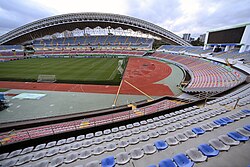
The people of San José, known as Josefinos, live in one of the most densely populated areas of the country. As of 2022, the city's population grew to 352,381, reflecting a steady increase from the 2011 census of 288,054. The population is predominantly urban, with a balanced gender ratio of approximately 0.92 men per woman.
San José is recognized as one of the safest cities in Latin America. The city and the nation have seen significant reductions in crime indices over the last decade. Furthermore, the city is an educational powerhouse, serving as the hub for numerous public and private universities, contributing to Costa Rica's status as having the highest education levels in Central America.
Climate and Environment
The city experiences a tropical wet and dry climate (classified as Aw under the Köppen system). This means the city sees distinct rainy and dry seasons. Precipitation is highly variable, ranging from a dry low of 6.3 mm in the driest month to a peak of 355.1 mm in the wettest month (September). Temperatures remain relatively stable throughout the year, with April being the warmest month (average 23.7°C) and October the coolest (average 21.8°C).
Major Landmarks and Culture
San José is rich in artistic and historical sites, offering a blend of neoclassical architecture and modern design.
Theaters and Museums
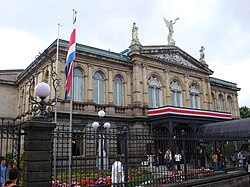
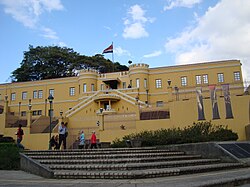
The National Theater of Costa Rica stands as one of the city's most iconic architectural achievements. For those interested in history and art, the city offers a diverse array of museums, including the National Museum of Costa Rica, the Museum of Pre-Columbian Gold, and the Museum of Jade.
Parks and Public Spaces
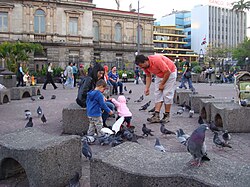
Green spaces are integral to the city's layout. The National Park and Morazán Park (which features the Neoclassical Temple of Music) provide serene escapes. The Simón Bolívar Zoo is the city's only zoo, showcasing both native and exotic species. For social gatherings, the Plaza de la Cultura and Plaza de la Democracia serve as central meeting points.
Urban Infrastructure
In an effort to modernize its logistics, San José began installing thousands of street signs and plaques in 2012 to address a long-standing lack of proper street naming, which had previously caused significant economic losses due to mail delivery issues.
City Overview Summary
| Category | Detail |
|---|---|
| Founded | c. 1739 |
| Capital Status | Since May 16, 1823 |
| Metro Population | ~3,160,000 |
| Metro GDP (PPP) | $30.2 billion (2023) |
| Per Capita GDP | $20,700 |
| Time Zone | UTC-06:00 (CST) |
Frequently Asked Questions
What is the nickname of San José?
The city is affectionately known as "Chepe," which is a colloquial version of the name "Joe."
When did San José become the capital of Costa Rica?
San José officially became the capital on May 16, 1823, making it one of the youngest capital cities in Latin America.
What is the climate like in San José?
It has a tropical wet and dry climate. While temperatures are fairly consistent year-round, there is a significant difference in rainfall between the dry and wet seasons.
Is San José a safe city for visitors?
Yes, San José is considered one of the safest cities in Latin America, with a documented reduction in crime indices over the past decade.
What are the must-visit museums in the city?
Highly recommended museums include the National Museum of Costa Rica, the Museum of Pre-Columbian Gold, and the Museum of Jade.