Samir Geagea: The Political Journey of the Lebanese Forces Leader
Samir Geagea is a prominent Lebanese politician and former militia commander who has served as the leader of the Lebanese Forces (LF) since 1986. From his early days as a medical student to his role as a central figure in Lebanon's complex political landscape, Geagea's life reflects the turbulence and transformation of the Lebanese state.
Key Facts
- Current Role: Executive Chairman of the Lebanese Forces.
- Leadership Tenure: Head of the LF since January 15, 1986.
- Education: Studied medicine at the American University of Beirut and Saint Joseph University.
- Political Affiliations: Formerly associated with the Kataeb Party and the March 14 Alliance; currently part of the Lebanese Opposition.
- Notable Action: Founded the "Ground-0" relief committee following the 2020 Beirut explosion.
Early Life and Education
Born on October 25, 1952, in the Ain el-Remmaneh district of Beirut, Samir Geagea grew up in a modest Maronite family originally from Bsharri in northern Lebanon. His father, Farid Geagea, served as an adjutant in the Lebanese Army. Geagea attended the free private school "Ecole Bénilde" before pursuing medical studies.
With a scholarship from the Khalil Gibran association, he enrolled at the American University of Beirut and later Saint Joseph University. However, the outbreak of the Lebanese Civil War in 1975 interrupted his medical education. During this period, he became an active member of the right-wing Phalangist Party, a primary Christian fighting force during the conflict.
Military Leadership During the Civil War
In the early 1980s, Geagea was appointed head of the Lebanese Forces' Northern Front, commanding approximately 1,500 soldiers primarily from Bsharri and northern Lebanon. He led significant engagements against the Syrian Army in El-Koura and Qnat. Between 1982 and 1983, he commanded forces in the Chouf mountains against the Palestinians, Syrians, and Walid Jumblatt's Progressive Socialist Party militia.
In 1985, following the Israeli withdrawal from Sidon, Geagea launched an offensive targeting the city and the Ain al-Hilwa refugee camp. By April 1985, his forces retreated, leading to the displacement of roughly 60,000 Maronites from the Iqlim al-Kharrub villages.
Rise to Leadership of the Lebanese Forces
Geagea's ascent to the top of the Lebanese Forces involved strategic internal shifts. In March 1985, he and Elie Hobeika orchestrated a coup to remove Fouad Abou Nader, who was viewed as too close to President Amine Gemayel. On January 15, 1986, Geagea overthrew Hobeika after the latter signed the Syrian-sponsored Tripartite Accord, a move seen as betrayal by the Christian sector.
Under Geagea's leadership, the LF was transformed into a highly organized and equipped military force. Beyond military strength, Geagea established social security and public services to compensate for the failing state administration. He implemented taxes in Christian regions, provided free open-heart surgeries, and attempted to open an airport in the Halat region to bypass the Syrian-controlled Beirut International Airport.
Political Refusals and Legal Battles
In the immediate post-war era, Geagea was twice offered ministerial positions—first in 1990 under Prime Minister Omar Karami and again in 1992 under Rashid El Solh. He rejected both appointments, citing the Syrian regime's excessive control over the Lebanese cabinet.
In 1994, Geagea was arrested on several charges, including the bombing of the Church of Sayyidet Al Najet and various political assassinations from the war period. He maintained that the charges were fabricated by the Syrian-Lebanese security apparatus. While acquitted of the church bombing, he received four life sentences for other crimes. Amnesty International later criticized the trial as politically motivated and unjust.
Release and Return to Politics
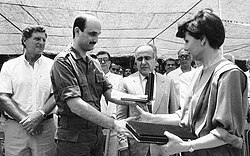
Following an amnesty bill passed by the Lebanese Parliament on July 18, 2005, Geagea was released from prison on July 26, 2005. After receiving medical care abroad, he returned to Lebanon and eventually established his residence in Maarab, Keserwan, in 2007.
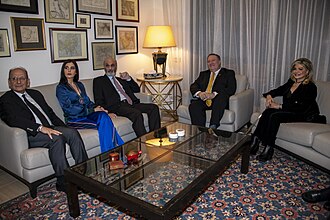
Geagea sought to rebuild international ties, meeting with French President Jacques Chirac in 2007 and various U.S. officials, including Secretary of State Condoleezza Rice, in 2008.
Recent Political Activity and Crisis Management
In 2014, Geagea ran for the presidency to succeed Michel Suleiman, backed by the March 14 Alliance. He challenged rival Michel Aoun to a direct run or the selection of a non-partisan consensual candidate.
Following the devastating Beirut port explosion on August 6, 2020, Geagea was the first politician to visit the site. He launched the "Ground-0" relief committee, led by Dr. May Chidiac. By December 2020, the committee had repaired 709 houses, assisted thousands of individuals and families, and provided numerous medical consultations and scholarships.
More recently, Geagea has been involved in tensions surrounding the 2021 Beirut clashes and has expressed skepticism regarding French influence in Lebanese presidential elections, stating in 2023 that he no longer expected assistance from France.
| Category | Details |
|---|---|
| Political Party | Lebanese Forces (Leader since 1986) |
| Education | Medicine (AUB and Saint Joseph University) |
| Key Conflict Role | Commander of LF Northern Front (1979–1984) |
| Imprisonment | 1994–2005 |
| Humanitarian Work | Founder of Ground-0 (Beirut Explosion Relief) |
Frequently Asked Questions
When did Samir Geagea become the leader of the Lebanese Forces?
Samir Geagea assumed leadership of the Lebanese Forces on January 15, 1986, after overthrowing Elie Hobeika.
Why did Geagea refuse ministerial positions in 1990 and 1992?
He rejected these positions because he believed the Lebanese cabinets were under the flagrant control of the Syrian regime.
What was the "Ground-0" committee?
Ground-0 was a relief committee launched by Geagea after the 2020 Beirut explosion to support the rebuilding of the city, providing housing repairs, food, medicine, and scholarships.
What was the basis for Geagea's imprisonment in 1994?
He was accused of ordering a church bombing and committing several political assassinations during the civil war, though he claimed the prosecution was a political fabrication by Syrian-Lebanese security forces.
Which international leaders has Samir Geagea met with?
He has met with several high-ranking officials, including former French President Jacques Chirac and former U.S. Secretary of State Condoleezza Rice.