Saint Verena: The Legacy and Veneration of a Swiss Saint
Saint Verena stands as one of the most revered figures in the spiritual history of medieval Switzerland. Her legacy is woven into the geography, art, and naming traditions of the region, evolving from a local cult of veneration into a global presence with shrines extending as far as Egypt and the United States.
The Origins of Veneration
The center of Saint Verena's veneration is the Verena Minster in Zurzach, which was constructed over her grave within an ancient Roman cemetery. By the 10th century, a Benedictine abbey—a monastery following the Rule of Saint Benedict—was established at the site of her burial in Bad Zurzach. Before 1265, this monastery was replaced by a collegiate church, with Saint Verena serving as its patroness.
Her influence expanded rapidly during the 12th century. In southern Germany, a chapel dedicated to her existed at the site of the Salem Abbey minster by 1137, where a dedicated niche remains today. Additionally, the convent of beguines (laywomen living in semi-monastic communities) in Zürich established a chapel in her honor during the mid-13th century.

Iconography and Symbolism
In religious art, Saint Verena is typically portrayed as a matron. Her depictions often include specific attributes—symbolic objects used to identify the saint—that reflect her life of service. She is frequently shown holding a jar of water or bread in one hand and a comb in the other, symbolizing her dedicated care for lepers and the poor.
![St. Verena's Mercy, Verena washing a leper's hair (Swabia, c. 1525).[3]](/images/14/21/14217d0000205ada2417cd7a9dc7ff24165455c21e9261e25ab084130aa085e9.jpg)
Other artistic representations emphasize her spiritual victory. In some depictions, such as those found in the Bad Wurzach parish church, she is shown with a palm branch, a traditional symbol of victory over the flesh, alongside her characteristic jar.

Late Gothic sculptures, such as the one in the Grödig parish church, continue this tradition, emphasizing her identity through the presence of the jar.
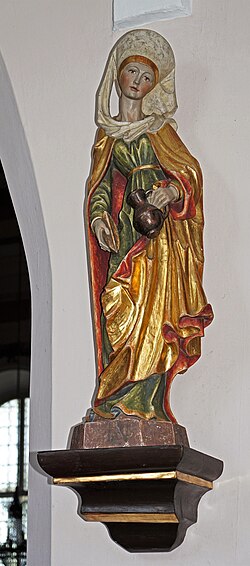
Cultural Impact and the Name Verena
The name Verena is unique in that it is not recorded outside the context of this saint. It is believed to be associated with the name Berenice (or Veronica). Due to her popularity, Verena became a common feminine name in Switzerland, leading to the hypocoristic (pet name) form Vreni and the diminutive Vreneli.
This naming tradition extended into Swiss folklore and mythology. A notable example is the Vrenelisgärtli ("Verena's garden") glacier, located in the Glärnisch massif. Furthermore, the municipality of Stäfa at Lake Zürich has featured Saint Verena in its coat of arms since 1526.
The Verena Gorge Hermitage
Located north of Solothurn, the Verena Gorge Hermitage is traditionally cited as the site where the saint resided. The site has been known since the 12th century, and records indicate a resident hermit lived there as early as 1442.
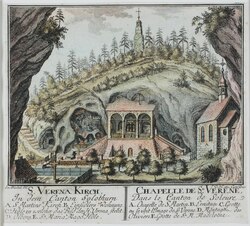
The site has undergone several transformations over the centuries:
- 1613: Installation of the Stations of the Cross (restored circa 1990).
- 18th Century: Developed into a Romantic-style landscape garden, largely through the efforts of French diplomat Louis Auguste Le Tonnelier de Breteuil.
- 1810–1813: The footpath was expanded to serve as both a Roman Catholic pilgrimage site and a national romantic shrine for the Solothurn patriciate.
To this day, the resident hermit is supported by the Bürgergemeinde (citizens' community) of the city of Solothurn.
Global Expansion of Her Cult
In the modern era, the veneration of Saint Verena has reached an international scale through the distribution of her relics.
| Year | Destination | Key Site/Church |
|---|---|---|
| 1986 | Egypt | Saint Maurice and Saint Verena's Church, Cairo (consecrated 1994) |
| 2004 | USA (California) | Shrines in Orange and Yorba Linda (Anaheim) |
The Coptic church in Cairo was consecrated by Pope Shenouda III on February 22, 1994. In the United States, a delegation from the Diocese of Los Angeles, including Metropolitan Serapion, brought relics to establish shrines in Orange and Anaheim (now located in Yorba Linda).
Key Facts
- Primary Site: Verena Minster in Zurzach, built over her grave in a Roman cemetery.
- Symbols: Often depicted with a jar of water, bread, and a comb to represent her care for the poor.
- Naming: The name Verena (and variants Vreni/Vreneli) is deeply tied to her cult and Swiss identity.
- Hermitage: The Verena Gorge near Solothurn has hosted hermits since at least 1442.
- International Reach: Relics are now housed in Cairo, Egypt, and California, USA.
Frequently Asked Questions
What are the common symbols associated with Saint Verena?
Saint Verena is typically depicted with a jar of water or bread and a comb, which symbolize her compassion and care for lepers and the impoverished. She is also sometimes shown with a palm branch, symbolizing victory over the flesh.
Where is the Verena Gorge Hermitage located?
The hermitage is located north of Solothurn, Switzerland. It is a site of pilgrimage and a landscape garden that has been in existence since the 12th century.
How did the name Verena become popular in Switzerland?
The name became common as a result of the widespread veneration of the saint. It evolved into popular Swiss forms such as "Vreni" and "Vreneli," and even influenced the naming of geographical features like the Vrenelisgärtli glacier.
Does Saint Verena have a presence outside of Europe?
Yes. In 1986, relics were brought to Egypt, leading to the consecration of Saint Maurice and Saint Verena's Church in Cairo in 1994. Additionally, relics were brought to California in 2004 for shrines in Orange and Yorba Linda.