Saint Kitts and Nevis Vital Statistics: Population and Demographic Trends (1967–2023)
Analyzing the demographic trajectory of a nation provides critical insights into its social and economic evolution. For Saint Kitts and Nevis, the period between 1967 and 2023 reveals a significant shift in population dynamics, characterized by changing birth rates, fluctuating mortality, and a gradual transition in natural population growth.
To understand these trends, we look at vital statistics—the quantitative data regarding births, deaths, and other life events. By examining the relationship between the crude birth rate and the crude death rate, we can determine the natural change, which is the difference between live births and deaths within a specific timeframe.
Key Facts
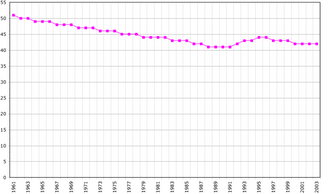
- Population Peak: The average population grew from 47,000 in 1967 to a peak of 52,650 in 2010 before stabilizing around 50,000 by 2023.
- Birth Rate Decline: The crude birth rate dropped significantly from 31.7 per 1,000 inhabitants in 1967 to 9.6 per 1,000 in 2023.
- Natural Change Shift: The nation moved from a high natural increase of 22.3 per 1,000 in 1967 to a slight natural decrease (-0.0 per 1,000) by 2023.
- Infant Mortality: This rate has fluctuated over decades, recording figures as high as 27.0 in 2018 and as low as 8.3 in 2023.
Population Dynamics and Natural Change
From 1967 through the late 1980s, Saint Kitts and Nevis maintained a relatively high crude birth rate, often exceeding 25 per 1,000 people. During this era, the population remained fairly stable, hovering between 41,000 and 47,000 inhabitants. The natural change—the surplus of births over deaths—was consistently positive, ensuring a steady internal growth rate.
Entering the 1990s and 2000s, a noticeable decline in the birth rate began. By 2005, the crude birth rate had fallen to 13.5 per 1,000. Despite this decline, the total population continued to climb, reaching its highest recorded average of 52,650 in 2010. This suggests that other factors, such as migration, may have influenced the total population count beyond natural increase alone.
The Transition to Stability
In the most recent decade (2013–2023), the demographic profile has shifted toward stability and slight contraction. The number of live births has trended downward, reaching a low of 481 in 2023. Simultaneously, the crude death rate has remained relatively steady, fluctuating between 6.6 and 9.3 per 1,000. This convergence has led to a near-zero natural change rate in recent years.
Comparative Demographic Data
The following table summarizes the vital statistics at key intervals to illustrate the long-term demographic shift in Saint Kitts and Nevis.
| Year | Avg Population | Live Births | Deaths | Crude Birth Rate (per 1000) | Crude Death Rate (per 1000) | Natural Change (per 1000) |
|---|---|---|---|---|---|---|
| 1967 | 47,000 | 1,502 | 445 | 31.7 | 9.4 | 22.3 |
| 1985 | 42,000 | 1,026 | 441 | 24.4 | 10.5 | 13.9 |
| 2000 | 46,000 | 838 | 357 | 18.4 | 7.8 | 10.6 |
| 2010 | 52,650 | 656 | 346 | 13.9 | 6.6 | 18.3 |
| 2023 | 50,090 | 481 | 482 | 9.6 | 9.3 | -0.0 |
Frequently Asked Questions
What is the crude birth rate?
The crude birth rate is the total number of live births per 1,000 people in a population over a specific period, typically one year.
How has the population of Saint Kitts and Nevis changed since 1967?
The population started at 47,000 in 1967, dipped to around 41,000 in the late 1980s, peaked at 52,650 in 2010, and settled at 50,090 by 2023.
What does a negative natural change indicate?
A negative natural change, as seen in 2023 (-0.0 to -1 in absolute numbers), indicates that the number of deaths has equaled or slightly exceeded the number of live births.
What is the infant mortality rate?
The infant mortality rate refers to the number of deaths of infants under one year of age per 1,000 live births. In Saint Kitts and Nevis, this has varied significantly, reaching 27.0 in 2018 and dropping to 8.3 in 2023.
Which year had the highest crude birth rate in the dataset?
The highest crude birth rate recorded in the provided data was 31.7 per 1,000 inhabitants in 1967.