Saint Eustace: The Legend of the Roman General and His Family
The story of Saint Eustace is a compelling narrative of faith, loss, and eventual reunion. Rooted in early Christian hagiography—the writing of the lives of saints—the legend follows a high-ranking Roman official whose life is transformed by a divine encounter. While the story evolved through different cultural lenses, primarily Greek and French, the core themes of steadfastness and divine providence remain constant.
Key Facts
- Original Name: Plakidas (Greek) or Placidus (French).
- Baptismal Name: Eustathios/Eustace, meaning "steadfast."
- Family: Wife Theopiste (or Theopista) and sons Agapius and Theopistus.
- Defining Vision: A cross appearing between the antlers of a stag while hunting.
- Imperial Conflict: Persecuted by Emperor Hadrian for refusing to sacrifice to pagan gods.
- Method of Martyrdom: Death in a brazen bull after surviving a den of lions.
The Greek Tradition: The Earliest Accounts
The oldest surviving version of the saint's passion is the Greek Vita (BHG 641), composed between the 5th and 7th centuries. In this account, Plakidas is a stratēlátēs (a pagan general) serving under Emperor Trajan. His life changes during a hunt when he sees a vision of a cross and hears a divine voice prophesying future misfortune.
Following his conversion and baptism, Plakidas becomes Eustathios. His wife is renamed Theopiste, and their sons are named Agapios and Theopistos. This spiritual awakening leads to material ruin; the family loses their wealth and estates, forcing them to emigrate to Egypt. During the voyage, the ship's captain demands Theopiste as payment for their passage. While Eustathios and his sons escape by swimming, the family is torn apart. Tragedy strikes again when wild animals take the two sons while crossing a river, leaving Eustathios to believe they are dead.
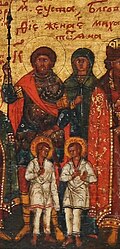
Years later, Emperor Trajan recalls Eustathios to Rome to lead an army against barbarians. In a twist of fate, his two sons—who had survived their encounter with the animals—are among his soldiers. After victory, the army stays with an old woman who is revealed to be Theopiste, having escaped the captain's clutches. The family is miraculously reunited.
The French Tradition: Medieval Adaptations
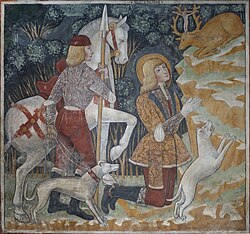
By the middle of the 13th century, a French prose Vita emerged, adding specific details to the narrative. In this version, the vision of the cross occurs in the woods after Placidus becomes separated from his hunting party. He is commanded by God to be baptized that very night by the Bishop of Rome.
The French account emphasizes the depth of their suffering. After losing their livestock, servants, and social status, the family is separated during their attempted voyage. The scene at the river is more detailed: Eustathios carries his sons across one by one, but a lion and a wolf seize the children. Eustathios spends fifteen years working as a field guard before Trajan's envoys recruit him to quell an uprising.
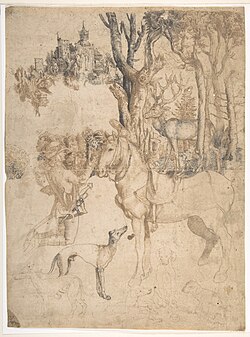
The reunion in the French tradition occurs after a military victory in the home country of the captain who abducted Theopista. Two soldiers discover they are brothers, and Theopista recognizes her husband. The family returns to Rome for a victory dinner hosted by Emperor Hadrian.
Martyrdom and Legacy
Both traditions converge on the family's end. Emperor Hadrian, less tolerant of Christians than Trajan, demands that Eustace and his family offer sacrifices to the pagan gods. Upon their refusal, they are thrown to lions, but the animals refuse to harm them. Consequently, Hadrian orders them to be executed in a brazen bull (a hollow metal statue heated from below). Despite the flames, the French tradition notes their bodies remained untouched by fire. Their remains were later recovered in secret by fellow Christians.
The legend of Saint Eustace is a variation of the "Man Tried By Fate" narrative type, common in chivalric romances. It influenced numerous medieval works, including the Spanish Book of the Knight Zifar and at least ten different medieval plays.
| Feature | Greek Vita (5th-7th c.) | French Vita (13th c.) |
|---|---|---|
| Initial Name | Plakidas | Placidus |
| Baptism | Following vision of cross | Commanded by God; performed by Bishop of Rome |
| Separation | Captain takes wife; animals take sons | Captain takes wife; lion and wolf take sons |
| Interim Life | Emigrated to Egypt | Fifteen years as a field guard |
| Reunion | At the house of an old woman | After victory in the captain's home country |
| Execution | Brazen bull | Brazen bull (bodies untouched by flames) |
Frequently Asked Questions
What was Saint Eustace's name before his conversion?
Before his baptism, he was known as Plakidas in the Greek tradition and Placidus in the French tradition.
How did Eustace become a Christian?
He converted after experiencing a vision of a cross between the antlers of a stag while hunting, accompanied by a divine voice.
Who were the members of Eustace's family?
His family consisted of his wife, Theopiste (or Theopista), and their two sons, Agapius and Theopistus.
Why was Saint Eustace executed?
He and his family were executed by Emperor Hadrian because they refused to perform sacrifices to the pagan gods.
What is a brazen bull in the context of this story?
A brazen bull was a hollow metal statue used as an instrument of execution, where victims were placed inside and the metal was heated until they died.
How does the legend relate to other medieval stories?
The story follows the "Man Tried By Fate" narrative archetype, which was a popular theme in chivalric romances and works like the Spanish Book of the Knight Zifar.