Saint Erasmus: Life, Persecution, and Martyrdom
The story of Saint Erasmus is a narrative of faith, endurance, and divine intervention set against the backdrop of the Roman Empire's most severe Christian persecutions. As the Bishop of Formia, Italy, Erasmus navigated a world where his religious convictions placed him in direct conflict with the highest authorities of the state.
Key Facts
- Role: Bishop of Formia, Italy.
- Persecutors: Emperors Diocletian and Maximian Hercules.
- Key Locations: Mount Libanus, Antioch, Lycia, and Illyricum.
- Traditional Patronage: Sailors (symbolized by the windlass).
- Core Narrative: A series of arrests, miraculous escapes, and eventual martyrdom.
Flight and First Arrest
During the reign of emperors Diocletian (284–305) and Maximian Hercules (286–305), the Roman Empire launched systemic persecutions against Christians. To escape this violence, Erasmus left his diocese in Formia and sought refuge on Mount Libanus, where he remained in hiding for seven years. According to tradition, an angel appeared to him during this period, counseling him to return to his city.
Upon his return, Erasmus was intercepted by soldiers. After admitting his Christian faith, he was taken to Antioch to stand trial before Emperor Diocletian. Despite enduring severe tortures and being imprisoned in chains, he is said to have escaped through the assistance of an angel.
Conflict with Emperor Maximian
Erasmus later traveled through Lycia, where he performed a miracle by raising the son of a prominent citizen from the dead. This event led to numerous baptisms, which attracted the attention of the Western Roman Emperor Maximian. Historical accounts, such as those by Voragine, describe Maximian as being even more ruthless than Diocletian.
Maximian ordered the arrest of Erasmus. When the Bishop refused to renounce his faith, the emperor ordered a brutal punishment: Erasmus was enclosed in a barrel filled with protruding spikes and rolled down a hill. Tradition holds that he survived this ordeal due to further angelic intervention.
Final Trials and Martyrdom
The later accounts of Erasmus' life are characterized by a mix of historical tradition and legend. He was reportedly imprisoned with the intent that he would die of starvation, yet he managed to escape once more. He was eventually recaptured in the Roman province of Illyricum after continuing to preach and convert pagans to Christianity.
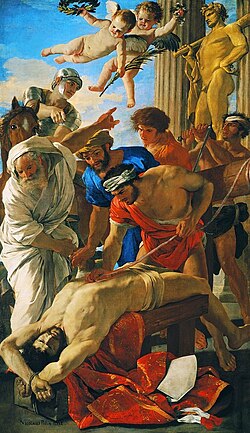
The traditional account of his death describes a gruesome martyrdom where he was disemboweled, and his intestines were wound around a windlass—a mechanical winch used for lifting heavy weights. Modern scholars suggest this specific detail may have evolved from the interpretation of religious icons depicting him with a windlass, which later became a symbol of his patronage of sailors.
| Phase | Location | Key Event | Outcome |
|---|---|---|---|
| Exile | Mount Libanus | Seven years of hiding | Angelic call to return |
| First Trial | Antioch | Trial under Diocletian | Imprisonment and escape |
| Second Trial | Lycia | Conflict with Maximian | The spiked barrel ordeal |
| Martyrdom | Illyricum | Final capture and execution | Death by disembowelment |
Frequently Asked Questions
Who was Saint Erasmus?
Saint Erasmus was the Bishop of Formia, Italy, who became a martyr during the persecutions of the Roman emperors Diocletian and Maximian Hercules.
Why is Saint Erasmus associated with a windlass?
The windlass is associated with him because traditional accounts claim his intestines were wound around one during his martyrdom. This imagery later led to his recognition as a patron of sailors.
Which Roman emperors persecuted him?
He was persecuted by Emperor Diocletian and the Western Roman Emperor Maximian Hercules.
Where did Erasmus hide to avoid persecution?
He hid on Mount Libanus for seven years before an angel advised him to return to his city.
What happened to Erasmus in Lycia?
In Lycia, he raised the son of an illustrious citizen from the dead, leading to many baptisms and his subsequent arrest by Emperor Maximian.