Saginaw City: The History of a Defunct Michigan Municipality
In the heart of Michigan's Saginaw County lies a complex history of urban development and administrative evolution. While modern residents know the area as the city of Saginaw, the region was once divided between two distinct entities. One of these was Saginaw City, a defunct municipality that played a pivotal role in the early growth of the region before merging into the current city structure.
To avoid confusion between the current municipality and its predecessor, historians use the term "Saginaw City" to refer to the defunct entity, although it was not officially incorporated under that specific name during its existence.
The Foundations of Settlement
The origins of the area date back to 1816, when Louis Campau established a fur-trading post on the west bank of the Saginaw River. This post served as the first permanent white settlement in the region, marking the beginning of a transition from wilderness to organized township.
The expansion of settlement was facilitated by the Treaty of Saginaw in 1819. Through this agreement, the U.S. federal government extinguished Native American interests for the majority of the land in the area, effectively clearing the path for an influx of white settlers.
By 1822, the original trading post had evolved into Fort Saginaw. Shortly thereafter, in 1823, Campau platted the town, creating the formal layout that would guide the community's early growth.
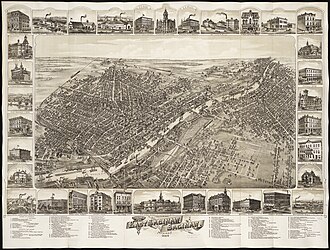
Incorporation and Consolidation
As the population grew and the local economy expanded, the settlement transitioned from a frontier town to a formal legal entity. Saginaw City was officially incorporated as a city in 1857.
For several decades, the area was characterized by the presence of two separate cities: Saginaw City and East Saginaw. However, the need for a unified administration eventually led to a legislative change. On June 2, 1889, the Michigan State Legislature passed an act to consolidate these two municipalities.
This consolidation created the present-day city of Saginaw. The merger became fully effective in March 1890 following the election of officers for the newly unified city government.
Key Facts
- Founder: Louis Campau established the first permanent white settlement in 1816.
- Land Acquisition: The Treaty of Saginaw (1819) transferred most local Native American lands to the U.S. government.
- Military Presence: The area featured Fort Saginaw, established in 1822.
- Incorporation: Saginaw City became an incorporated city in 1857.
- Consolidation: Saginaw City and East Saginaw merged in March 1890.
Historical Timeline Summary
| Year | Event | Significance |
|---|---|---|
| 1816 | Fur-trading post established | First permanent white settlement by Louis Campau |
| 1819 | Treaty of Saginaw | Extinguished Native American land interests |
| 1822 | Establishment of Fort Saginaw | Transition from trading post to fort |
| 1823 | Town platted | Formal layout of the town created |
| 1857 | City Incorporation | Saginaw City officially becomes a city |
| 1890 | Consolidation | Saginaw City and East Saginaw merge into the current city of Saginaw |
Frequently Asked Questions
What is the difference between Saginaw City and the current city of Saginaw?
Saginaw City refers to the defunct municipality that existed prior to 1890. The current city of Saginaw is the result of the consolidation of Saginaw City and East Saginaw.
Who was Louis Campau?
Louis Campau was the individual who established the first permanent white settlement in the area in 1816 via a fur-trading post and later platted the town in 1823.
What was the purpose of the Treaty of Saginaw?
The 1819 Treaty of Saginaw was used by the U.S. federal government to extinguish Native American interests in most of the land in the area, allowing white settlers to move in.
When did the consolidation of the two cities occur?
The Michigan State Legislature passed the act for consolidation on June 2, 1889, and the process became effective in March 1890 with the election of new officers.
Was the defunct city ever officially called "Saginaw City" during its existence?
No. The name "Saginaw City" is used by historians today to distinguish the defunct entity from the current city, but it was not incorporated under that specific name at the time.