Saddleback: The Remarkable Recovery of New Zealand's Tīeke
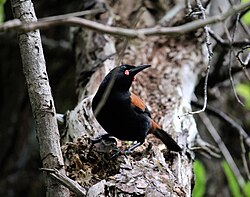
The saddleback, known in Māori as the tīeke, is a striking bird endemic to New Zealand. Characterized by its glossy black plumage and a distinctive chestnut-colored patch across its back—resembling a saddle—this bird is a member of the Callaeidae family. These birds are part of a unique group known as the New Zealand wattlebirds, distinguished by the fleshy, brightly colored wattles located on either side of their beaks.
Key Facts
- Species: North Island saddleback (Philesturnus rufusater) and South Island saddleback (Philesturnus carunculatus).
- Distinctive Feature: Vivid red fleshy wattles and a chestnut-brown "saddle" on the back.
- Diet: Primarily insectivorous, but also consumes fruit and nectar.
- Behavior: Territorial and noisy, known for being fearless and poor fliers.
- Conservation Status: Once extinct on the mainland, now recovering via island reserves and fenced sanctuaries.
Taxonomy and Classification
The genus Philesturnus was established in 1832 by French zoologist Isidore Geoffroy Saint-Hilaire. The name is a linguistic blend of Philedon (a honeyeater genus) and Sturnus (a starling genus). The South Island saddleback serves as the type species for the genus.
Saddlebacks are considered remnants of an early expansion of passerines (perching birds) in New Zealand. They belong to the Callaeidae family, which also includes the endangered North Island kōkako, the possibly extinct South Island kōkako, the extinct huia, and their closest relative, the stitchbird.
Physical Characteristics and Behavior
Saddlebacks are among the larger arboreal insectivorous birds in New Zealand's forests, reaching lengths of up to 25 cm (10 in) and weighing up to 75 grams. They possess short, robust beaks that are unusually strong, allowing them to tear bark from tree trunks to find insects. While they primarily hunt in bark and leaf litter, they are opportunistic feeders that also enjoy nectar and fruit.
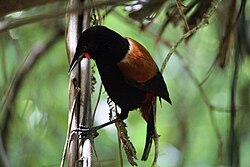
In terms of movement, saddlebacks are poor fliers. Like the kōkako, they prefer to bound from branch to branch rather than fly long distances. They are highly territorial and express this through a hierarchy of behaviors: starting with dawn singing, progressing to threat displays (such as head bobbing, tail fanning, and dilating their wattles), and occasionally escalating to physical fights where they grapple with each other's wattles.
Nesting and Breeding
Saddlebacks typically nest in tree-fern crowns, epiphytes (plants that grow on other plants), or holes in tree trunks. They often choose nesting sites near the ground. Once they hatch, fledglings are known to be noisy, hopping around the forest floor as they develop the wing strength necessary for flight.
Cultural Significance
The tīeke holds a prominent place in Māori culture. Traditionally, their cries were interpreted as omens: a call from the right was seen as a good sign, while a call from the left was viewed as a bad omen.
Māori legend also explains the bird's appearance. According to folklore, the demi-god Māui once asked a tīeke for water after his battle to ensnare the sun. When the bird rudely ignored him, an angry Māui seized the bird with his fiery hand, leaving a permanent brown scorch mark across its back.
Conservation and Recovery
The saddleback's habit of nesting and fledgling activity near the ground made them easy targets for introduced mammalian predators, such as brown rats, ship rats, and mustelids. This led to their rapid disappearance from the New Zealand mainland, and by the early 20th century, they survived only on two remote islands: Hen Island (North Island species) and Taukihepa/Big South Cape Island (South Island species).
A crisis occurred in 1963 when rats were accidentally introduced to Big South Cape Island by visiting muttonbirders. While this event led to the extinction of the South Island snipe, bush wren, and greater short-tailed bat, a swift rescue operation by the New Zealand Wildlife Service saved the saddleback from total extinction.
Today, saddlebacks have been reintroduced to various island nature reserves and mainland fenced sanctuaries. In a significant milestone, sightings and breeding evidence in Polhill Reserve since 2015 marked the first presence of the bird on the unfenced mainland since it was declared extinct there in 1910.
| Feature | North Island Saddleback | South Island Saddleback |
|---|---|---|
| Scientific Name | Philesturnus rufusater | Philesturnus carunculatus |
| Key Identifier | Chestnut saddle, red wattles | Chestnut saddle, red wattles |
| Historical Refuge | Hen Island | Taukihepa / Big South Cape Island |
| Family | Callaeidae | Callaeidae |
Frequently Asked Questions
What is a saddleback?
The saddleback, or tīeke, is a glossy black bird from New Zealand featuring a distinctive chestnut-brown patch on its back and red fleshy wattles near its beak.
Why are they called saddlebacks?
Their common name comes from the demarcated brown plumage on their backs, which resembles a riding saddle.
What do saddlebacks eat?
They are primarily insectivorous, using strong beaks to find insects under bark and in leaf litter, though they also eat fruit and drink nectar.
Why did saddlebacks almost go extinct?
Their tendency to nest and raise fledglings near the ground made them highly vulnerable to introduced predators like rats and mustelids.
Are saddlebacks still found on the New Zealand mainland?
While they were declared extinct on the mainland in 1910, they now live in fenced sanctuaries and have recently been spotted breeding in unfenced areas like Polhill Reserve.