Rurik: The Service History of the Russian Armored Cruiser
The Rurik was a formidable armored cruiser of the Imperial Russian Navy, designed to project power and maintain security in the volatile waters of the Baltic Sea. From her troubled beginnings in the shipyard to her role as a flagship during the First World War, Rurik's career reflects the strategic challenges and technical struggles of the Russian fleet during the early 20th century.
Construction and Early Trials
The keel for Rurik was laid down on August 22, 1905, and the vessel was launched on November 17, 1906. However, her entry into service was not without complications. During gunnery testing in 1907, the Russian Navy discovered structural weaknesses. These tests involved firing thirty rounds from two 254 mm guns, thirty shells from two 203 mm guns, and fifteen shots from the 120 mm guns.
Rather than delaying completion, the Navy decided to address these defects after delivery. During steam trials in 1908, Rurik proved her mechanical prowess by exceeding both her design speed and horsepower. She was completed in September 1908 and delivered to the fleet, immediately heading to the Kronstadt shipyard for essential hull modifications to correct the previously identified design flaws.
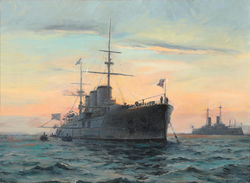
For the next several years, Rurik operated primarily in the Baltic Sea, with a notable cruise to the Mediterranean in July 1910. By 1913, her importance to the fleet was cemented when she was designated as the flagship of the Baltic Fleet.
World War I: The Core of the Baltic Fleet
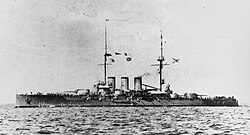
When World War I erupted in July 1914, the Russian Navy faced a significant gap in its capabilities; the Borodino-class battlecruisers and Gangut-class dreadnoughts were not yet complete. Consequently, Rurik and the Bayan-class cruisers became the primary operational force against the superior Imperial German Navy.
Serving as the flagship for Admiral Nikolai Ottovich von Essen, Rurik was initially commanded by Captain Mikhail Bakhirev. In August 1914, she and the armored cruiser Pallada conducted a sweep near Danzig, Germany, and Bornholm, Denmark. While no enemy ships were found, the mission boosted fleet morale. During this same period, Russia achieved a major intelligence breakthrough when the German cruiser SMS Magdeburg ran aground, allowing the Russians to recover code books and decrypt German wireless signals.
Minelaying Operations
In November 1914, Rurik was modified to serve as a fast minelayer. On December 14, under Admiral Ludvig Kerber, she laid a field of 120 mines off the German port of Danzig. In January 1915, she provided escort for other cruisers that laid minefields off the island of Rügen—the furthest west the Russian fleet penetrated during the war. These mines eventually damaged the German cruisers Augsburg and Gazelle.
Rurik's operational luck turned on February 13, 1915, when she ran aground during another mission off Danzig. The ship took on 2,400 long tons of water, flooding half of her boiler rooms. Despite the severe damage, she managed to free herself and return to port under her own power.
The Battle of Åland Islands
In July 1916, the Russian command planned a bombardment to support the garrison at Windau. While initial plans suggested attacking Rostock, Vice Admiral Vasily Kanin limited the scope to Memel. Rear Admiral Bakhirev led the force, though historical accounts differ on the exact composition of the group. Heavy fog eventually forced the cancellation of the bombardment.
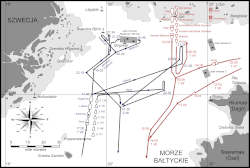
Using decrypted German wireless intercepts, Bakhirev pivoted to intercept a German flotilla. This led to the Battle of Åland Islands on July 2, where Russian cruisers forced the German minelayer SMS Albatross ashore.
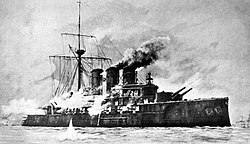
Rurik arrived late to the main engagement and encountered the German light cruiser SMS Lübeck. Despite her superior firepower, Rurik failed to score any hits, while the Lübeck landed ten. These hits caused a fire on the forecastle and damaged a forward rangefinder. While the 10.5 cm shells could not penetrate Rurik's armor, fumes from an explosion temporarily disabled one of her main battery turrets.
The engagement escalated when the German armored cruiser SMS Roon and the light cruiser Augsburg intervened. Rurik engaged Roon at a range of 15,000 to 16,000 meters but again failed to score hits. After taking a hit to her rear conning tower and spotting what was mistakenly believed to be a U-boat, Rurik disengaged, allowing the German ships to escape.
Final Years and Dismantling
Rurik returned to minelaying in late 1916, sowing 560 mines off Gotland in November and another 700 in December. These efforts, combined with Allied submarine activity, eventually deterred German capital ships from operating in the Baltic. However, on November 7, 1916, Rurik struck a mine off Hogland, Russia, and remained under repair until April 1917, during which time she received a new tripod foremast.
The political upheaval of the Russian Revolution and the subsequent Treaty of Brest-Litovsk ended Russia's role in the war. With Finland gaining independence, the fleet abandoned Helsingfors and returned to Kronstadt. Rurik was placed in reserve in October 1918. By 1923, she had fallen into poor condition and was struck from the naval register on November 1. She was dismantled in Petrograd between 1924 and 1925, though her 203 mm guns were repurposed as coastal artillery.
Key Facts
- Laid down: August 22, 1905.
- Launched: November 17, 1906.
- Primary Role: Armored cruiser and fast minelayer.
- Major Engagement: Battle of Åland Islands (July 1916).
- Notable Incident: Ran aground in February 1915, taking on 2,400 long tons of water.
- Fate: Dismantled 1924–1925 in Petrograd.
| Category | Details |
|---|---|
| Armament Tested | 254 mm, 203 mm, and 120 mm guns |
| Key Commanders | Mikhail Bakhirev, Ludvig Kerber |
| Strategic Role | Flagship of the Baltic Fleet (from 1913) |
| Minelaying Totals | 1,380+ mines laid off Danzig and Gotland |
| Final Disposition | Broken up; guns used for coastal defense |
Frequently Asked Questions
Why was Rurik sent back to the shipyard after delivery?
During gunnery testing in 1907, the Russian Navy discovered structural weaknesses in the ship's design. To avoid delaying her completion, the Navy decided to perform the necessary hull modifications at the Kronstadt shipyard after she was officially delivered.
What role did Rurik play in the Battle of Åland Islands?
Rurik acted as a reinforcement force. She engaged the German light cruiser SMS Lübeck and the armored cruiser SMS Roon. Although she was more powerful, she failed to score hits on the enemy while sustaining several hits herself before disengaging due to a suspected submarine threat.
How did Rurik contribute to the war effort as a minelayer?
Rurik was modified to carry naval mines and conducted several operations, including laying 120 mines off Danzig and contributing to fields off Rügen and Gotland. These efforts helped make the Baltic Sea too dangerous for German capital ships.
What happened to Rurik after the Russian Revolution?
Following the Treaty of Brest-Litovsk and the independence of Finland, Rurik returned to Kronstadt and was placed in reserve in 1918. Due to her deteriorating condition, she was struck from the naval register in 1923 and dismantled between 1924 and 1925.