Royal Society of Edinburgh: A History of Scottish Intellectual Excellence
The 18th century in Edinburgh was defined by a vibrant intellectual climate that gave rise to numerous clubs and societies, a period now recognized as the Scottish Enlightenment. Among these, the pursuit of knowledge in the arts, sciences, and medicine flourished, eventually leading to the creation of one of Scotland's most prestigious academic institutions: the Royal Society of Edinburgh (RSE).
The Evolution of the Society
The roots of the RSE trace back to 1731 with the co-founding of the Society for the Improvement of Medical Knowledge, commonly known as the Medical Society of Edinburgh, by mathematician Colin Maclaurin. However, Maclaurin soon found the specialist focus of the medical society too restrictive. In 1737, he helped establish a broader organization called the Edinburgh Society for Improving Arts and Sciences and particularly Natural Knowledge.
By 1738, this group adopted the more concise name of the Edinburgh Philosophical Society. With the influence of prominent University of Edinburgh professors—including Joseph Black, William Cullen, and John Walker—the organization evolved into the Royal Society of Edinburgh in 1783. Shortly thereafter, in 1788, the society began publishing its scholarly output in the Transactions of the Royal Society of Edinburgh.
Internal Divisions and the Wernerian Society
As the 18th century closed, ideological shifts created friction among members. Younger scholars, such as James Hall, began adopting the new chemical nomenclature developed by Antoine Lavoisier. This theoretical divide led to a split in the society's objectives.
In 1808, the Wernerian Society was founded as a parallel organization. Led by Professor Robert Jameson, the Wernerians focused on natural history and scientific research intended to bolster Scotland's industrial and agricultural infrastructure. This split resulted in a fragmented publishing landscape for four decades; while the RSE continued its Transactions, the Wernerians produced the Memoirs of the Wernerian Natural History Society (1808–1821) and the Edinburgh Philosophical Journal (starting in 1822). It was not until the 1850s that the society unified its membership under a single journal once again.
Modern Era and the Young Academy
Throughout the 19th century, the RSE hosted scientists whose work formed the bedrock of modern science. In the 20th century, the society expanded its scope to become a central hub for not only the sciences but also the arts and humanities. Today, it remains a vital promoter of original research across Scotland.
A landmark moment in the society's leadership occurred in February 2014, when Dame Jocelyn Bell Burnell was announced as the first female president of the RSE, officially taking office in October of that year.
To foster future innovation, the RSE founded the Young Academy of Scotland in 2011. This body brings together professionals aged from their mid-20s to 40s across various disciplines and regions to address challenges facing the nation. Members are selected every two years, serve five-year terms, and maintain a roughly equal gender balance. As of 2021, the academy consisted of 134 members.
Key Facts
- Founded: Established as the Royal Society of Edinburgh in 1783.
- First Female President: Dame Jocelyn Bell Burnell (appointed 2014).
- Primary Publication: Transactions of the Royal Society of Edinburgh (est. 1788).
- Young Academy: Founded in 2011 to engage professionals aged mid-20s to 40s.
- Scope: Promotes original research in sciences, arts, and humanities.
Location History
The society has occupied several prestigious sites throughout Edinburgh's New Town and university districts over the centuries.
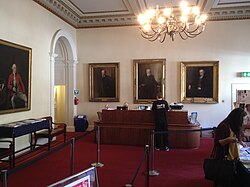
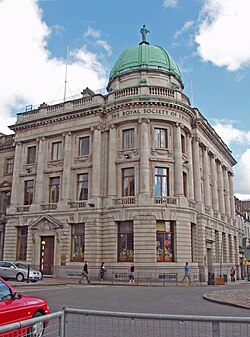
The current headquarters at 22–24 George Street was purchased from the Edinburgh Life Assurance Company in 1909, supported by a £25,000 grant from the Scottish Office.
| Period | Location | Notes |
|---|---|---|
| 1783–1807 | College Library, University of Edinburgh | Initial headquarters |
| 1807–1810 | Physicians' Hall, George Street | Home of the Royal College of Physicians of Edinburgh |
| 1810–1826 | 40–42 George Street | Shared with Society of Antiquaries of Scotland from 1813 |
| 1826–1908 | The Royal Institution (The Mound) | Shared with various fine arts and manufacture boards |
| 1908–1909 | High School Yards | University premises |
| 1909–Present | 22–24 George Street | Purchased with a £25,000 Scottish Office grant |
Frequently Asked Questions
Who co-founded the precursor to the Royal Society of Edinburgh?
The mathematician Colin Maclaurin co-founded the Society for the Improvement of Medical Knowledge in 1731, which served as the earliest precursor to the RSE.
What was the Wernerian Society?
The Wernerian Society (1808–1858) was a parallel organization that split from the RSE to focus specifically on natural history and scientific research aimed at improving Scotland's industrial and agricultural base.
Who was the first woman to lead the society?
Dame Jocelyn Bell Burnell became the first female president of the Royal Society of Edinburgh, taking office in October 2014.
What is the purpose of the Young Academy of Scotland?
Founded in 2011, the Young Academy brings together professionals aged mid-20s to 40s from diverse disciplines to provide ideas and direction for challenges facing Scotland.
How are members of the Young Academy selected?
Members are selected from applicants every two years, serve for a term of five years, and the academy maintains a roughly equal balance of men and women.