Rote Learning: Techniques, Applications, and the Debate on Critical Thinking
Rote learning is a memorization technique centered on repetition. It operates on the fundamental premise that the more a piece of material is repeated, the faster and more efficiently it can be recalled. While often viewed simply as "learning by heart," this method serves as a cornerstone for acquiring foundational knowledge across various disciplines.
Key Facts
- Core Mechanism: Relies on repetition to increase the speed of recall.
- Primary Use: Effective for mastering foundational facts, such as multiplication tables or chemical elements.
- Limitation: By definition, it avoids comprehension, making it insufficient for mastering complex subjects at an advanced level.
- Alternatives: Meaningful learning, associative learning, active learning, and spaced repetition.
- Computer Science Application: In machine learning, it refers to a pattern where a system retrieves stored outputs based on a history of inputs.
Rote Learning vs. Critical Thinking
Rote learning is frequently employed to establish the basic building blocks of knowledge. In academic settings, this is evident in the study of phonics for reading, the periodic table in chemistry, anatomy in medicine, and the memorization of statutes in law or basic formulae in science.
However, because rote learning does not require an understanding of the underlying logic, it is often contrasted with critical thinking. When used exclusively, it is an ineffective tool for advanced mastery. A common example of this is "cramming," where students memorize vast amounts of information quickly just before an exam.
Due to this lack of depth, the practice is sometimes criticized using terms like "parrot fashion," "regurgitation," or "mugging." These terms suggest that a person may appear to understand a subject simply because they can repeat the words, even if they cannot apply the concepts.
Educational Standards and the Shift Toward Understanding
Many modern curriculum standards, particularly in the United States, discourage a reliance on rote memorization. The National Council of Teachers of Mathematics has emphasized that mathematics should prioritize the mastery of concepts and the meaningful use of technology over the "computational tedium" of mere memorization.
Proponents of these newer standards argue that students achieve better results when they derive formulas themselves or use them in practical exercises, which allows them to transfer their knowledge to complex problem-solving tasks more successfully.
The Argument for Foundational Skills
Conversely, some educators argue that the shift away from rote learning may overlook the importance of basic facts. They maintain that students must develop strong computational skills and a solid base of knowledge—the "tools of the subject"—before they can truly grasp abstract concepts. From this perspective, practicing skills through repetition is a necessary precursor to higher-level investigation and inquiry.
Rote Learning in Computer Science
In the field of machine learning, the term "rote learning" describes a specific pattern that differs from the human version because it does not involve repetition. Instead, the machine is programmed to maintain a history of its calculations. When new input is received, the machine compares it against its history; if a match is found, it retrieves the previously stored output.
For this to work, the machine must function as a pure function, meaning it always produces the same output for the same input. A notable historical milestone of this approach was Samuel's Checkers program running on an IBM 701, which represented a significant step in early artificial intelligence.
Practical Tools for Memorization
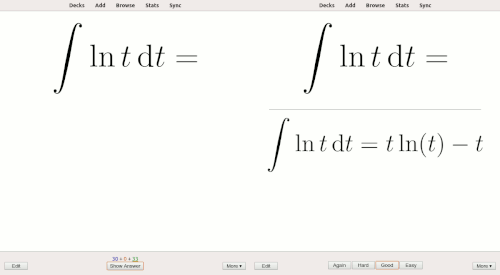
Traditional education utilizes several specific tools to facilitate rote learning. These include mnemonic devices (memory aids), outlines, and flashcards, which help students commit course material to memory through structured repetition.
The following table summarizes the differences between rote learning and its primary educational alternatives.
| Method | Primary Mechanism | Main Strength | Main Weakness |
|---|---|---|---|
| Rote Learning | Repetition | Rapid acquisition of basic facts | Lack of conceptual understanding |
| Meaningful Learning | Integration of new info with existing knowledge | Deep understanding and transferability | Slower initial acquisition |
| Active Learning | Engagement and problem-solving | High retention and critical thinking | Requires more resources/time |
| Spaced Repetition | Timed intervals of review | Long-term retention | Requires disciplined scheduling |
Frequently Asked Questions
Is rote learning always bad for students?
No. While it is insufficient for advanced mastery, rote learning is highly effective for committing foundational facts—like multiplication tables or basic formulas—to memory, which can then serve as a base for more complex learning.
How does rote learning differ from meaningful learning?
Rote learning focuses on the repetition of information without necessarily understanding it, whereas meaningful learning involves connecting new information to existing knowledge to create a deeper understanding.
What is "cramming" in the context of rote learning?
Cramming is a colloquial term for using rote learning to quickly memorize a large volume of information in a short period, typically immediately before an examination.
How is rote learning applied in artificial intelligence?
In machine learning, rote learning is a process where a system stores a history of inputs and outputs. When it encounters a known input, it simply retrieves the corresponding stored output rather than calculating it again.
What are some common tools used for rote memorization?
Common tools include flashcards, mnemonic devices, and outlines, all of which help learners repeat and recall specific pieces of information.