Romanization: Converting Diverse Writing Systems to Latin Script
In the field of linguistics, romanization refers to the process of converting text from a non-Latin writing system into the Roman (Latin) script. This essential tool allows for the representation of various languages in a format that is accessible to those using the Latin alphabet, facilitating international communication, academic study, and digital data processing.
While the term is often used broadly, the process involves distinct methodologies depending on whether the goal is to represent written characters or spoken sounds.
Core Methodologies of Romanization
To understand how languages are mapped to the Latin script, it is necessary to distinguish between two primary methods: transliteration and transcription.
Transliteration
Transliteration is the method used for representing written text. It focuses on a character-for-character or letter-for-letter mapping between the source script and the Roman script. The primary goal is to preserve the original spelling and orthography of the source language.
Transcription
Transcription is used to represent the spoken word rather than the written characters. This method is further divided into two specialized categories:
- Phonemic transcription: This records the phonemes, which are the smallest units of semantic meaning in speech.
- Phonetic transcription: This is a more rigorous method that records specific speech sounds with high precision.
In many practical applications, linguists use a compromise that combines elements of both to ensure a system is both readable and accurate.
Key Facts
- Romanization is the conversion of text into the Roman (Latin) script.
- Transliteration focuses on representing written text and spelling.
- Transcription focuses on representing spoken sounds.
- Phonemic transcription records units of semantic meaning.
- Phonetic transcription records speech sounds with high precision.
Global Applications and Standards
Different writing systems require unique approaches to romanization. Because every language has its own phonetic and structural nuances, various international organizations and academic bodies have developed specific standards.
Arabic and Persian
Romanizing Arabic and Persian involves complex systems to account for unique sounds. Various standards exist, including the Deutsche Morgenländische Gesellschaft (the basis for the Hans Wehr dictionary), ISO 233, and the Buckwalter transliteration system, which was developed at Xerox to avoid the need for unusual diacritics (special marks added to letters).
Chinese Systems
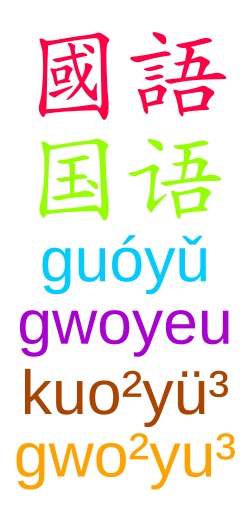
Mandarin Chinese utilizes several romanization methods. Hanyu Pinyin is a widely used standard, while Wade–Giles was a popular transliteration method used by Western academics for many years. In Taiwan, systems such as Gwoyeu Romatzyh and Tongyong Pinyin have been utilized historically.
Japanese and Korean
In Japan, romanization is known as rōmaji. Common systems include Hepburn (used for phonetic transcription in geographical names) and Nihon-shiki (a transliteration system). Korean romanization includes the Revised Romanization of Korean, which is the official system in South Korea, and the Yale romanization, which is primarily used by international linguists.
Cyrillic Scripts
Languages using the Cyrillic script, such as Russian, Bulgarian, and Ukrainian, have various standards. For example, Bulgaria transitioned to a Streamlined System in the late 1990s to optimize compatibility with English by avoiding diacritics.
Summary of Romanization Methods and Examples
| Method | Primary Focus | Example Application |
|---|---|---|
| Transliteration | Written characters/spelling | Mapping Hebrew or Arabic letters to Latin equivalents |
| Phonemic Transcription | Units of meaning (phonemes) | Representing the core sounds of a language |
| Phonetic Transcription | Precise speech sounds | Detailed linguistic studies of pronunciation |
| Compromise | Readability and accuracy | General-purpose language learning tools |
Frequently Asked Questions
What is the difference between transliteration and transcription?
Transliteration maps the written characters of one script to another, focusing on spelling. Transcription maps the sounds of spoken language to the Latin script, focusing on pronunciation.
Why are there so many different romanization systems?
Different systems serve different purposes, such as academic research, international travel, or digital data entry. Some prioritize exact spelling, while others prioritize how a word sounds to a native speaker.
What is Hanyu Pinyin?
Hanyu Pinyin is a widely used system for the romanization of Standard Mandarin Chinese.
What are diacritics in romanization?
Diacritics are marks added to letters (such as accents or dots) to indicate specific pronunciations or to distinguish between different sounds that are represented by the same Latin letter.
Is rōmaji the same as romanization?
Rōmaji is specifically the Japanese term for the use of Roman letters to write the Japanese language.