Rocket Engine Test Facility: The Legacy of Liquid Hydrogen Propulsion
In the mid-20th century, the race to master space propulsion required more than just theoretical mathematics; it required massive, specialized infrastructure capable of handling the volatile power of liquid hydrogen. The Rocket Engine Test Facility, located at the NASA Glenn Research Center (formerly known as the Lewis Research Center) in Cleveland, Ohio, served as a critical cornerstone for this technological leap. This facility played a vital role in testing the engines that would eventually propel humanity toward the moon and beyond.
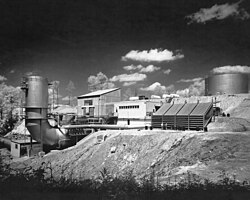
Foundations of a Propulsion Powerhouse
The development of the facility began in 1954 under the direction of the National Advisory Committee for Aeronautics (NACA) Rocket Branch of the Fuels and Combustion Research Division. Completed in 1957 at a cost of $2.5 million, the facility was situated at the south end of the center, adjacent to Abrams Creek. Its primary mission was to test full-scale liquid hydrogen rockets, managing thrust chamber pressures of up to 2100 psia (pounds per square inch absolute) and thrust levels reaching at least 20,000 pounds.
Technical Capabilities and Test Stands
The facility was a complex of major buildings and specialized support systems designed to simulate various flight conditions. The infrastructure was divided into two primary testing configurations:
Test Stand A: Sea-Level Testing
Test Stand A was engineered for the sea-level testing of vertically mounted rocket engines. These engines exhausted into a specialized system consisting of an exhaust gas scrubber and a muffler. This stand possessed immense power, capable of testing engines with chamber pressures up to 4300 psia and thrust levels as high as 50,000 pounds.
Test Stand B: Altitude Simulation
Designed by Anthony Fortini and Vearl N. Huff in 1959, Test Stand B was not constructed until after 1980. Unlike the vertical orientation of Stand A, Stand B was designed for horizontally mounted rocket engines. It utilized an exhaust diffuser, a cooler, and a nitrogen-driven two-stage ejector system to simulate a space environment. This allowed for altitude testing with chamber pressures up to 1000 psia and thrust levels of 1500 pounds. For their work on this stand, Fortini and Huff received awards under the Space Act.
: 1982 photographSupport Infrastructure
To maintain these high-energy tests, the facility required extensive support systems, including:
- Storage dewars: Specialized containers for cryogenic (extremely low-temperature) fuels.
- Water reservoir: A large-scale supply for cooling and operational needs.
- Specialized shelters: Including a block house for observation, a pump house, a helium compressor shelter, and a liquid hydrogen pump vaporizer shelter.
In 1984, the facility underwent modifications to accommodate the testing of extremely large area ratio nozzles, reaching ratios of up to 1000:1.
A Landmark in Aerospace History
The Rocket Engine Test Facility was more than just a collection of buildings; it was a site of immense scientific achievement. Because of its pivotal role in developing liquid hydrogen as a viable rocket fuel, it was designated a U.S. National Historic Landmark and added to the National Register of Historic Places on April 3, 1985.
The facility's testing capabilities contributed to some of the most iconic milestones in space exploration, including:
- The development of the Pratt & Whitney RL10 engine for the Centaur upper stage.
- The testing of the J-2 engine, which provided 200,000 pounds of thrust for the second stage of the Saturn V rocket.
- The testing of the hydrogen-oxygen engines used by the Space Shuttle.
Despite its historical significance, the facility met an end driven by local infrastructure needs. It was demolished in 2003 to facilitate the runway expansion of the Cleveland Hopkins International Airport. Following its demolition, its status as a National Historic Landmark was removed on April 4, 2005.
Key Facts
- Location: Lewis Research Center (now NASA Glenn), Cleveland, Ohio.
- Primary Fuel: Liquid hydrogen.
- Major Engines Tested: Pratt & Whitney RL10, J-2 (Saturn V), and Space Shuttle hydrogen-oxygen engines.
- Construction Cost: $2.5 million.
- Historical Status: Former U.S. National Historic Landmark (1985–2005).
- Reason for Demolition: Cleveland Hopkins International Airport runway expansion.
Summary of Facility Specifications
| Feature | Test Stand A | Test Stand B |
|---|---|---|
| Orientation | Vertical | Horizontal |
| Primary Use | Sea-level testing | Altitude/Space environment testing |
| Max Chamber Pressure | 4300 psia | 1000 psia |
| Max Thrust Level | 50,000 pounds | 1500 pounds |
Frequently Asked Questions
What was the main purpose of the Rocket Engine Test Facility?
The facility was designed to test full-scale liquid hydrogen rocket engines under various pressures and thrust levels to advance space propulsion technology.
Which famous rockets were tested at this facility?
The facility was used to test engines for the Saturn V rocket (the J-2 engine), the Centaur upper stage (the RL10 engine), and the Space Shuttle.
Why was the facility demolished?
The facility was demolished in 2003 to make room for the expansion of the runways at the Cleveland Hopkins International Airport.
When was the facility a National Historic Landmark?
It was designated a National Historic Landmark on April 3, 1985, and remained so until it was de-designated on April 4, 2005, following its demolition.
What is the difference between Test Stand A and Test Stand B?
Test Stand A was used for vertical, sea-level testing with much higher thrust and pressure capabilities, while Test Stand B was designed for horizontal altitude testing to simulate space environments.