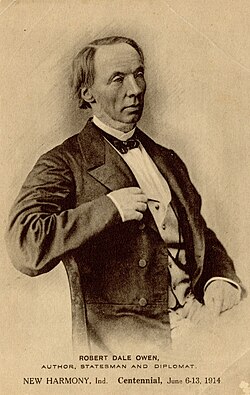
Robert Dale Owen: Statesman, Reformer, and Architect of Public Institutions
Robert Dale Owen was a multifaceted figure in 19th-century American history, blending the roles of a politician, diplomat, and social reformer. From his early leadership in labor movements to his influence on the physical and intellectual landscape of the United States, Owen dedicated his career to expanding civil liberties and establishing enduring public institutions.
Key Facts
- Political Leadership: Served as a leader of the Working Men's Party in New York City (1829–30).
- Legislative Impact: Secured state funding for Indiana's public school system and advocated for women's property and divorce rights.
- National Service: Represented Indiana in the U.S. House of Representatives from 1843 to 1847.
- Institutional Legacy: Instrumental in the founding of the Smithsonian Institution and the design of its "Castle" building.
- Diplomatic Career: Served as the U.S. minister to the Kingdom of the Two Sicilies in Naples (1853–1858).
- Human Rights Advocacy: Pushed for general emancipation during the Civil War and proposed gender-neutral voting rights in the Fourteenth Amendment.
Early Political Activism and Indiana Legislation
Owen's political journey began in New York City between 1829 and 1830, where he emerged as an active leader of the Working Men's Party. During this time, he established a stance against slavery, which put him at odds with Democratic Presidents Andrew Jackson and James K. Polk, though his specific political leanings kept him separate from the era's primary abolitionist circles.
Upon returning to New Harmony, Indiana, in 1833, Owen transitioned into state politics. He served multiple terms in the Indiana House of Representatives (1835–38 and 1851–53). He is most remembered in the state for securing appropriations for a tax-supported public school system. Owen was also a pioneer for gender equality, introducing legislation to protect the property rights of married women and widows, and proposing laws to grant women greater freedom of divorce.
In 1850, as a delegate from Posey County to the Indiana Constitutional Convention, Owen attempted to embed women's property rights directly into the state constitution. While the proposal failed initially, it paved the way for future laws regarding voting, divorce, and property. His most lasting achievement was the inclusion of an article in the 1851 Indiana Constitution that established a free, uniform system of common schools and created the office of the state superintendent of public instruction.
Service in the U.S. Congress and the Smithsonian
After two unsuccessful bids, Owen was elected as a Democrat to the U.S. House of Representatives in 1842, serving from 1843 to 1847. During the Twenty-eighth Congress, he chaired the Committee on Roads and Canals. He also played a role in critical national debates, including the annexation of Texas and the Oregon boundary dispute, the latter of which resulted in the 1846 Oregon Treaty establishing the U.S-British boundary at the 49th parallel north.
One of Owen's most significant national contributions was his role in founding the Smithsonian Institution in 1846. Not only did he help secure the bill's passage, but he also served on the first Board of Regents and chaired the Building Committee. He recommended James Renwick Jr. as the architect and helped select the distinct dark-red sandstone from the Seneca Quarry for the construction.
Owen's interest in architecture extended beyond administration. Alongside his brother, David Dale Owen, and Robert Mills, he helped develop the preliminary plans for the Smithsonian Building. This influence led to the selection of the Romanesque Revival (or Norman-style) architecture. Owen later defended this aesthetic choice in his 1849 book, Hints on Public Architecture, though some critics accused him of bias toward Renwick.
Diplomacy and Civil War Reform
Following a defeat in his 1846 re-election bid, Owen returned to the Indiana General Assembly. In 1853, President Franklin Pierce appointed him as the U.S. minister (Chargé d'Affaires and Minister Resident) to the Kingdom of the Two Sicilies at Naples. He held this diplomatic post until September 20, 1858, after which he retired from formal politics but remained a vocal advocate for social reform.
During the American Civil War, Owen contributed to the Union effort through the Ordnance Commission and the Freedman's Inquiry Commission (a precursor to the Freedmen's Bureau). He became a strong advocate for general emancipation, writing open letters to President Abraham Lincoln and Treasury Secretary Salmon P. Chase in 1862. Owen argued that ending slavery was both a moral imperative and a strategic necessity to weaken Confederate forces.
His writings, including the 1863 pamphlet Emancipation is Peace and a 1864 report on the future of the African race in the U.S., emphasized that the Union should provide direct assistance to freedmen to ensure a successful transition to freedom.
The Fight for Suffrage
In the final stages of his public life, Owen focused on federal voting rights for women. In 1865, he submitted a draft for the Fourteenth Amendment to the U.S. Constitution that sought to remove gender restrictions on voting. Despite his efforts, the final version of the Amendment ratified in 1868 limited suffrage to male citizens over the age of twenty-one.
| Period/Year | Role/Achievement | Key Impact |
|---|---|---|
| 1829–1830 | Working Men's Party Leader | Early labor and anti-slavery activism |
| 1835–1853 | Indiana State Legislator | Public school funding and women's rights advocacy |
| 1843–1847 | U.S. Congressman | Founded the Smithsonian Institution; Oregon Treaty |
| 1853–1858 | U.S. Minister to Naples | Diplomatic representation in the Kingdom of the Two Sicilies |
| 1862–1865 | Civil War Reformer | Advocated for emancipation and women's suffrage |
Frequently Asked Questions
How did Robert Dale Owen influence the Smithsonian Institution?
Owen helped secure the legislation to found the institution in 1846, served on its first Board of Regents, and chaired the Building Committee. He was instrumental in selecting the architect James Renwick Jr. and promoting the Romanesque Revival style for the "Castle" building.
What were Owen's contributions to education in Indiana?
Owen secured appropriations for the state's tax-supported public school system and authored the article in the 1851 Indiana Constitution that guaranteed a free, uniform system of common schools open to all, while also establishing the state superintendent of public instruction.
What was Owen's stance on slavery and emancipation?
Owen was opposed to slavery throughout his career. During the Civil War, he wrote open letters to President Lincoln urging general emancipation on both moral and strategic grounds, arguing it would help the Union win the war.
Did Robert Dale Owen succeed in gaining voting rights for women?
While he was a persistent advocate and proposed a gender-neutral version of the Fourteenth Amendment in 1865, his efforts were not successful at the federal level; the final 1868 amendment limited voting rights to males.
What was Owen's role during the American Civil War?
Beyond his advocacy for emancipation, Owen served on the Ordnance Commission to supply the Union Army and was appointed to the Freedman's Inquiry Commission in 1863.