Road to Perdition: The Making of a Cinematic Masterpiece
The journey of Road to Perdition from a graphic novel to a critically acclaimed film is a study in artistic restraint and thematic depth. What began as a story by Max Allan Collins evolved through the vision of director Sam Mendes and a powerhouse cast into a poetic exploration of fatherhood, violence, and the cyclical nature of crime in 1930s America.
Development and Creative Vision
The project gained momentum in 1999 when Dean and Richard D. Zanuck recognized the cinematic potential of Collins' graphic novel. After the story reached Steven Spielberg, it was set up at DreamWorks. While Spielberg remained a producer, the directorial reins were handed to Sam Mendes, who was seeking a project following the success of American Beauty.
Mendes was drawn to the story's contrast: a simple narrative structure paired with complex themes. He focused specifically on the emotional distance between parents and children and the psychological impact of violence on youth. To Mendes, the script offered a world without moral absolutes, providing a rich canvas for a nuanced character study.
Writing and Adaptation
Screenwriter David Self provided the initial adaptation, staying close to the original dialogue. Subsequent uncredited rewrites streamlined the plot and toned down some of the graphic novel's harsher elements. For instance, a subplot involving Michael Sullivan's alcoholism was removed to maintain a tighter focus.
The story's DNA is heavily influenced by the manga series Lone Wolf and Cub, which Max Allan Collins described as an "unabashed homage." To adapt the story for the screen, several changes were made:
- Character Names: The real-life gangsters John and Connor Looney became the Rooneys, and the family name O'Sullivan was shortened to Sullivan.
- New Characters: The character of Maguire was created to add a persistent sense of pursuit.
- Tonal Shifts: Mendes and Tom Hanks pushed for meaningful violence over gratuitous carnage, stripping away the "pulpy" nature of the source material in favor of nonverbal simplicity.
This commitment to minimalism is most evident in the film's final 20 minutes, which contain only six lines of dialogue, allowing the imagery to carry the emotional weight.
Key Facts
- Source Material: Based on a graphic novel by Max Allan Collins, influenced by the manga Lone Wolf and Cub.
- Visual Inspiration: Lighting was modeled after the paintings of Edward Hopper.
- Casting Scale: Over 2,000 candidates were screened to find Tyler Hoechlin for the role of Michael Jr.
- Filming Location: Shot on location in Chicago, IL, including the historic Pullman neighborhood.
- Cinematic Style: Filmed using the Super 35 format with a muted palette of greens and grays.
Casting the World of the 1930s
Tom Hanks joined the project after reading the screenplay, noting the devastating emotional core of a father protecting his offspring. Paul Newman was the first choice for John Rooney, preparing for the role by studying recordings of author Frank McCourt to perfect his voice.
To create the character of Maguire, Jude Law underwent a physical transformation. He was given a sallow skin tone, a thinning hairline, and rotted-looking teeth to reflect a life spent in the seedy environment of a darkroom. Stanley Tucci joined as Nitti, a real-life Chicago Mob boss, while Al Capone was cast with Anthony LaPaglia, though Mendes ultimately decided Capone was more menacing as an unseen presence.
Filming and Atmospheric Design
To avoid gangster clichés, Mendes filmed on location in Chicago, utilizing the University Club of Chicago and the Charles G. Dawes House. Large-scale interiors, including the Sullivan home and Rooney mansion, were built inside the General Jones Armory to allow total control over lighting.
The production embraced the bleakness of the Illinois winter and spring of 2001. Real snow, rain, and mud were used to mirror the characters' internal emotional states. Costume designer Albert Wolsky and production designer Dennis Gassner collaborated to create a muted, cold aesthetic dominated by dark grays and greens.
Cinematography and Visual Storytelling
Cinematographer Conrad Hall utilized a "less is more" approach, drawing inspiration from Edward Hopper's 1939 painting New York Movie. He employed wide apertures to keep specific points of the frame in sharp focus while blurring others, adding an emotional dimension to the imagery.
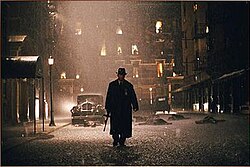
Hall also used specific camera placements to tell the story. Early in the film, the camera remains distant from Michael Sullivan, often viewing him through doorways or in shadows to reflect his son's limited understanding of his father's true profession. Additionally, several shots were lifted directly from Richard Piers Rayner's illustrations in the graphic novel, such as the reflection of the Chicago skyline in a car window.
| Category | Details |
|---|---|
| Director | Sam Mendes |
| Cinematographer | Conrad Hall |
| Lead Actors | Tom Hanks, Paul Newman, Jude Law |
| Format | Super 35 |
| Primary Locations | Chicago, IL (Pullman, Geneva, Evanston) |
Frequently Asked Questions
How does the film differ from the original graphic novel?
The film is more streamlined and less "pulpy" than the novel. Key changes include the removal of Sullivan's alcoholism, the addition of the character Maguire, and a change in narration; in the novel, the son narrates as an adult priest, whereas in the film, he narrates as a young boy.
What was the inspiration for the film's lighting?
Director Sam Mendes and cinematographer Conrad Hall drew inspiration from the atmospheric paintings of Edward Hopper, specifically the work New York Movie, to create a moody, minimalist look.
Why was Al Capone not seen in the final cut?
Although Anthony LaPaglia filmed a scene as Al Capone, Sam Mendes decided to omit it, believing that Capone was more menacing as an unseen presence in the story.
What techniques were used to make Jude Law look like Maguire?
To achieve a "seedy countenance," Law was given a sallow skin tone, a thinning hairline, and prosthetic dental work to make his teeth appear rotted.
How did the production handle the weather?
The crew filmed during the winter and spring of 2001 in Illinois, using actual snow, rain, and mud to emphasize the coldness and bleakness of the characters' emotional journeys.