Rioplatense Spanish: The Unique Dialect of Argentina and Uruguay
Rioplatense Spanish (also known as Castellano rioplatense) is a distinctive variety of the Spanish language spoken primarily in the Río de la Plata basin. Predominant in Argentina and Uruguay, this dialect is celebrated for its melodic cadence and unique grammatical structures, setting it apart from other Spanish varieties in the Americas and Spain.
While it is classified as a dialect rather than a separate language, it is spoken by an estimated 25 to 30 million people. Its influence extends beyond the borders of Argentina and Uruguay, reaching parts of Paraguay, eastern Bolivia, and the border regions of Brazil.
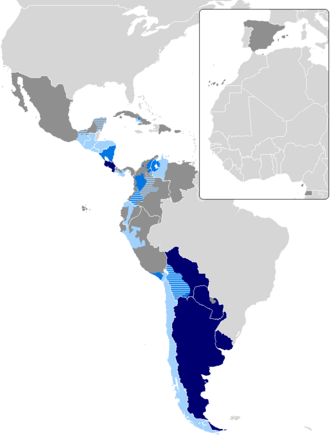
Key Facts
- Primary Regions: Argentina (centered in Buenos Aires, Rosario, Santa Fe, La Plata, Mar del Plata, and Bahía Blanca) and Uruguay (spoken nationwide).
- Defining Feature: The standard use of voseo (using vos instead of tú).
- Major Influence: Heavy linguistic impact from Italian immigrants, particularly Neapolitan and Sicilian dialects.
- Phonetics: Characterized by seseo (no distinction between /θ/ and /s/) and a specific pronunciation of the /x/ phoneme.
- Official Regulation: Regulated by the Academia Argentina de Letras and the Academia Nacional de Letras de Uruguay.
The History and Evolution of Rioplatense
Spanish was introduced to the region during the colonial era. In 1776, the area became the Viceroyalty of the Río de la Plata. Following independence in the early 19th century, the local criollo Spanish evolved with minimal external influence until the late 19th century.
The Impact of European Immigration
Between the 1870s and the mid-1960s, Argentina and Uruguay experienced massive waves of immigration. This demographic shift profoundly reshaped the local language:
- 1870–1890: Arrivals primarily from Northern Italy, Spain, the Basque Country, Galicia, France, and Germany.
- 1910–1945: A second wave including Southern Italians, Portuguese, and significant Jewish immigration from Poland and the Russian Empire.
Indigenous Contributions
Indigenous languages also left a mark on the vocabulary. For example, the word for popcorn varies by region: choclo or pochoclo (derived from Quechua) is common in Argentina, while pororó (derived from Guaraní) is used in Uruguay, Paraguay, and some Argentine provinces.
Linguistic Characteristics
Phonology and Intonation
Rioplatense is easily recognized by its sound. Like most American Spanish dialects, it employs seseo, meaning the letters 'z' and 'c' (before 'e' or 'i') are pronounced as [s]. Additionally, the phoneme /x/ (written as 'j' or 'g') is always realized as [x] and is never glottalized to [h] on the Atlantic coast.
One of the most striking features is its intonation. The speech patterns in Uruguay and the Buenos Aires area closely resemble Italian dialects. Research indicates that residents of Buenos Aires and Rosario speak with an intonation most similar to Neapolitan, a result of the Southern Italian immigration wave in the early 20th century.
The Voseo System
The most prominent grammatical feature is voseo: the use of the pronoun vos instead of tú for the second person singular. While voseo is considered nonstandard in some other Latin American countries, it is the standard in Argentina and Uruguay.
Voseo involves specific verb conjugations. For example, in the present indicative, the stress shifts to the final syllable:
| Verb | Peninsular Spanish (tú) | Rioplatense Spanish (vos) | English |
|---|---|---|---|
| Amar | tú amas | vos amás | you love |
| Correr | tú corres | vos corrés | you run |
| Decir | tú dices | vos decís | you say |
| Venir (Irregular) | tú ven | vos vení | come (imperative) |
Usage and Modern Influence
In informal spoken Rioplatense, the future tense is often replaced by a verbal periphrasis (a phrase using multiple words). For instance, instead of saying La visitaré mañana (I will visit her tomorrow), speakers typically say La voy a visitar mañana (I am going to visit her tomorrow).
The dialect's influence has reached beyond the Southern Cone. Certain Argentine terms have entered Iberian Spanish slang, such as pibe and piba (boy and girl), which led to the creation of the term pibón to describe a very attractive person.
Frequently Asked Questions
What is the difference between Rioplatense and standard Spanish?
The primary differences are the use of the pronoun vos (voseo) instead of tú, a distinct Italian-influenced intonation, and specific phonetic realizations of consonants like /x/.
Why does the accent sound like Italian?
This is due to the massive waves of Italian immigration to Argentina and Uruguay between the late 19th and mid-20th centuries, particularly from Naples and Sicily, which influenced the melodic patterns of the local speech.
Is voseo considered incorrect in Argentina?
No. Unlike some other Spanish-speaking regions where voseo might be viewed as a lower-class or nonstandard speaking style, it is the standard and accepted form of address in Argentina and Uruguay.
Where exactly is Rioplatense Spanish spoken?
It is the predominant variety in Uruguay and in the major urban centers of Argentina, including Buenos Aires, Rosario, and La Plata, as well as their surrounding regions.
What is seseo?
Seseo is a phonetic feature where the voiceless dental fricative /θ/ (the 'th' sound in 'think') is not distinguished from /s/. Consequently, words like casa (house) and caza (hunt) are pronounced identically.