Right of Abode in the UK: Eligibility, Rights, and Legal Status
The Right of Abode (ROA) is a specific immigration status in the United Kingdom that grants an individual the unrestricted right to enter, live, and work in the UK without any immigration restrictions. Established by the Immigration Act 1971 and effective from January 1, 1973, this status is distinct from other forms of residency and is primarily tied to British citizenship and specific historical connections to the UK.
While it is the most common immigration status due to its link with citizenship, it is frequently confused with Indefinite Leave to Remain (ILR). Unlike ILR, which is a form of permanent residence for non-citizens, the Right of Abode is an absolute right that cannot be revoked through standard immigration control.
Key Facts
- Unrestricted Access: Holders can live, work, and study in the UK without conditions.
- Citizenship Link: Since 1983, only British citizens can acquire this status.
- Travel Perks: Eligible individuals may use the UK/EEA/Switzerland immigration channels at ports of entry.
- Political Rights: Commonwealth citizens with ROA can vote and stand for public office, provided they reside in the UK.
- Proof of Status: Validated via a British citizen passport or a Certificate of Entitlement.
Rights and Privileges
Individuals possessing the Right of Abode enjoy several significant legal advantages regardless of whether they are British citizens, British subjects, or qualifying Commonwealth citizens. These include the unconditional right to reside and work in the UK, as well as the ability to use expedited immigration channels.
Furthermore, those with ROA who are not yet British citizens may apply for citizenship through naturalisation or registration. Children born in the UK, British Crown Dependencies, or British Overseas Territories to parents with the Right of Abode typically become British citizens automatically by birth.
Historical Context: Right of Abode Before 1983
Before the British Nationality Act 1981, ROA was determined by a combination of nationality and specific ties to the UK. Between 1973 and 1983, two main groups could qualify:
Citizens of the United Kingdom and Colonies (CUKCs)
CUKCs acquired the Right of Abode if they were born in the British Islands, born to a CUKC parent born in the British Islands, or had been settled in the British Islands for at least five years before December 31, 1982. Additionally, female CUKCs married to CUKC men with ROA were eligible.
Commonwealth Citizens
Commonwealth citizens could qualify if they were born to or adopted by a CUKC parent born in the British Islands. This was particularly relevant for those born to UK-born mothers, as women could not pass down CUKC status at the time. Female Commonwealth citizens married to CUKC men with ROA also qualified, subject to specific restrictions regarding previous marriages.
A notable complexity arose from the "so had it" language in legislation regarding grandparents' status. Courts eventually ruled that this referred specifically to CUKC status derived from the UK and islands, rather than general CUKC status. This interpretation was critical, as ROA on December 31, 1982, was a prerequisite for becoming a British citizen on January 1, 1983.
The Impact of the British Nationality Act 1981
The 1981 Act fundamentally changed how ROA functioned. CUKCs with the Right of Abode became British citizens in 1983. Those without ROA became either British Dependent Territories citizens or British Overseas citizens.
However, this transition created vulnerabilities. Anyone who lost their CUKC or Commonwealth status between 1973 and 1983—sometimes involuntarily due to a colony's independence—also lost their Right of Abode. This legal gap contributed to the 2018 Windrush scandal, where individuals found themselves without legal status despite long-term residency.
Acquiring and Proving Right of Abode Today
Since 1983, the Right of Abode is held by all British citizens and certain Commonwealth citizens or British subjects who retained the status prior to 1983. No person born in 1983 or later can possess ROA unless they are a British citizen.
Maintaining this status requires continuous Commonwealth citizenship. For example, citizens of Pakistan and South Africa generally do not have ROA because those countries were not Commonwealth members on January 1, 1983 (unless the individual holds citizenship in another Commonwealth country). Conversely, citizens of Fiji and Zimbabwe are still considered Commonwealth citizens for these purposes because the UK has not amended the relevant schedules of the 1981 Act.
To prove this status at a border, an individual must present one of two documents:
- A British passport identifying the holder as a British citizen or a British subject with the right of abode.
- A Certificate of Entitlement, which is a government-issued document affixed to a non-British passport.
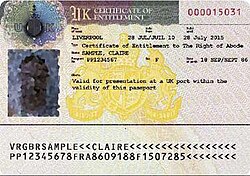
While a British passport is the most cost-effective proof, some individuals—such as dual nationals—prefer a Certificate of Entitlement. However, this certificate is significantly more expensive than a passport, costing £550.
Summary of UK Residency and Immigration Statuses
| Status | Who Holds It | Right to Live/Work | Proof Required |
|---|---|---|---|
| Right of Abode | British citizens, some Commonwealth citizens | Unrestricted / Absolute | British Passport or Certificate of Entitlement |
| Indefinite Leave to Remain | Non-British/Irish nationals | Permanent residency | BRP or visa stamp |
| Irish Citizenship | Citizens of the Republic of Ireland | Settled status (Common Travel Area) | Irish Passport |
| EEA Settlement | Eligible EU/EEA/Swiss nationals | Conditional/Settled status | Digital status/EUSS |
Other Immigration Concessions
Irish Citizens and the Common Travel Area
Irish citizens occupy a unique position. Under the Common Travel Area, they do not require leave to enter the UK and are considered to have "settled status," which exceeds the privileges of Indefinite Leave to Remain. They are also subject to more lenient deportation procedures than other EEA nationals.
EU, EEA, and Swiss Nationals
Following Brexit, the preferential residency rights for EEA citizens ceased. Those who resided in the UK on or before December 31, 2020, were eligible to apply for settlement or pre-settlement status. Those arriving after 2020 are subject to standard immigration rules, though the status of Irish citizens remains unaffected.
Frequently Asked Questions
What is the difference between Right of Abode and Indefinite Leave to Remain?
Right of Abode is an absolute, unrestricted right to live in the UK, typically tied to citizenship. Indefinite Leave to Remain (ILR) is a permanent residency status granted to non-citizens, which does not confer the same absolute right of entry.
Can I apply for a Right of Abode if I was born after 1983?
No. Since 1983, the only way to possess the Right of Abode is to be a British citizen.
How much does a Certificate of Entitlement cost?
A Certificate of Entitlement costs £550, making it considerably more expensive than applying for a British passport.
Do all Commonwealth citizens have the Right of Abode?
No. Only Commonwealth citizens who met specific criteria before 1983 (such as having a UK-born parent) and have maintained their Commonwealth citizenship continuously since then may hold the Right of Abode.
How do I prove my Right of Abode at the border?
You must present either a British passport that identifies you as a British citizen (or a British subject with ROA) or a valid Certificate of Entitlement affixed to your travel document.