Rifleman: New Zealand's Smallest Endemic Bird
The rifleman (Acanthisitta chloris), known in Māori as titipounamu or tītitipounamu, is a remarkable small insectivorous passerine bird endemic to New Zealand. As one of only two surviving species in the family Acanthisittidae (the New Zealand wrens), it represents a unique lineage of avian evolution. While it resembles a wren in appearance, it is not related to the true wrens of the Troglodytidae family or the Australian fairy-wrens.
The bird takes its English name from a colonial New Zealand regiment, as its plumage closely resembles the military uniforms worn by riflemen of that era.
Key Facts
- Status: Least Concern (IUCN 3.1).
- Size: New Zealand's smallest endemic bird, measuring 7 to 9 cm.
- Diet: Insectivorous, specializing in maggots and small insects.
- Habitat: Thinly wooded forests, including beech and podocarp forests.
- Unique Trait: Calls that include frequencies in the ultrasonic range.
Taxonomy and Classification
First described by Anders Sparrman in 1787 from a specimen collected in Queen Charlotte Sound, the rifleman was initially placed in the nuthatch genus Sitta. In 1842, Frédéric de Lafresnaye established the monotypic genus Acanthisitta—a portmanteau of Acanthisitta (thornbill) and Sitta.
There are two recognized subspecies: A. c. chloris, found in the South Island, and A. c. granti, primarily located in the lowland tawa forests of the North Island.
Physical Description
The rifleman is a diminutive bird, with adults typically reaching 7 to 9 cm in length. There is a slight difference in weight and anatomy between the sexes: males average 6 g, while females average 7 g. Females also possess a longer bill and hind claw, a physical divergence likely rooted in ecological needs to support different foraging niches when feeding chicks.
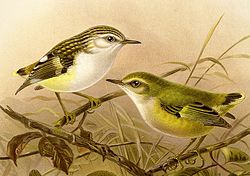
The male is striking, featuring bright green upperparts, a yellow-green rump, and black wings accented with green, white, and a yellow band. In contrast, the female has a more somber brownish tone with ochre flecks on her head and back. Both sexes share white eyebrow stripes and a long, thin, brownish, awl-like bill that is slightly upturned, allowing them to probe deep into cracks.
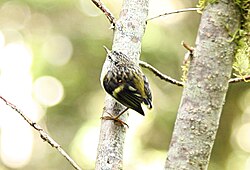
Their flight is rapid, characterized by a wing beat that produces a humming sound similar to that of a hummingbird.
Distribution and Habitat
Riflemen are most widespread across the two main islands of New Zealand, though they are rarely found north of Te Aroha. Their preferred habitats vary by subspecies: the South Island variety inhabits high-altitude beech forests or lowland podocarp forests, while the North Island variety favors lowland tawa forests.
These birds are highly territorial, with pairs defending the same territory daily. Because they only fly short distances and avoid crossing open areas, forest fragmentation due to land development has led to more isolated populations.
Behavior and Ecology
Feeding Habits
The rifleman is an insectivore that hunts maggots and small insects. It employs a systematic foraging method similar to the treecreeper: starting at the base of a tree, it spirals upward around the trunk before gliding to the foot of the next tree to repeat the process.
Vocalizations
Their vocal range consists of simple, high-pitched calls, most notably a repetitive, squeaky "zipt." Interestingly, some of these calls reach ultrasonic frequencies, though it remains unknown if the birds can actually hear these sounds or what purpose they serve.
Breeding and Nesting
Both the male and female collaborate to build a dome-shaped or ovoid nest made of grass blades, down feathers, and other light materials. These nests are tucked into tree trunk holes, branches, or ground cavities, often featuring a tunnel entrance so narrow the bird may struggle to enter.
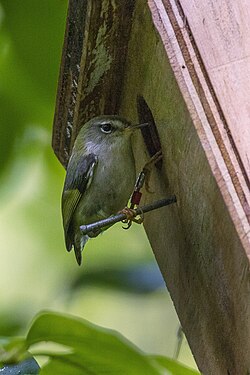
Courtship feeding is vital; males provide up to 42% of the food they collect to the female, accounting for 35% of her total intake during the laying period. A typical clutch consists of two to five eggs, incubated for 19–21 days by both parents. Chicks fledge after 21–27 days and become independent within four to six weeks. Two broods per year are common, and the use of nest boxes has been shown to increase fledging success.
Summary Table
| Feature | Details |
|---|---|
| Scientific Name | Acanthisitta chloris |
| Average Length | 7–9 cm |
| Weight | Male: 6g | Female: 7g |
| Diet | Insectivorous (maggots, small insects) |
| Conservation Status | Least Concern |
| Key Habitats | Beech, Podocarp, and Tawa forests |
Frequently Asked Questions
Is the rifleman a true wren?
No. Although it resembles a wren and is part of the New Zealand wren family (Acanthisittidae), it is not related to the true wrens (Troglodytidae) or the Australian fairy-wrens.
Why is the rifleman called a "rifleman"?
The bird was named after a colonial New Zealand regiment because its plumage colors were similar to the uniforms worn by riflemen of that time.
How does the rifleman find its food?
It searches for insects by starting at the base of a tree and spiraling upward around the trunk, then gliding to the next tree to begin the process again.
What are the differences between male and female riflemen?
Males are bright green with yellow-green rumps, while females are brownish with ochre flecks. Females also have longer bills and hind claws, likely to support different foraging needs during chick-rearing.
Does the rifleman appear in any cultural references?
Yes, the rifleman was featured on the reverse side of the New Zealand $2 banknote from 1967 until 1991.