Richard Dawkins: The Evolutionary Biologist and Public Intellectual
Richard Dawkins is a world-renowned evolutionary biologist, author, and public intellectual known for his rigorous defense of science and his provocative critiques of organized religion. From his early academic work at the University of Oxford to his role as a leading figure in the New Atheism movement, Dawkins has spent decades shaping how the general public understands the mechanisms of life and the nature of belief.
His work is characterized by a commitment to clarity and a desire to bridge the gap between complex scientific research and public understanding. Whether discussing the genetic drivers of behavior or the philosophical implications of a godless universe, Dawkins remains one of the most influential and debated figures in contemporary science.

Key Facts

- Primary Field: Evolutionary Biology.
- Key Concepts: Gene-centred view of evolution, the "meme," and the extended phenotype.
- Education: Oundle School and the University of Oxford (MA, DPhil).
- Notable Works: The God Delusion and The Ancestor's Tale.
- Major Awards: ZSL Silver Medal, Michael Faraday Prize, and the International Cosmos Prize.
Academic Foundation and Scientific Career
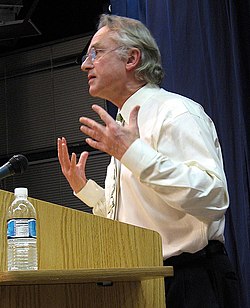
Born in Nairobi, British Kenya, Richard Dawkins pursued his higher education at the University of Oxford. His early scientific contributions were rooted in ethology—the study of animal behavior. His 1967 doctoral thesis, Selective pecking in the domestic chick, was completed under the guidance of the esteemed Nikolaas Tinbergen.
Dawkins is most famous for promoting a gene-centred view of evolution. This perspective suggests that the gene, rather than the individual or the species, is the primary unit of selection in evolution. He further expanded this theory with the concept of the extended phenotype, which argues that a gene's influence can extend beyond the physical body of the organism to affect its environment.
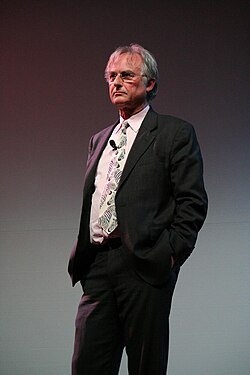
The Concept of the Meme
Beyond biology, Dawkins introduced the term meme to describe a unit of cultural transmission. Similar to how genes propagate in a biological population, memes—such as ideas, melodies, or fashions—spread from person to person through imitation and mutation, evolving as they move through a culture.
Public Intellectualism and Criticism of Religion
While his early career focused on biology, Dawkins later became a prominent critic of religion and creationism. He is often associated with New Atheism, a movement characterized by a more assertive and critical approach to religious faith. His 2006 book, The God Delusion, serves as a comprehensive argument against the existence of a supernatural creator.

Dawkins has frequently campaigned to keep religious instruction out of classrooms and has advocated for the promotion of scientific literacy. His public appearances, ranging from lectures at the Cooper Union to appearances in documentaries, have cemented his status as a champion of reason and evidence-based thinking.
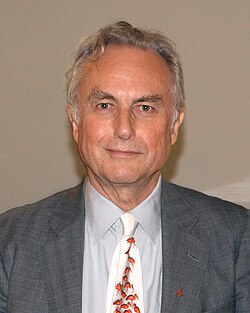
Advocacy and Activism
His activism has taken many forms, including the Atheist Bus Campaign in London and various lectures across the United States and Europe. Despite his strident views, Dawkins has described himself as a "cultural Christian," acknowledging the cultural heritage of the faith while rejecting its theological claims.

Awards, Recognition, and Media
Throughout his career, Dawkins has received numerous accolades for his contributions to science and humanism. He has been awarded the ZSL Silver Medal (1989), the Michael Faraday Prize (1990), and the Nierenberg Prize (2009). In 2012, he was honored with the Services to Humanism award by the British Humanist Association.

In addition to his writing, Dawkins has produced a vast array of documentary films, including The Blind Watchmaker (1987) and The Enemies of Reason (2007). He has also made guest appearances in popular media, including a cameo as himself in the Doctor Who episode "The Stolen Earth" (2008).
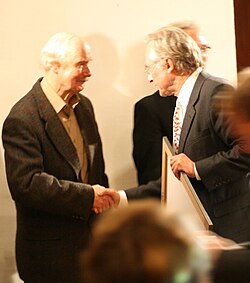
Summary of Career and Achievements
| Category | Details |
|---|---|
| Academic Degrees | MA, DPhil (University of Oxford) |
| Key Scientific Theories | Gene-centred evolution, Memetics, Extended Phenotype |
| Major Publications | The God Delusion, The Ancestor's Tale |
| Notable Awards | International Cosmos Prize, Deschner Prize, Trotter Prize (2025) |
| Institutional Affiliations | University of Oxford, UC Berkeley, New College of the Humanities |
Personal Life
Dawkins has been married four times: to Marian Stamp, Eve Barham, Lalla Ward, and most recently to Jana Lenzová in 2021. He has one child. In 2016, he suffered a mild stroke, which led to the temporary cancellation of some of his public appearances, though he continued his work following recovery.
Frequently Asked Questions
What is a "meme" in the context of Richard Dawkins' work?
A meme is a unit of cultural information—such as an idea, belief, or practice—that spreads from person to person through imitation. Dawkins proposed this to explain how cultural evolution mirrors biological evolution.
What is the "gene-centred view of evolution"?
This is the theory that the gene is the fundamental unit of selection. Rather than focusing on the survival of the species or the individual, this view posits that evolution is driven by genes that successfully replicate themselves across generations.
What is the main argument of The God Delusion?
In The God Delusion, Dawkins argues that the existence of a god is an improbable hypothesis and that religious faith is often based on flawed logic or tradition rather than empirical evidence.
Has Richard Dawkins received any major scientific awards?
Yes, he has received several prestigious awards, including the ZSL Silver Medal, the Michael Faraday Prize, the International Cosmos Prize, and the Nierenberg Prize.
What is the "extended phenotype"?
The extended phenotype is the idea that the effects of a gene are not limited to the organism's physical body but can include the environment it modifies or the structures it builds (such as a beaver's dam).