Ricardo Lagos: The Legacy of Chile's 32nd President
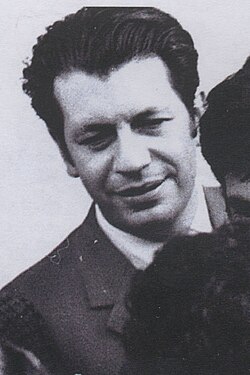
Ricardo Lagos Escobar is a distinguished Chilean lawyer, economist, and social-democratic politician who served as the 32nd President of Chile from 2000 to 2006. A pivotal figure in the nation's transition to democracy, Lagos is remembered not only for his executive leadership but for his courageous defiance of military rule during the 1980s.
His journey from academic circles to the presidency reflects a lifelong commitment to social democracy and the rule of law. As a leader of the center-left Concertación (a coalition of parties for democracy), Lagos helped steer Chile through economic challenges and a profound process of national healing following years of dictatorship.
Key Facts
- Presidency: Served as President of Chile from March 11, 2000, to March 11, 2006.
- Historic Defiance: Openly denounced dictator Augusto Pinochet on live television in 1988.
- Academic Background: Holds a law degree from the University of Chile and a Ph.D. in Economics from Duke University.
- Human Rights: Oversaw the release of the Valech Report and provided compensation to approximately 30,000 victims of torture.
- Global Role: Served as a UN Special Envoy on Climate Change from 2007 to 2010.
Early Life and Academic Foundation
Born on March 2, 1938, in Santiago, Ricardo Lagos built a formidable intellectual foundation early in his career. After earning his law degree from the University of Chile in 1960, he moved to the United States to pursue a Ph.D. in Economics at Duke University, which he completed in 1966. During this period, he also served as a visiting professor at the University of North Carolina at Chapel Hill.
Upon returning to Chile, Lagos held several high-ranking academic positions, including Director of the School of Political and Administrative Sciences and Secretary General of the University of Chile. His expertise in economics and law positioned him as a key intellectual voice in Chilean public life.
Diplomatic Career and the Fight for Democracy
Throughout the 1970s, Lagos operated as an "independent of the left," utilizing his academic and diplomatic skills on the global stage. He served as a Chilean delegate to the United Nations, where he gained attention for criticizing U.S. President Richard Nixon's decision to suspend the convertibility of the U.S. dollar into gold.
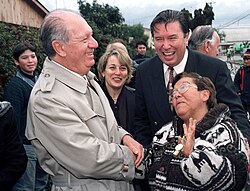
By the 1980s, Lagos became a central figure in the resistance against the military dictatorship of General Augusto Pinochet. As President of the Democratic Alliance, he unified various democratic parties. In a moment that stunned the nation in 1988, Lagos used a live television appearance to openly denounce Pinochet, citing the regime's history of torture and human rights violations.
Rise to the Presidency
Following the return to democracy, Lagos served in two critical cabinet roles: Minister of Education (1990–1992) under President Patricio Aylwin, and Minister of Public Works (1994–1998) under President Eduardo Frei Ruiz-Tagle. In the latter role, he introduced an innovative system of road concessions that integrated private sector investment into public infrastructure.
In the 1999–2000 election, Lagos faced a tight race against Joaquín Lavín. After a narrow first round, he won the first-ever presidential runoff in Chilean history with 51.3% of the vote, taking office on March 11, 2000.
The Presidency (2000–2006)
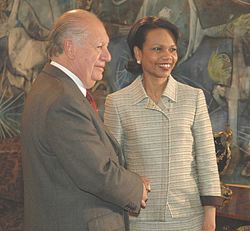
Lagos's presidency was marked by a focus on economic stability and social reconciliation. He managed high unemployment rates caused by regional instability and worked to keep inflation and budget deficits low. He was noted for his "policy of proximity," which included reopening the doors of the Palacio de La Moneda—the presidential palace—which had remained closed since the 1973 coup.
Human Rights and Legal Reforms
One of the most significant achievements of the Lagos administration was the advancement of human rights. He established a commission to investigate torture, leading to the Valech Report. Following this, his government provided compensation to roughly 30,000 victims of the military dictatorship. Additionally, in 2001, Lagos signed a bill abolishing the death penalty for civilian crimes in Chile.
International Relations
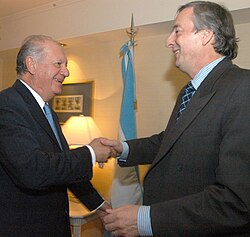
Lagos maintained strong international ties, positioning Chile as a stable and democratic partner on the world stage. His leadership was characterized by a commitment to social democratic values, which he helped refine as a member of the Socialist International's Committee of Twelve Distinguished Members.
Post-Presidential Life and Global Impact
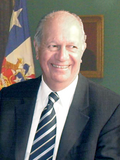
After leaving office in 2006 with a historic approval rating of 75%, Lagos transitioned to global diplomacy. From 2007 to 2010, he served as the Special Envoy on Climate Change for UN Secretary-General Ban Ki-moon. He also returned to academia, teaching at Brown University's Watson Institute for International Studies for five years starting in 2007.
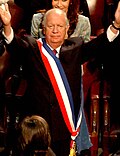
Though he briefly considered a presidential bid in 2017, he ultimately withdrew and announced his retirement from active politics.
Summary of Political Career
| Role | Period | Key Contribution/Context |
|---|---|---|
| Minister of Education | 1990–1992 | Initiated reforms for educational equality. |
| Minister of Public Works | 1994–1998 | Developed private sector road concessions. |
| President of Chile | 2000–2006 | Abolished death penalty; oversaw Valech Report. |
| UN Special Envoy | 2007–2010 | Focused on global climate change. |
Frequently Asked Questions
How did Ricardo Lagos contribute to human rights in Chile?
Lagos established a commission to determine the extent of torture during the military dictatorship, which resulted in the Valech Report. He subsequently provided financial compensation to approximately 30,000 recognized victims and submitted the bill that created the National Institute of Human Rights.
What was the significance of the 2000 presidential election?
The election was historic because it resulted in the first-ever presidential runoff in Chile's history. Ricardo Lagos won the runoff with 51.3% of the vote after failing to secure an absolute majority in the first round.
What was the "policy of proximity" mentioned during his presidency?
This policy aimed to make the government more accessible to the people. A symbolic gesture of this approach was the reopening of the doors of the Palacio de La Moneda, which had been closed to the public since the 1973 coup d'état.
What academic qualifications does Ricardo Lagos hold?
Ricardo Lagos is both a lawyer and an economist. He earned his law degree from the University of Chile in 1960 and a Ph.D. in Economics from Duke University in 1966.
Did Ricardo Lagos serve in any international roles after his presidency?
Yes, from 2007 to 2010, he served as the Special Envoy on Climate Change for United Nations Secretary-General Ban Ki-moon.