Regina Carter: Pioneering the Art of Jazz Violin
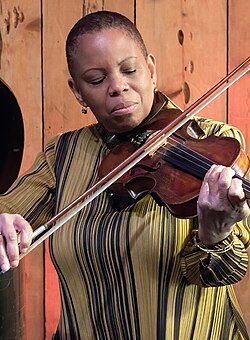
Regina Carter is a virtuoso American jazz violinist who has redefined the role of the violin within the jazz idiom. Known for her fluid grace and a signature style that blends classical precision with improvisational freedom, Carter has bridged the gap between the rigid traditions of the concert hall and the spontaneous energy of the jazz club.
Key Facts
- Born: August 6, 1966, in Detroit, Michigan.
- Education: Studied at the New England Conservatory of Music and Oakland University.
- Major Honors: Recipient of the MacArthur "Genius Grant" (2006) and the Doris Duke Award (2018).
- Historic Achievement: First jazz musician and first African American to play the 1743 Il Cannone Guarnerius violin.
- Musical Range: Integrates Motown, Afro-Cuban, Swing, Bebop, Folk, and World music into her repertoire.
Early Life and Musical Foundations
Born into a musical environment in Detroit, Carter's journey began at age two with piano lessons. However, her creative spirit led her toward the violin. After a piano teacher noted her tendency to experiment with notes, it was suggested that the Suzuki Method—a pedagogical approach emphasizing ear training and repetition—would better suit her creativity. By age four, she was studying violin at the Detroit Community Music School, while simultaneously pursuing tap, ballet, and piano.
As a teenager, Carter's talent was evident as she performed with the youth division of the Detroit Symphony Orchestra and attended master classes with legendary violinists Itzhak Perlman and Yehudi Menuhin. Her high school years at Cass Technical High School were a period of diverse exploration; she played in the Detroit Civic Orchestra and a pop-funk group called Brainstorm, while studying viola, oboe, and choir.
The Transition to Jazz
Carter initially pursued classical violin at the New England Conservatory of Music in Boston. However, her passion shifted toward jazz, leading her to transfer to Oakland University in Rochester, Michigan. Under the guidance of Marvin "Doc" Holladay and trumpeter Marcus Belgrave, she immersed herself in the Detroit jazz scene. After graduating in 1985, she spent two years in Germany teaching violin and working as a nanny before returning to the United States to launch her professional career.
Professional Career and Artistic Evolution
Carter first gained prominence in 1987 as a member of Straight Ahead, an all-female pop-jazz quintet. The group earned praise from Branford Marsalis and released three albums on the Atlantic Jazz label. In 1991, Carter moved to New York City to pursue a solo path.
In New York, she became a versatile session musician, accompanying icons such as Aretha Franklin, Billy Joel, Dolly Parton, Lauryn Hill, and Mary J. Blige. She also collaborated with jazz greats Max Roach and Oliver Lake and became a member of the String Trio of New York, contributing to albums like Intermobility and Octagon.
Solo Success and Historic Performances
Carter released her self-titled debut solo album in 1995, followed by Something for Grace in 1997. A move to the Verve Music Group provided her with greater artistic freedom, resulting in acclaimed works such as Rhythms of the Heart (1999) and Motor City Moments (2000), the latter of which paid tribute to her Detroit roots.
One of the most significant moments of her career occurred in December 2001 in Genoa, Italy. Carter was invited to perform on Il Cannone Guarnerius, a 1743 violin once owned by Niccolò Paganini. This performance was a gesture of solidarity following the September 11 attacks, making Carter the first jazz musician and the first African American to play the historic instrument, known for its "explosive" sound.
Education, Mentorship, and Recognition
Beyond her performances, Carter is a dedicated educator. She served as Artist in Residence at Oakland University from 2007 to 2018 and has taught at the Stanford Jazz Workshop. In 2018, she took on the role of Artistic Director for the New Jersey Performing Arts All-Female Jazz Camp.
In 2006, Carter was awarded the prestigious MacArthur Fellows Program grant, often called the "genius grant," which provided $500,000 over five years. The committee praised her for pioneering new possibilities for the violin in jazz, noting her ability to blend a wide array of influences—from Bebop to Afro-Cuban rhythms—with the fluidity of her classical training.
| Category | Details |
|---|---|
| Primary Instrument | Violin |
| Key Labels | Atlantic, Verve, Masterworks |
| Notable Collaborations | Wynton Marsalis, Kenny Barron, Eddie Palmieri |
| Major Awards | MacArthur Grant (2006), Doris Duke Award (2018) |
| Academic Affiliations | Oakland University, New England Conservatory |
Frequently Asked Questions
What is the significance of the Il Cannone Guarnerius violin?
Il Cannone is a historic violin made in 1743 and owned by Niccolò Paganini. Regina Carter made history as the first jazz musician and first African American to perform on this instrument during a 2001 concert in Genoa.
Which musical styles influence Regina Carter's work?
Her style is a fusion of her classical training and a broad range of jazz and world influences, including Swing, Bebop, Motown, Afro-Cuban, and Folk music.
What is the MacArthur "genius grant"?
The MacArthur Fellows Program grant is a prestigious award given to individuals who show exceptional creativity and promise. Carter received this in 2006, including a $500,000 grant over five years.
Has Regina Carter worked with other famous musicians?
Yes, she has collaborated with a diverse array of artists, including Wynton Marsalis, Aretha Franklin, Billy Joel, and the String Trio of New York, and performed on Eddie Palmieri's Grammy-winning album Listen Here!
What is Carter's connection to the Suzuki Method?
Carter began her violin studies using the Suzuki Method at age four and has since become a proponent and mentor of the method through her workshops and master classes.