Ella Fitzgerald: The Life and Legacy of the First Lady of Song
Known affectionately as the "First Lady of Song" and the "Queen of Jazz," Ella Fitzgerald remains one of the most influential vocalists in music history. Renowned for her purity of tone, impeccable diction, and a "horn-like" ability to improvise, she transformed the art of jazz singing. Her mastery of scat singing—a vocal style using nonsense syllables to improvise like a musical instrument—set a gold standard for generations of performers.
From her humble beginnings in Virginia to the global stages of Europe and the White House, Fitzgerald's career spanned nearly six decades, bridging the gap between traditional pop and the complex harmonies of bebop.
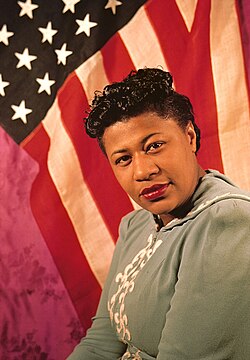
Key Facts
- Full Name: Ella Jane Fitzgerald
- Active Years: 1934–1993
- Key Genres: Jazz, swing, bebop, traditional pop, blues, soul, and doo-wop
- Signature Style: Exceptional intonation, phrasing, and pioneering scat singing
- Major Contributions: The "Song Book" series, documenting the Great American Songbook
- Notable Collaborators: Louis Armstrong, Duke Ellington, and Count Basie
Early Life and Challenges
Ella Jane Fitzgerald was born on April 25, 1917, in Newport News, Virginia. Her early years were marked by instability; her parents were unmarried, and she eventually moved to Yonkers, New York, with her mother and stepfather, Joseph da Silva. A promising student, Ella attended Benjamin Franklin Junior High School in 1929.
Tragedy struck in 1932 when her mother died following a car accident. At age 15, after a brief period under the care of her stepfather—a time later speculated by biographer Stuart Nicholson to have involved ill treatment—Fitzgerald moved to Harlem to live with her aunt. This transition to New York City placed her in the heart of the jazz world, setting the stage for her professional ascent.
The Ascent of a Jazz Icon
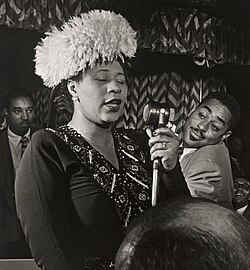
Fitzgerald's professional journey began in earnest in the mid-1930s. Between 1935 and 1942, she recorded nearly 150 songs with the Chick Webb orchestra. During this era, she also performed with the Benny Goodman Orchestra and led her own side project, Ella Fitzgerald and Her Savoy Eight.
The Verve Years and the Song Books
A pivotal moment in her career occurred on March 15, 1955, when she began an engagement at the Mocambo nightclub in Hollywood. This booking was facilitated by Marilyn Monroe, who lobbied the club's owner to hire her. While some reports claimed she was the first Black performer at the venue, records show that artists like Herb Jeffries and Eartha Kitt had performed there previously.
Under the guidance of Norman Granz, Fitzgerald embarked on her most ambitious project: the "Song Book" sets. Starting with the Cole Porter Song Book in 1956, she recorded eight sets between 1956 and 1964. These recordings focused on the Great American Songbook—the cultural canon of standard songs from the early 20th century—and helped her reach audiences beyond the jazz community.
Diversification and Later Labels
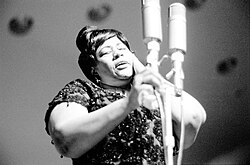
After Verve Records was sold to MGM in 1960 and her contract ended in 1967, Fitzgerald explored various styles across labels like Atlantic, Capitol, and Reprise. She recorded hymns, traditional Christmas carols, and country-influenced music. In 1972, the success of Jazz at Santa Monica Civic '72 led Norman Granz to found Pablo Records, where Fitzgerald recorded approximately 20 more albums.
Legendary Collaborations
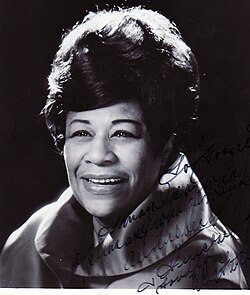
Fitzgerald's career was defined by her chemistry with other jazz giants. She recorded three studio albums with Louis Armstrong, including the acclaimed Ella and Louis. Her work with Count Basie, particularly the 1963 album Ella and Basie! (arranged by a young Quincy Jones), is regarded as some of her finest work.
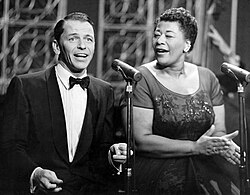
She also collaborated extensively with Duke Ellington, producing live and studio albums that cemented Ellington's place in the Great American Songbook. In her later years, she found a perfect melodic foil in guitarist Joe Pass, with whom she recorded four albums between 1973 and 1986.
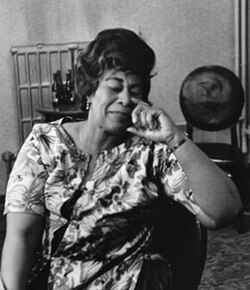
Personal Life and Final Years
Fitzgerald's personal life included two marriages: first to Benny Kornegay (1941–1942) and later to bassist Ray Brown (1947–1953). In the 1960s, she spent significant time in Denmark, even purchasing a home in Klampenborg, though she eventually returned permanently to the United States.
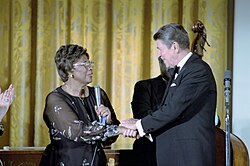
Her later years were complicated by diabetes, which led to severe health issues. She suffered from congestive heart failure and respiratory problems, and in 1993, both of her legs were amputated below the knee. Despite these hardships, she continued to be honored globally, including a performance at the White House in 1981 for President Ronald Reagan.
Ella Fitzgerald passed away on June 15, 1996, at the age of 79. She is buried at Inglewood Park Cemetery.
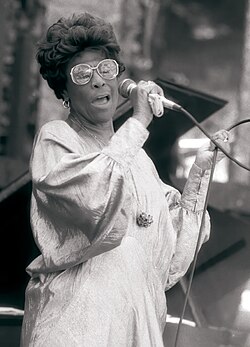
Legacy and Tributes
The influence of "Lady Ella" persists through numerous tributes. Artists such as Ann Hampton Callaway, Dee Dee Bridgewater, and Patti Austin have recorded tribute albums. She is referenced in songs by Stevie Wonder ("Sir Duke") and Frank Sinatra ("Mack the Knife").
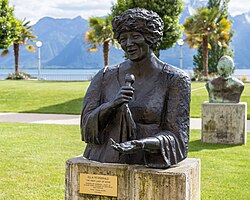
In 2008, the Downing-Gross Cultural Arts Center in her hometown of Newport News named its theater the Ella Fitzgerald Theater. Her global impact is further symbolized by a statue in her honor located in Montreux, Switzerland.
| Category | Details |
|---|---|
| Primary Labels | Decca, Verve, Capitol, Reprise, Pablo |
| Key Instruments | Vocals, Piano |
| Major Works | The Song Book series, Ella and Louis, Ella and Basie! |
| Notable Honors | White House performance (1981), Ella Fitzgerald Theater (2008) |
Frequently Asked Questions
What is scat singing?
Scat singing is a jazz vocal improvisation technique where the singer uses nonsense syllables instead of words, effectively treating the voice as a musical instrument like a trumpet or saxophone.
What was the "Song Book" series?
The "Song Book" series consisted of eight sets recorded for Verve Records between 1956 and 1964. These albums showcased the works of great American composers and lyricists, helping to define the Great American Songbook.
Who was the "First Lady of Song"?
The "First Lady of Song" is a title given to Ella Fitzgerald in recognition of her immense contribution to jazz and traditional pop music, as well as her technical mastery of singing.
Did Marilyn Monroe help Ella Fitzgerald's career?
Yes, Marilyn Monroe lobbied the owner of the Mocambo nightclub in Hollywood to book Fitzgerald in 1955, which provided a significant boost to her career and visibility.
Which famous musicians did Ella Fitzgerald collaborate with?
Fitzgerald collaborated with some of the most legendary figures in jazz, including Louis Armstrong, Duke Ellington, Count Basie, and guitarist Joe Pass.