Regierungsbezirk: Germany's Mid-Level Administrative Districts
In the complex structure of German governance, the Regierungsbezirk (plural: Regierungsbezirke) serves as a vital mid-level administrative division. Literally translated as a "governmental district," these entities act as decentralized organs of a state government, bridging the gap between the state level (Länder) and the local rural or urban districts.
While Germany consists of sixteen states, not all utilize this system. Currently, only four states employ Regierungsbezirke to manage regional administrative decisions. These districts are non-legislative bodies, meaning they focus on execution and administration rather than creating laws.
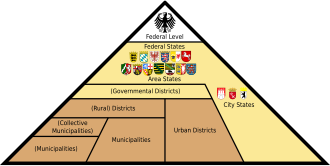
Key Facts
- Current Usage: Only 4 of Germany's 16 states currently use Regierungsbezirke.
- Total Districts: There are 19 active Regierungsbezirke across Germany.
- Governing Bodies: They are led by a Regierungspräsident (governing president) and managed by a Regierungspräsidium or Bezirksregierung.
- Population Range: Districts vary significantly in size, from Gießen (1,040,000) to Düsseldorf (5,244,000).
- Historical Origin: The system was first established in 1808 in the Kingdoms of Bavaria and Prussia.
Administrative Structure and Function
A Regierungsbezirk functions as a regional authority that oversees the districts within its jurisdiction. Depending on the state, the governing body may be called a Regierungspräsidium (governing presidium) or a Bezirksregierung (district government). Their primary role is to implement state-level policies and handle administrative decisions locally.
In contrast, the state of Saxony previously used Direktionsbezirke (directorate districts), which held more responsibilities shifted from the state parliament, before eventually merging them into a single state directorate (Landesdirektion) in 2012.
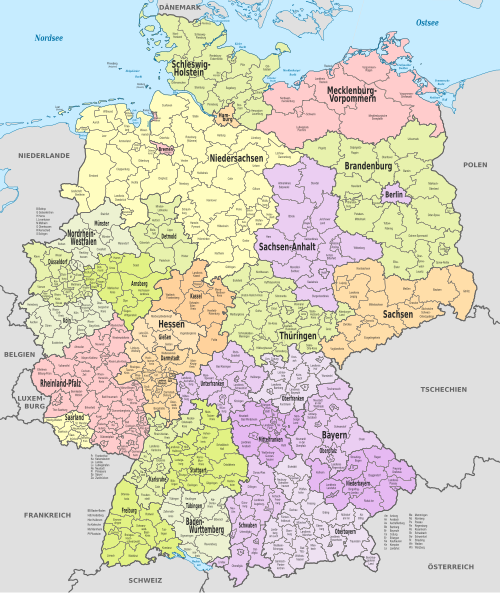
Historical Evolution
The concept of the Regierungsbezirk emerged during the early 19th century. Between 1808 and 1816, Prussia subdivided its provinces into 25 districts, a number that eventually grew to 37 across twelve provinces. By the time of German unification in 1871, most states in the German Empire had adopted similar systems, though they often used different names such as Kreishauptmannschaft in Saxony or province in Hesse.
During the Nazi era, these various regional names were standardized to Regierungsbezirk, though these naming reforms were reverted after World War II. Some modern districts, particularly in North Rhine-Westphalia, are direct continuations of the Prussian Rhine and Westphalia provinces established in 1816.
Post-War and Reunification Changes
Following the 1946 merger that created Lower Saxony, the state initially utilized a mix of Verwaltungsbezirke (administrative regions of extended competence) and Prussian-style Regierungsbezirke. These were standardized into four Regierungsbezirke in 1978. After German reunification in 1990, Saxony and Saxony-Anhalt initially established three Regierungsbezirke each, though these were later reorganized or disbanded.
Modern Disbandment and Reorganization
Since the turn of the millennium, several states have moved away from the mid-level district model to streamline administration:
- Rhineland-Palatinate (2000): Disbanded three districts (Koblenz, Rheinhessen-Pfalz, and Trier), converting them into state-wide public authorities.
- Saxony-Anhalt (2004): Disbanded Dessau, Halle, and Magdeburg, replacing them with a Landesverwaltungsamt (state administration office).
- Lower Saxony (2005): Disbanded its four remaining districts: Brunswick, Hanover, Lüneburg, and Weser-Ems.
- Saxony (2008-2012): Renamed its districts to Direktionsbezirke in 2008 before merging them into one Landesdirektion in 2012.
Current Regierungsbezirke by State
The following table summarizes the current distribution of the 19 active Regierungsbezirke across the four remaining states.
| State | Districts (Bezirke) | Total Population | Total Area (km²) |
|---|---|---|---|
| Baden-Württemberg | Freiburg, Karlsruhe, Stuttgart, Tübingen | 11,245,898 | 35,748 |
| Bavaria | Lower Bavaria, Lower Franconia, Middle Franconia, Swabia, Upper Franconia, Upper Bavaria, Upper Palatinate | 13,248,928 | 70,549 |
| Hesse | Darmstadt, Gießen, Kassel | 6,280,793 | 21,116 |
| North Rhine-Westphalia | Arnsberg, Cologne, Detmold, Düsseldorf, Münster | 18,034,454 | 34,112 |
Frequently Asked Questions
What is a Regierungsbezirk?
A Regierungsbezirk is a mid-level administrative division in Germany that acts as a decentralized arm of the state government, managing administrative tasks for the districts within its region.
Which German states still use Regierungsbezirke?
Currently, only Baden-Württemberg, Bavaria, Hesse, and North Rhine-Westphalia utilize this administrative structure.
Who leads a Regierungsbezirk?
Each district is headed by a Regierungspräsident (governing president), who oversees the Regierungspräsidium or Bezirksregierung.
How does a Regierungsbezirk differ from a Land?
A Land is a federal state with its own legislative powers, whereas a Regierungsbezirk is a non-legislative administrative unit within a state used to implement government decisions locally.
Why have some states disbanded their Regierungsbezirke?
States like Lower Saxony and Saxony-Anhalt disbanded their districts to reorganize administrative responsibilities, often moving them to state-wide offices or directly to local districts to increase efficiency.