German Districts: The Structure of Landkreise and Stadtkreise
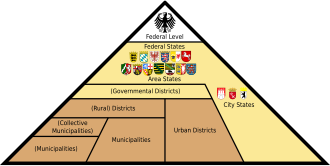
In the complex administrative landscape of Germany, the district (known as Kreis) serves as a vital intermediate level of governance. Positioned between the federal states (Länder) and the local municipalities (Gemeinden), these districts ensure that essential public services are delivered efficiently across both rural and urban environments. In the Nomenclature of Territorial Units for Statistics, these correspond to level-3 administrative units (NUTS 3).
While most German states utilize this system, the specific application varies depending on whether an area is predominantly rural or a densely populated city. This structure allows larger cities to manage their own affairs independently while ensuring rural municipalities have a centralized administrative body to handle larger-scale infrastructure and social services.
Key Facts
- Total Districts: There are 400 districts in total (as of 2017).
- Rural Districts: 294 Landkreise manage groups of municipalities.
- Urban Districts: 106 Stadtkreise (or kreisfreie Städte) function as both a municipality and a district.
- Governance: Rural districts are led by a Landrat and governed by an elected Kreistag.
- Scope: Districts handle critical services including waste disposal, car registration, and secondary education.
Types of German Districts
Rural Districts (Landkreise)
The majority of districts are Landkreise. These are administrative bodies that encompass several smaller municipalities. They provide a layer of coordination and resource sharing for towns and villages that are too small to manage high-level infrastructure independently.
Urban Districts (Stadtkreise)
Cities with more than 100,000 inhabitants typically do not belong to a rural district. Instead, they are designated as Stadtkreise (urban districts) or kreisfreie Städte (district-free cities). These entities are unique because they combine the administrative functions of both a municipality and a district into a single government.
There are exceptions to this rule. In North Rhine-Westphalia, cities such as Recklinghausen, Gütersloh, Siegen, Paderborn, Bergisch Gladbach, Neuss, and Moers have over 100,000 residents but remain part of a rural district, though they may still perform many district-level responsibilities themselves.
Special Municipal Unions
Some regions utilize Kommunalverbände besonderer Art (municipal unions of a special kind). These are fusions of a district-free town and its surrounding rural district. Examples include the Hanover Region (since 2001), the Städteregion Aachen (since 2009), and the Regionalverband Saarbrücken. In these cases, cities like Aachen and Hanover retain certain rights of an urban district while remaining integrated with the surrounding region.
Administrative Responsibilities
Districts are tasked with managing services that exceed the capacity of a single municipality. Their responsibilities are divided into mandatory tasks defined by federal and state law, and optional tasks based on local priorities.
Mandatory Responsibilities
- Infrastructure: Building and maintaining district roads (Kreisstraßen) and planning local public transport.
- Social Services: Managing youth welfare, general social welfare, and the upkeep of hospitals.
- Education: Maintaining state schools for secondary education.
- Environment: Household waste collection, disposal, and the care of national parks.
- Administration: Handling car registrations and regional building plans.
Additional Local Functions
Depending on regional laws, districts may also provide financial support for culture, manage public libraries, encourage tourism, revitalize the local economy, or run state-run adult education colleges (Volkshochschulen). They may also invest in bicycle lanes and pedestrian zones.
Governance and Administration
The District Council (Kreistag)
The Kreistag is the highest decision-making body of a rural district, setting the guidelines for regional self-administration. Members are directly elected every five years, with the exception of Bavaria, where elections occur every six years.
The Landrat and Administration
The Landrat (or Landrätin) serves as the chief executive and official representative of the district, managing day-to-day operations. In urban districts, these functions are performed by a mayor, often an Oberbürgermeister (lord mayor).
The administrative headquarters is located in the Kreisstadt (district city). While the district is often named after this city, the administrative seat is occasionally located in an adjacent district-free city.
| Feature | Landkreis (Rural) | Stadtkreis (Urban) |
|---|---|---|
| Composition | Multiple municipalities | Single large city |
| Administrative Head | Landrat | Mayor / Oberbürgermeister |
| Governing Body | Kreistag | City Council |
| Typical Population | Various (Rural/Small Town) | Usually > 100,000 |
| Function | Intermediate administration | Combined municipality/district |
Frequently Asked Questions
What is the difference between a Landkreis and a Stadtkreis?
A Landkreis is a rural district that encompasses several municipalities, while a Stadtkreis is an urban district where a single city performs the duties of both a municipality and a district.
Who is the Landrat?
The Landrat is the chief executive officer of a rural district, responsible for its daily administration and acting as its official representative.
How often is the Kreistag elected?
In most German states, the Kreistag is elected every five years, although in Bavaria, the election cycle is every six years.
Is a Kreis the same as a Regierungsbezirk?
No. A Kreis is a lower-level administrative unit. A Regierungsbezirk (government district) is a higher administrative level located between the state government and the districts, used only in four states: Bavaria, Baden-Württemberg, Hesse, and North Rhine-Westphalia.
What services are managed at the district level?
Districts manage larger-scale services such as car registration, waste disposal, secondary schools, hospitals, and the maintenance of district roads.